// NATURE NEWS — SPAZIO & SCIENZA
How countries can grow without impoverishing future generations
Eoin McLaughlin is a professor of economics at the Edinburgh Business School, Heriot-Watt University, Edinburgh, UK.
Search author on:
PubMed
Google Scholar
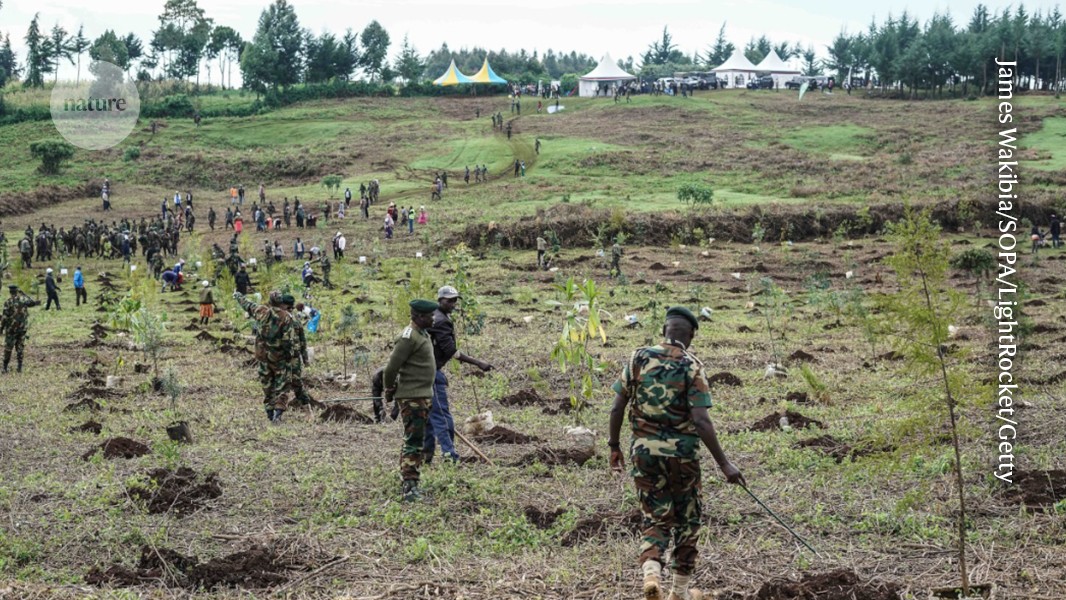
Reforestation efforts in Kenya aim to restore thousands of hectares of degraded forests to improve the land for future generations. Credit: James Wakibia/SOPA Images/LightRocket/Getty
Two reports have renewed the debate over whether nations should stop prioritizing economic growth.
In June, the Global Justice Report, published by a research organization called the World Inequality Lab, called for a rebalancing of income and wealth, and for the richest countries to accept lower growth, to solve planet-wide problems such as environmental degradation and climate change1.
In May, a United Nations group of economists, the High-Level Expert Group on Beyond GDP, published a set of recommendations for moving beyond gross domestic product (GDP)2. The report called on nations to manage their economies around a dashboard of indicators of sustainable well-being, and not just GDP.
How to measure a good life — tips for moving beyond GDP
Yet, this focus on growth risks asking the wrong question. The central issue is not simply whether economies should become richer faster or slower, or how general well-being can be measured, but whether governments are leaving behind more or less wealth for future generations.
Sustainability is fundamentally a matter of justice3: what one generation owes to the next. The debate around how this can be achieved has given rise to tensions (see Nature 655, 547; 2026). The Global Justice Report largely frames justice in the context of space: between countries and between wealthy people and those living in poverty. Approaches to managing sustainability within planetary boundaries — to avoid breaching global limits of natural resources and systems — seek justice across periods of time, between present and future generations.
Here, I clarify what justice between generations means, how it applies to economics and how inclusive national accounts for produced, human and natural capital offer a way forwards.