// NATURE NEWS — SPAZIO & SCIENZA
PLA2G2D in tumour-draining lymph nodes regulates anti-tumour immunity
Nature
(2026) Cite this article
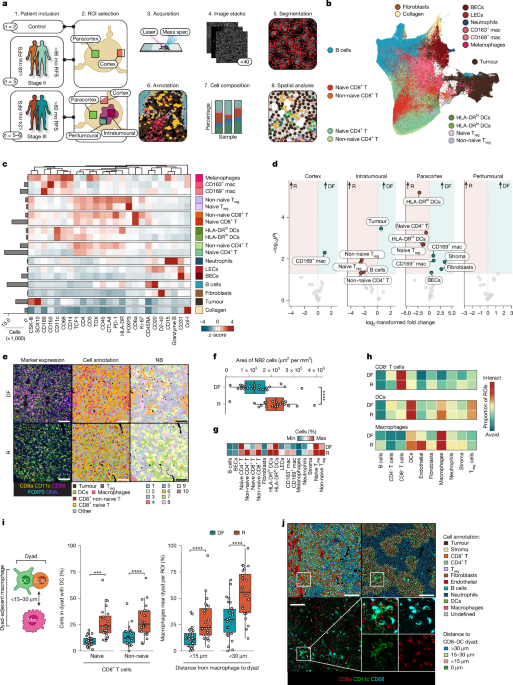
Systemic anti-tumour immunity results from T cell priming in tumour-draining lymph nodes (TDLNs)1,2,3,4. Although the suppression of T cells in tumours is well characterized5,6,7,8, whether this occurs in TDLNs—and if so, through which mechanisms—remains poorly understood. Here, using imaging mass cytometry of TDLNs from patients with melanoma, we identify a spatial neighbourhood in the TDLN paracortex that is linked to the development of distant metastases. Targeted spatial transcriptomics of cells inside this neighbourhood revealed activated CD8+ T cells engaging with myeloid cells that expressed high levels of the immunosuppressive secretory phospholipase PLA2G2D. PLA2G2D+ myeloid cells were substantially more abundant in TDLNs than they were in primary tumours or metastases. Genetic loss-of-function or antibody-mediated inhibition of PLA2G2D reduced tumour growth markedly, and single-cell transcriptomics in melanoma-bearing mice revealed that expression of Pla2g2d is confined to lymph-node macrophages. Mechanistically, PLA2G2D directly suppressed the early proliferation of T cells in vitro, and inhibiting PLA2G2D resulted in an expansion of tumour-specific T cells in TDLNs, leading to an increase in these T cells in the circulation and subsequently in tumours. Notably, PLA2G2D and PD-1 act as non-redundant immune checkpoints, with combination treatment showing additive or synergistic efficacy in humanized mice treated with human-specific antibodies. Collectively, our in-depth spatial profiling identifies PLA2G2D as a TDLN-centred targetable immune checkpoint for cancer immunotherapy.
T-cell-driven adaptive immune responses against cancer antigens are a cornerstone of effective tumour control, although immune checkpoint activation limits T cell activity. Studies in preclinical models and early findings in patients indicate that TDLNs are a primary source of tumour-reactive T cells1,2,3,4,9,10. Immune checkpoint inhibitors (ICIs), such as anti-PD-1 or anti-PD-L1, act in part by enhancing T cell priming and differentiation, thereby inducing a systemic anti-tumour immune response that is crucial for therapy efficacy in multiple tumour types4,11,12,13,14. Despite the clinical success of ICIs, many patients do not respond, or develop adaptive immune resistance15,16. Although the molecular underpinnings of ICI resistance and T cell dysfunction in the tumour microenvironment (TME) have been widely studied, the mechanisms that underlie immune suppression in TDLNs remain mostly unknown. TDLN characteristics are associated with distant disease relapse after melanoma resection, suggesting that TDLNs have a role in generating systemic anti-tumour immunity11,17. Although several immune-suppressive pathways known from studies in tumours have been implicated (for example, upregulation of PD-L1), an in-depth understanding of immunoregulatory mechanisms in TDLNs and how these might affect patient outcomes is lacking. We therefore performed comprehensive spatial proteogenomics studies on TDLNs from patients with melanoma, aiming to identify targetable regulators of systemic anti-tumour immunity. We found that TDLN contexture correlates with patient outcomes after surgery. Specifically, we identified lymph node (LN) myeloid cells—predominantly macrophages—that express the secreted phospholipase A2 family member PLA2G2D to be associated with a poor prognosis. PLA2G2D acts as a LN-centred immune checkpoint that curtails anti-tumour T cell proliferation, and genetic or antibody-mediated inhibition of PLA2G2D suppressed tumour growth and synergized with anti-PD-1 ICI in preclinical models. Thus, PLA2G2D acts as a bona fide immune checkpoint in TDLNs and represents a new target for cancer immunotherapy.
We collected TDLNs from patients with resected stage II or III melanoma (non-metastatic or metastatic LNs, respectively) who did not receive adjuvant or neoadjuvant therapies and whose