// NATURE NEWS — SPAZIO & SCIENZA
Ancient proteins identify various Denisovan remains from Southwest China
Nature
(2026) Cite this article
More than a decade of multidisciplinary research has identified a collection of cranial, facial and dental remains of Denisovans from across Asia, providing insight into their cranial capacity, appearance, diet and evolutionary history. However, our understanding of their spatiotemporal dispersal and morphological phenotype is limited by a conspicuous distribution gap in Southwest China and the scarcity of postcranial remains, in particular, the absence of long bones with diagnostic characteristics. To identify further hominin long bones, we morphologically screened more than 60,000 bone fragments from Bianfu Cave in Southwest China, of which 76 were selected for zooarchaeology by mass spectrometry and 17 for proteomic sequencing analysis. These analyses identified three hominin fossils, comprising two parietal bone fragments and one proximal radial fragment, from layers dated to approximately 167–134 thousand years ago1. Subsequent proteomic analysis confirmed the taxonomic affiliation of these newly identified hominin bones, as well as that of two hominin teeth discovered during the excavation, as Denisovan. These findings establish Bianfu Cave as a Denisovan locality yielding the most abundant remains of this hominin group outside Denisova Cave in Siberia. The results also fill a critical geographic gap in the documented distribution of Denisovans and refine our understanding of their evolutionary history. Furthermore, this study provides direct information on the radial morphology of Denisovans, providing insight into their postcranial phenotype.
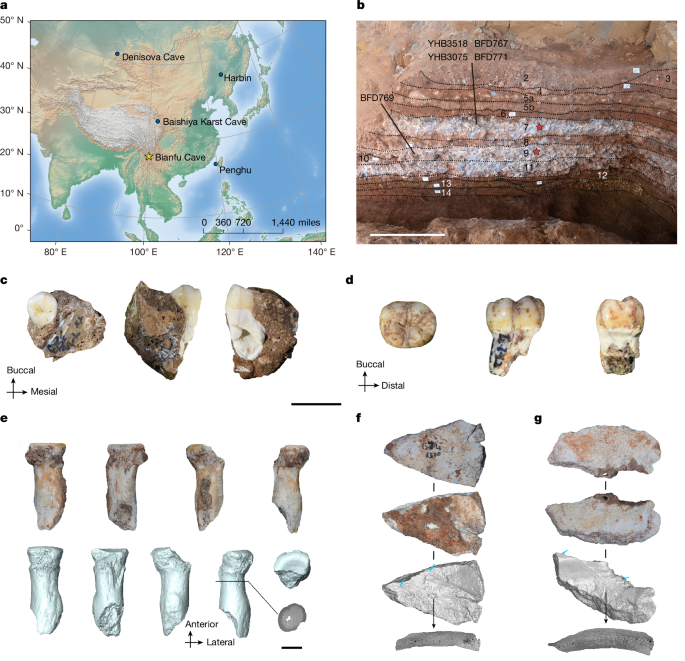
Despite more than a decade of multidisciplinary research, limited remains from outside Denisova Cave have been molecularly identified as Denisovan; those that have been identified include a partial mandible and a rib from Baishiya Karst Cave (Xiahe) on the Tibetan Plateau2,3, a partial mandible (Penghu) from the Taiwan Strait4 and a nearly complete cranium (Harbin) from northeastern China5,6 (Fig. 1a). These findings necessitated a re-evaluation of Middle Pleistocene hominin systematics in Asia, which led to the proposal of new species: Homo longi (comprising Harbin, Dali and Jinniushan) and Homo juluensis (comprising Xujiayao, Xuchang, Siberian Denisovans, Xiahe, Penghu and Tam Ngu Hao 2)7. Recent phylogenetic analyses based on morphological characteristics also placed Yunxian 2, Hualongdong and Maba in the H. longi clade8, implying their potential affinity with Denisovans. However, most putative Denisovan fossils have been confined to northern and southeastern China, leaving a conspicuous gap in southwestern China. Given genomic evidence of substantial Denisovan ancestry in present-day populations in Southeast Asia and Oceania9, this southwestern region warrants in-depth investigation as a key region for Denisovan dispersal.
a, Map showing the geographic locations of Denisovan fossils determined by molecular evidence. The colours of the map reflect a combination of elevation and environmental context. The map was projected using the Albers equal-area conic projection. b, Western profile map of Trench 2 in Bianfu Cave, showing the stratigraphic layers containing Denisovan remains (indicated by red stars). c, Different views of the lower fourth premolar from layer 7 (YHB3518; from left to right: occlusal, buccal and distal views). d, Different views of the lower second molar from layer 7 (YHB3075; from left to right: occlusal, buccal and mesial views). e, Different views of the Bianfu Cave radius from layer 7 (BFD771, upper row) and its virtual reconstruction (bottom row); from left to right: anterior, posterior, medial, lateral and proximal views. The cross-section indicates the elliptical contour of the radial neck. f, Ectocranial and endocranial surfaces of the Bianfu Cave parietal from layer 7 (BFD767) and its virtual reconstruction to show the branches of the middle meningeal vessels (blue arrows) and vault thick