// NATURE NEWS — SPAZIO & SCIENZA
TM184C is a GPCR-like regulator of intercellular exchange and autophagy
Nature
(2026) Cite this article
Sequence similarity underlies most protein annotation, yet many functions remain hidden beyond detectable homology1,2,3. By mining millions of AlphaFold2 models4,5, we identify two human families of ‘superdark’ seven-transmembrane proteins—TM184 and PRRT—with structural homology to G-protein-coupled receptors (GPCRs). These proteins exhibit hallmark GPCR activities, including β-arrestin recruitment and GPCR kinase (GRK)-dependent phosphorylation. Here we focus on TM184C—the most broadly expressed and evolutionarily conserved superdark GPCR-like protein, which localizes to highly dynamic intracellular vesicles rather than the plasma membrane. These vesicles move along microtubules, accumulate in cell projections and promote the formation of tunnelling nanotube- and tumour microtubule-like intercellular connections. These bridges mediate organelle sharing through a process that requires the TM184C C-terminal tail and its arrestin code motif6, linking GPCR-like β-arrestin and GRK regulation to vesicle function and intercellular connectivity. TM184C also constrains autophagic flux by limiting LC3B lipidation and autophagosome accumulation—a role that is deeply conserved, as human TM184C restores autophagic body homeostasis in yeast lacking its homologue, Hfl1. Together, these findings illustrate how structure-based protein discovery can illuminate the dark proteome and identify TM184C as an ancient GPCR-like regulator of autophagy, intercellular connectivity and material exchange.
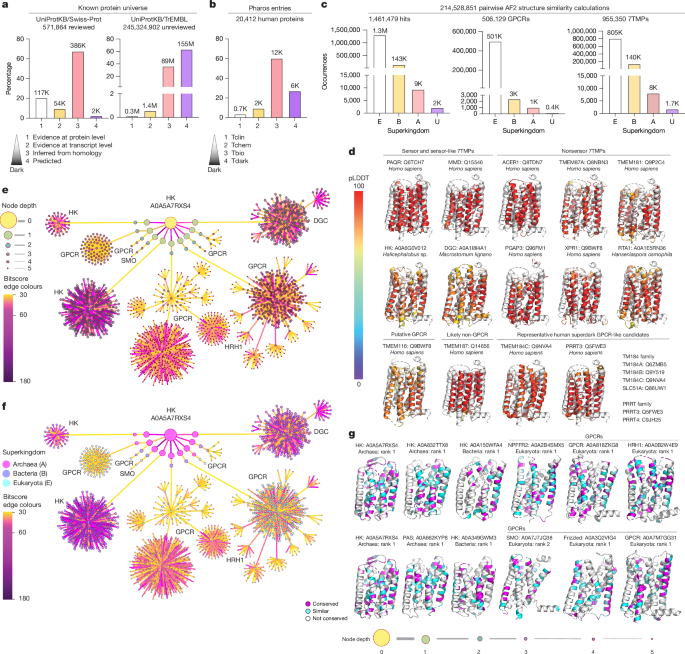
Much of the protein universe remains unexplored, with little known about sequence or structural similarities to studied proteins. As illustrated in Fig. 1a, only 571,864 (0.2%) protein sequences have been curated and reviewed manually by UniProtKB/Swiss-Prot7, leaving the vast majority—more than 245 million—annotated computationally and assigned functional or family membership on the basis of sequence homology. As depicted in Fig. 1b, this concept of darkness, or the ‘dark proteome’, also extends to human proteins, with 5,516 out of 20,412 (27%) classified as the darkest category, Tdark (poorly characterized with minimal functional data, which lack known approved drugs), Tclin (drug-targeted), Tchem (potent small molecule ligands, for example, high-potency small molecule binders) and Tbio (well-studied biology (disease relevant but of unclear druggability))8.
a, Most proteins in UniProt (99.5%) remain understudied (only 0.2% are reviewed), with functions inferred mainly from sequence homology or computational predictions, representing the ‘dark matter’ of the protein universe. b, Darkness in the human proteome is categorized into four levels: Tclin, Tchem, Tbio and Tdark. c, 7TMPs were identified through an exhaustive structural similarity search using the GPCR rhodopsin structure (Protein Data Bank (PDB) 1F88) as a query. UniProt and InterPro classifications were used to distinguish AF2 matches as GPCRs or 7TMPs by superkingdom: A (archaeal), B (bacterial), E (eukaryotic) or U (unclassified). d, AF2-predicted 7TMP structures aligned to the rhodopsin template (white) trimmed to display only their 7TM domains, highlighting the human repertoire of sensor, sensor-like and non-sensor 7TMPs and superdark candidates. Models are coloured by predicted local distance difference test (pLDDT) score from blue (low) to red (high). e,f, Tree-like network graphs spanning 2,000 representative 7TMPs, coloured by node depth from parent (e) and superkingdom (f). The corresponding interactive Cytoscape networks are provided as Supplementary Data 2 and 3, respectively. HK, histidine kinase; HRH1, histamine H1 receptor; SMO, Smoothened. g, Successive node-to-node sequence conservation across 7TM architectures originating in archaea and culminating in eukaryotic GPCRs. UniProt identifiers are provided in d,g. K, thousand; M, million.
In this work, we expand the concept of the dark human proteome to include a cate