// SPACE.COM — SPAZIO & SCIENZA
Astronomers discover two stars that joined together to form a binary system just 60 years ago
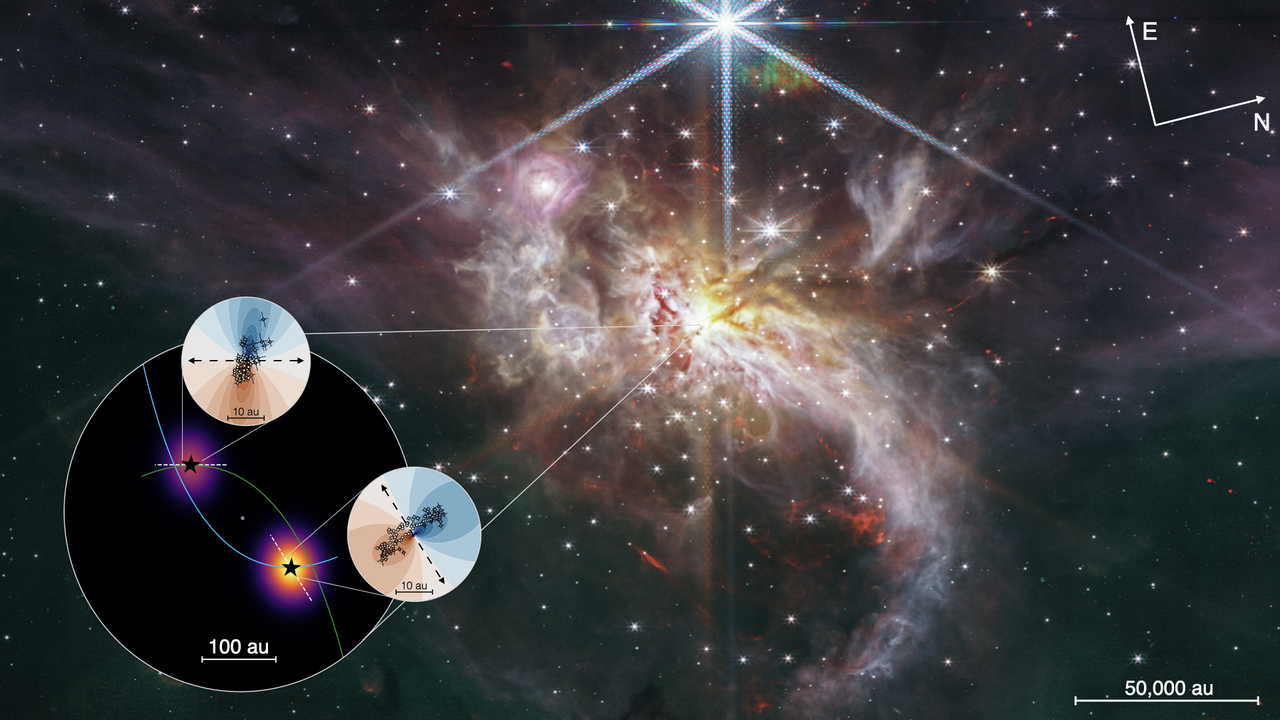
"For the first time, we were able to watch two massive stars move around one another while they were still being born."
When you purchase through links on our site, we may earn an affiliate commission. Here’s how it works.
Using the ALMA (Atacama Large Millimeter/submillimeter Array) radio telescope, astronomers have watched as two stars come together to form a massive stellar binary. The observations revealed that these stars didn't form from the same collapsing cloud of gas and dust, as most binary stars are assumed to form, but instead came together later in their infancy.
Here on Earth, we are slightly prejudiced by our single sun to view stars as somewhat solitary bodies. However, around half of sun-sized stars in the Milky Way have a companion star. This percentage of stellar partnership rises to around 90% of massive stars. Eventually, these massive stars go supernova and shape their cosmic surroundings. Thus, understanding these binary systems is vital to our understanding of stars and of galaxies in general.
The team behind this research initially observed the still-growing massive stars, or protostars, in the binary system IRAS 07299−1651, located around 5,300 light-years away in 2019. At first, the researchers didn't see anything that suggested these stars didn't form from the same disk-shaped cloud of gas and dust that later fragmented. However, one thing really stood out: the disks of material surrounding and feeding these protostars are oddly misaligned.
Over the course of eight years, the team mapped subtle shifts in the position of the stars using ALMA in addition to the Very Large Array (VLA), as well as infrared images from the James Webb Space Telescope (JWST) and the Very Large Telescope (VLT).
"For the first time, we were able to watch two massive stars move around one another while they were still being born," team leader Yichen Zhang of Shanghai Jiao Tong University, China, said in a statement.
The team was able to reconstruct the full 3-dimensional structure of IRAS 07299−1651 for the first time, obtaining details about how the stars orbit each other, the way their disks are aligned, and the angle at which they blast jets into space.
"Each telescope revealed a different piece of the puzzle," team member Rubén Fedriani, of the Instituto de Astrofísica de Andalucía (IAA) in Granada, Spain, said. "The combination of radio and infrared observations provides the most exquisite detail on the formation of this massive protobinary system."
The team's observations took them by surprise. They were expecting these stars to orbit each other in neat, near-circular orbits. Instead, the orbits were found to be highly flattened or "eccentric," almost parabolic.