// OMG! UBUNTU! — LINUX & OPEN SOURCE
Run a 30-year old version of GIMP on modern Linux via Flatpak
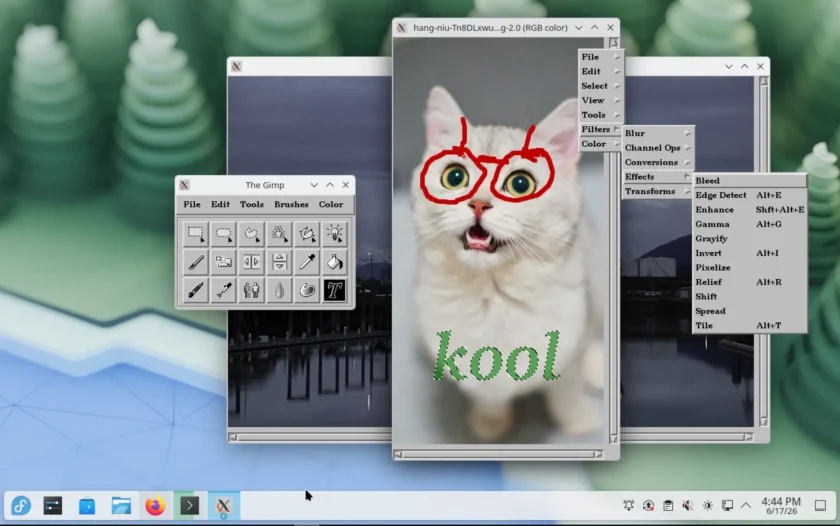
Every wondered what GIMP looked like in 1996, before GTK? Well, now you can.
Developer balooii has packaged GIMP 0.54 as a Flatpak that runs on modern 64-bit Linux desktops with Wayland. It’s apparently the earliest version of the app with the source code still available to build.
It’s not an official GIMP effort, but an enthusiast project hosted on the GNOME GitLab. It’s also something of a work-in-progress package of an ancient work-in-progress beta release, with the maintainer promising more plugins and tutorials in time.
Before we get to the install bit, there is a bit of trivia-laden history that will help explain why this version is more notable than later, more featured builds.
GIMP 0.54 was an early preview release from 1996 (1.0 didn’t arrive until 1998). The app’s interface at this point was using Motif, a closed-source GUI toolkit that, to quote the GIMP history page, made “efficient distribution to a lot of users impossible”.
The friction lead to one of GIMP’s founders, UC Berkeley undergraduate Peter Mattis, to replace Motif with his own custom toolkit: GTK, aka the GIMP Toolkit (careful Googling that phrase in 2026, mind).
GTK was never intended to become a general purpose toolkit (aka big or professional, rather a bit like another well-known scratch-your-own itch effort). Yet, in 1997, GTK became the foundation of the GNOME desktop.
This version also has the distinction of being the app designer Larry Ewing used to draw the original Linux Tux mascot (entirely with a mouse) – the OG peng Tux penguin with his antialiased edges.
Is a 30-year old version of GIMP worth using in 2026? As a nostalgia trip or retro-artistry, sure. But you won’t be doing any hardcore or innovative work. on this.
In 1996, GIMP 0.54 was beta release. There are bugs, there is no layers support and what effects are there are tucked behind a right-click on the canvas. It doesn’t look like the GIMP most of us have known for decades, and it doesn’t behave like it either.