// ARS TECHNICA — MOBILE & WEB
What happens when neutrinos swap identities inside a supernova?
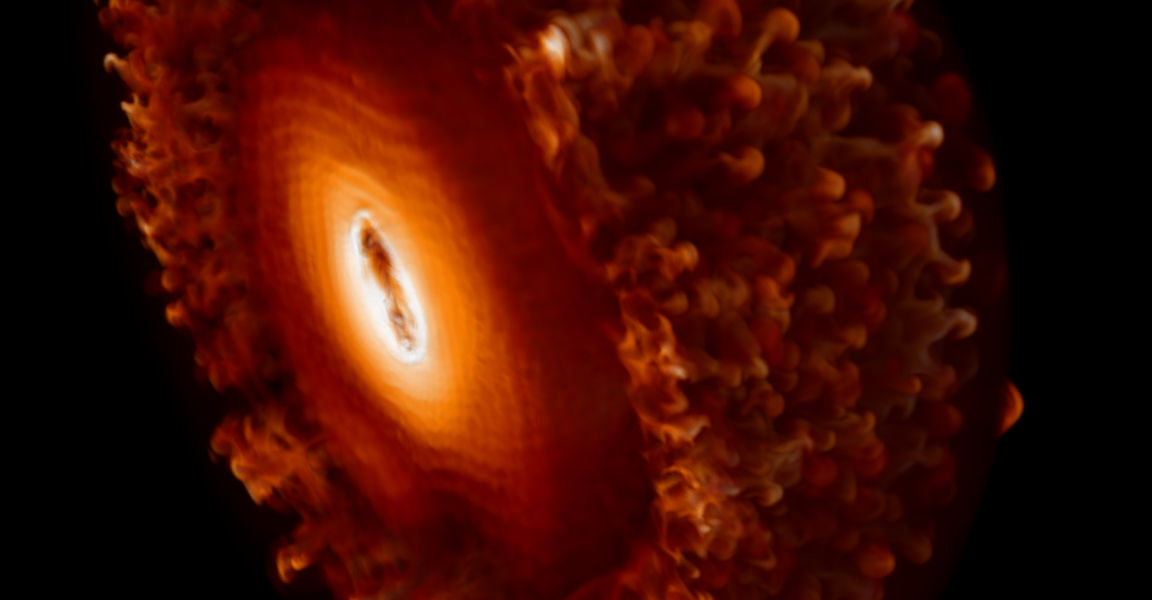
Identity-fluid particles may carry some energy out, leading to direct collapse.
Our basic understanding of core-collapse supernovae hasn’t changed in decades. Large stars burn through all the fuel at their cores and start creating heavier elements in reactions that consume energy. The lack of energy from these reactions allows gravity to pull the interior of the star in on itself, collapsing it into a neutron star or black hole. The energy released by this process then blows the remainder of the star apart.
And, generally, that’s right. But there’s an entire busload of devils in the details. The statistics of supernovae that we’ve observed indicate that the model may be seriously incomplete. And on the theoretical side, there are still plenty of uncertainties, including over some of the basics, such as whether all core collapses actually result in a supernova.
A paper being released by Physical Review D provides what might be a potential explanation for the discrepancy: flavor-changing neutrinos. Neutrinos play a key role in our current models of supernovae, and right now, those models don’t take into account one of neutrinos’ most striking features: their ability to change identity.
We’ve observed plenty of supernovae, so it would seem like there would be little mystery left. But a number of observations suggest there are some subtleties that we might be missing. For example, if we compare the rate of star formation in the Universe to the frequency of supernovae, there’s a discrepancy; it appears we’re forming enough stars to fuel a much higher frequency of supernovae than we actually observe. Also, in cases where we can identify the progenitor star that exploded, we find too few red supergiants, indicating that they may be contributing to this discrepancy.
Other problems come from observations of gravitational waves generated by mergers of the black holes left behind after a supernova. These mergers suggest there’s a “mass gap” in black hole formation—a range of masses where there are fewer black holes than you’d expect from an even distribution. But that data is complicated by the fact that theorists haven’t definitively identified the conditions that determine when a neutron star tips over into a black hole instead.
Meanwhile, on the theory side, things have been in a bit of flux. As we’ve added ever more sophisticated physics to our models of supernovae, we’ve gone through periods where either everything blows up or nothing blows up. It has been harder to develop models that give us a good picture of why some stars blow up and others might not.
Still, our best current models agree that neutrinos are essential to the process. Neutrinos are produced in prodigious quantities both by the complex fusion reactions that take place during a supernova and by the formation of neutron star material at the heart of the collapse (which happens even if the collapse continues on to form a black hole). And those numbers matter for the fate of the material outside the core of the dying star.
With fewer photons coming out of the core of the star, that material lacks the energy to resist the pull of gravity and starts rushing toward the core. On its way, it encounters the shock wave from the formation of a neutron star/black hole, which is rushing in the opposite direction. Left on its own, these forces roughly balance out, stalling the shock wave and letting gravity take over.
Neutrinos change the equation. While they tend not to interact with matter often, the sheer number of them rushing out ensures that enough bump into the material around the stalled shock wave. This transfers energy, heating it up enough to overcome gravity and allow the shock wave to escape, destroying the star. Failure of this process would, in contrast, allow almost the entire contents of the star to collapse into a black hole, killing the star without an explosion.