// NATURE NEWS — SPAZIO & SCIENZA
Overmassive black holes and little red dots naturally form in simulations
Nature
volume 657, pages 621–625 (2026) Cite this article
The origin of supermassive black holes remains a long-standing problem in astrophysics. Recent James Webb Space Telescope (JWST) observations reveal an unexpectedly abundant population of overmassive black holes at z > 4–6, at which the black hole masses lie far above local scaling relations and are not reproduced by present cosmological models1,2,3,4,5. How such overmassive black holes form and rapidly grow within young galaxies has remained unclear. Here we present fully cosmological radiation-hydrodynamic simulations that self-consistently follow the birth, early growth and emergent observable signatures of supermassive black holes in protocluster environments. We find that heavy seeds on the order 106 M⊙ naturally form, exceeding typical theoretical expectations by an order of magnitude. These seeds rapidly develop dense, optically thick disks whose strong electron scattering produces broad Hα emission comparable to that seen in little red dots6,7,8,9,10. Sustained super-Eddington accretion then drives fast growth to about 3 × 10⁷ M⊙ by z ≃ 8. To our knowledge, this is the first demonstration that unifies little red dots to a short-lived, enshrouded phase of heavy-seed formation, which naturally evolve into the overmassive quasars detected by the JWST and ultimately the progenitors of today’s supermassive black holes.
Supermassive black holes (SMBHs) are known to exist less than a billion years after the Big Bang, yet how they were seeded and grew remains unclear. Recent JWST observations have revealed compact, red sources at z > 4–6, the so-called little red dots (LRDs), whose inferred black hole (BH) masses exceed local scaling relations1,2,3,4,5. Their spectra point to rapid BH growth in dense, obscured environments during early galaxy assembly6,7,8,9,10, consistent with recent theoretical predictions11,12,13. However, proposed pathways such as direct-collapse black holes (DCBHs) or Population III remnants rely on idealized conditions and have not been followed self-consistently in cosmological simulations14,15. Here we show that heavy BH seeds naturally form in overdense protocluster regions exposed to intense far-ultraviolet (FUV) radiation, from which the collapse of supermassive stars produces approximately 106 M⊙ seeds that undergo brief super-Eddington growth. These systems reproduce the Balmer features and red continua seen in LRDs and rapidly grow into overmassive BHs by z ≈ 8. Our results provide a unified pathway linking the birth of massive seeds, their short-lived obscured growth phases and the overmassive BHs discovered by the JWST, offering a cosmological explanation for their abundance and properties.
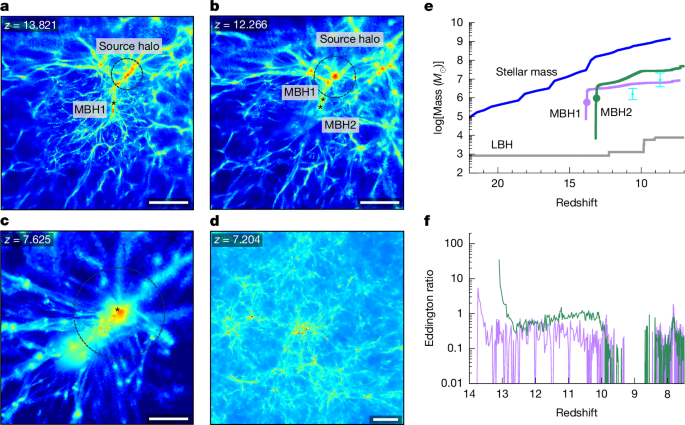
Our cosmological radiation-hydrodynamic simulations naturally produce massive BH seeds that grow into overmassive (≳107 M⊙) BHs by z ≈ 10. This rapid growth occurs in overdense protocluster regions exposed to intense FUV radiation from nearby star-forming galaxies, in which the radiation suppresses early star formation. We follow the collapse of one such halo using three-dimensional radiation-hydrodynamic simulations performed with the moving-mesh code AREPO (ref. 16) (Methods). The halo—identified by Ishiyama and Hirano17 as a promising heavy-seed site—is located about 10 kpc from a luminous neighbour that provides the strong FUV flux needed to form heavy seeds (Extended Data Fig. 2). As a result, the halo accumulates a large gas reservoir before collapsing at z ≃ 14 (Fig. 1a,b). Once collapse sets in, the central protostars grow rapidly, reaching 5–9 × 10⁵ M⊙, well above the canonical value of approximately 105 M⊙ predicted by standard direct-collapse models18,19,20,21,22. The unusually deep potential well of the host halo (virial temperature about 4 × 10⁴ K; Extended Data Fig. 1) enables ionized gas to remain gravitationally bound and sustain the high accretion rates needed to form such massive seeds. Several seed-for