// NATURE NEWS — SPAZIO & SCIENZA
Rapid patient-specific neural networks for X-ray to volume registration
Nature
(2026) Cite this article
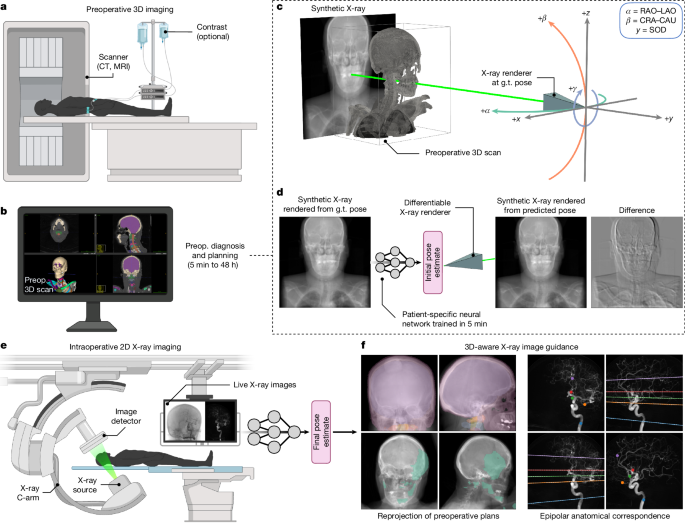
Advanced navigation techniques in image-guided interventions and surgical robotics require the rapid and precise alignment of three-dimensional (3D) preoperative volumes (such as computed tomography and magnetic resonance imaging) to two-dimensional (2D) intraoperative images (such as X-ray fluoroscopy)1,2. However, existing 2D/3D registration methods fail to generalize across the broad spectrum of fluoroscopy-guided procedures: intensity-based optimizers require per-individual hyperparameter tuning3,4, while deep-learning approaches demand extensive manually labelled datasets and remain constrained to the specific anatomy on which they were trained5,6. Here, to address these limitations, we present xvr—a self-supervised framework that combines patient-specific neural networks with gradient-based optimization for automatic 2D/3D registration. xvr uses physics-based simulation to generate training data from a patient’s own preoperative scan, eliminating the need for manual annotation. We present a foundation model pretrained on thousands of whole-body scans, achieving patient-specific adaptation to any anatomical region with only 5 min of fine-tuning. In to our knowledge the largest evaluation of 2D/3D registration on real fluoroscopy to date, xvr achieves high accuracy in seconds across diverse anatomical structures, volumetric imaging modalities and hospitals, improving on the accuracy of existing methods by an order of magnitude. xvr makes pan-anatomical 2D/3D rigid registration accessible to broad clinical and research communities through open-source software available online.
This is a preview of subscription content, access via your institution
Access Nature and 54 other Nature Portfolio journals
Get Nature+, our best-value online-access subscription
Prices may be subject to local taxes which are calculated during checkout
We evaluated xvr and other baseline methods using the following publicly available 2D/3D registration datasets: DeepFluoro57 (https://doi.org/10.7281/T1/IFSXNV), Femur58 (https://zenodo.org/records/15753063) and Ljubljana59 (https://lit.fe.uni-lj.si/en/research/resources/3D-2D-GS-CA). With permission from the original authors, remixed versions of these datasets in a standardized NIfTI and DICOM format are released to the community (https://huggingface.co/datasets/eigenvivek/xvr-data). We used the following 3D imaging datasets to pretrain our patient-agnostic foundation model: CTPelvic1K60 (https://doi.org/10.5281/zenodo.4588402), NITRC MRA Atlas29 (https://www.nitrc.org/projects/icbmmra), TotalSegmentator61 (https://doi.org/10.5281/zenodo.6802613) and the AutoPET partition of the ENHANCE.PET 1.6k62 (https://doi.org/10.57760/sciencedb.34150). The Brigham CTA/DSA and Boston Children’s MRA/DSA datasets are not publicly available due to patient privacy considerations and the terms of the Institutional Review Board approvals governing their use. All datasets were accessed and used in accordance with their respective data-use agreements and licences.
The Python package and command line interface for xvr, along with all scripts necessary to replicate the experiments presented in this manuscript, are available at GitHub (https://github.com/eigenvivek/xvr). xvr is implemented in Python (v.3.10+) using DiffDRR (v.0.6.0+) and PyTorch (v.2.2+)63.
Unberath, M. et al. The impact of machine learning on 2D/3D registration for image-guided interventions: a systematic review and perspective. Front. Robot. AI 8, 716007 (2021).
Article
PubMed
PubMed Central
Google Scholar