// NATURE NEWS — SPAZIO & SCIENZA
Targeted genomic integration and rearrangement using prime assembly
Nature
(2026) Cite this article
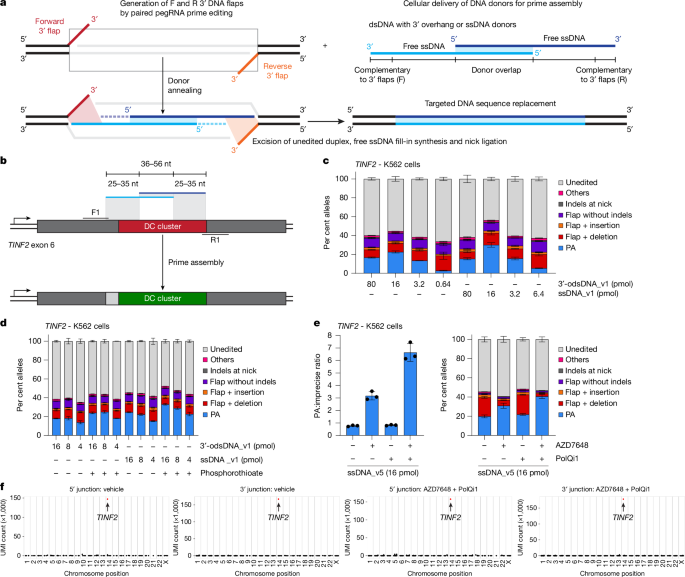
Although therapeutic genome editing holds great potential to remedy diverse inherited and acquired disorders, targeted installation of medium-to-large genomic modifications in therapeutically relevant cells remains challenging1. Here we develop prime assembly, an approach that permits DNA sequence assembly and integration in human cells leveraging CRISPR-targeted dual flap synthesis. This method enables RNA-programmable site-specific integration of single or double-stranded DNA fragments. Unlike homology-directed repair, prime assembly is similarly active in dividing and non-dividing cells. We applied prime assembly to perform targeted exon recoding, transgene integration and megabase-scale rearrangements, including at therapeutically relevant loci in primary human cells. Prime assembly expands the capabilities of genome engineering by enabling the targeted integration of medium to large-sized DNA sequences without relying on double-stranded DNA donors, nuclease-driven double-strand breaks or cell cycle progression.
The CRISPR–Cas9 toolkit provides unprecedented opportunities to engineer the human genome. However, as most genetic disorders are caused by heterogeneous mutations, generalizable approaches to replace larger DNA sequences could provide universal gene-specific solutions to remedy most pathogenic mutations that cause disease. Furthermore, there are many potential applications for site-specific integration of synthetic transgenes, such as installing antigen receptors to redirect immune cells2,3.
Therapeutic nuclease-based editing of haematopoietic stem and progenitor cells (HSPCs) has enabled the development of exa-cel, the first CRISPR–Cas9 therapy approved by regulatory agencies in North America and Europe1,4,5,6. As the field advances, cell context-specific barriers are emerging. The development of gene correction or knock-in strategies based on homology-directed repair (HDR), which occurs in the S and G2 phases of the cell cycle7, are restricted to actively dividing cells. Nuclease-driven DNA double-strand breaks (DSBs) also generate safety concerns regarding off-target editing8,9 and complex genomic rearrangements10,11 that are exacerbated in proliferating cells12,13. Gene editing technologies that do not require nuclease-driven DSBs and cell cycle progression could overcome these hurdles.
A variety of genome editors have been developed to precisely substitute DNA sequences without requiring DNA DSBs, including base and prime editors14,15,16. Although prime editing offers high product purity with limited off-target activity and genotoxicity16,17,18,19, it currently supports only short-to-medium genomic changes of less than 250 bp20. A two-step genome editing process, in which a prime editor installs a landing pad followed by recombinase-driven DNA integration, can expand this targeting range to large-sized modifications of more than 250 bp, although this is dependent on multicomponent delivery and sequential action21,22,23. Recombinase- and transposase-based technologies21,22,23,24,25,26,27,28,29 currently rely on double-stranded DNA (dsDNA) or adeno-associated virus (AAV) donors that induce toxicity due to cGAS–STING sensing30,31 and p53 activation32,33, respectively. Given their lower immunogenicity, single-stranded DNA (ssDNA) and circular ssDNA (cssDNA) donors are better tolerated by many cells30,34,35 and could potentially facilitate effective site-specific exon recoding or therapeutic transgene integration.
A new paradigm in molecular cloning emerged in 2009 when Gibson et al. reported the enzymatic assembly of kilobase-sized DNA molecules in vitro36. Molecular cloning through in cellulo DNA assembly in commonly used strains of Escherichia coli was reported more than a decade before that, but saw limited adoption37,38,39. DNA assembly in widely used cloning strains (such as E. coli DH5α) depends on an incompletely characterized RecA-independe