// NATURE NEWS — SPAZIO & SCIENZA
‘Remarkably encouraging’: stem-cell treatments for autoimmune diseases enter new phase
Rachel Nuwer is a freelance writer based in New York City.
Search author on:
PubMed
Google Scholar
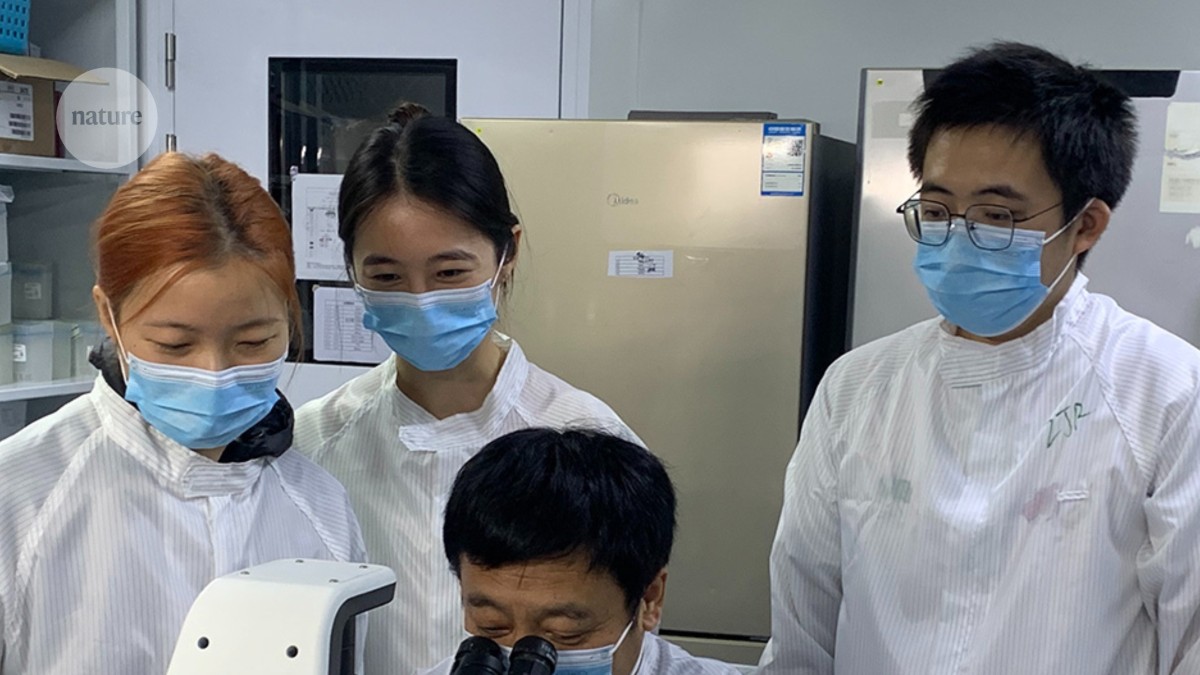
Hongkui Deng, who has been working on a trial involving iPSC transplants, is observed by students.
By the age of 25, Mingyu, a pseudonym being used to protect her privacy, had already undergone two liver transplants and a pancreas transplant in an effort to treat her type 1 diabetes. In her ten years living with the condition, she had also experienced three life-threatening periods of severe hypoglycaemia (low blood sugar), despite intensive insulin therapy. So, when her doctor suggested she enrol in a clinical trial at her local hospital in Beijing, it felt like a rare chance to regain her health.
In type 1 diabetes, the immune system attacks and destroys the β-cells in the pancreas that produce insulin, the hormone that regulates the body’s blood-sugar levels. People with this form of diabetes require lifelong insulin therapy to survive.
Researchers at Peking University in Beijing have been exploring an alternative treatment, using stem-cell technology to generate insulin-producing cells that can be transplanted into the patient, restoring their ability to produce the hormone. As part of Mingyu’s clinical trial, the team first took a small sample of fat cells from her and reprogrammed them to be induced pluripotent stem cells (iPSCs) — cells in an embryonic-like state that can become any other cell type in the body. They then guided these cells to develop into pancreatic islets — clusters of hormone-producing cells that include β-cells. Mingyu was then given an injection of these freshly grown islet cells.
The results were resoundingly positive: within a couple of months, Mingyu’s blood-sugar levels remained healthy and consistent, without the need for insulin injections. Nearly three years later, she is doing well, says immunologist Hongkui Deng, leader of the Peking University team and co-author of the 2024 study that describes the clinical trial1. “This has had a huge positive impact on her quality of life and overall physical, mental and emotional wellbeing,” says Deng.
Type 1 diabetes is one of more than 100 autoimmune diseases that span from organ-specific afflictions such as Graves’ disease — which mainly affects the thyroid — to systemic conditions that affect multiple sites and organs, such as rheumatoid arthritis and lupus. They all share a common underlying problem: the immune system’s failure to distinguish between something potentially harmful and the healthy self. Almost none of them have a cure.
Up to 10% of the global population has at least one autoimmune disease, and for reasons scientists do not understand, these diseases are becoming more common2. The prevalence of type 1 diabetes worldwide, for example, has nearly doubled in the past 40 years3. This makes the need to find safe and effective therapies and preventative approaches increasingly urgent, says Frederick Miller, an emeritus immunologist and rheumatologist at the US National Institutes of Health in Bethesda, Maryland.
For decades, the most that doctors could do was to manage autoimmune diseases indirectly, by suppressing the immune system to blunt the inflammation it causes, or by replacing what the body is unable to produce on its own. More recently, momentum has been building around the potential for regenerative medicine to be an effective, long-term solution, with scientists exploring a variety of methods to reset dysfunctional components of the immune system and restore lost function.