// NATURE NEWS — SPAZIO & SCIENZA
The gene-regulatory evolution of the human skeleton
Nature
(2026) Cite this article
Skeletal modifications were central to human evolution, enabling adaptations for bipedalism, large cranial vaults and childbirth1. Despite their importance, the genetic changes that gave rise to the unique human form remain mostly unknown2. Here we systematically map the gene-regulatory changes that shaped human skeletal evolution. Using massively parallel reporter assays (MPRAs) in chondrocytes, we assayed 561,410 human-derived substitutions in promoters and enhancers, identifying 15,077 loci with human-specific regulatory activity. We then generated human–ape hybrid cells and differentiated them into osteochondral progenitors. Integrating the hybrid cells with MPRA measurements produced genome-wide atlases of human-specific changes in cis-regulatory expression, and the sequence variants that drive them. These atlases reveal an extensive rewiring of the extracellular matrix (ECM), including a marked suppression of glycosaminoglycan (GAG) biosynthesis, leading to an approximately three-to-fourfold reduction in joint GAG content in humans compared with non-human apes. We find that this human-specific shift bears signatures of selection, and is likely to be a key contributor to the exceptional susceptibility of humans to degenerative skeletal diseases3,4,5. Together, our results reveal a coordinated evolutionary remodelling of the human skeletal ECM, and establish a comprehensive framework for dissecting the genetic basis of human skeletal biology.
Humans have a unique set of phenotypes that distinguish them from other great apes. The skeleton has had a particularly central role in human evolution, facilitating hallmark human features such as bipedal locomotion, slender bones and large cranial vaults. These skeletal features are well-characterized at the phenotypic level1, but our understanding of the genetic changes that propelled them, and the pathologies that emerged with them, is limited2.
Phenotypic divergence between closely related species is thought to be driven mainly by gene-regulatory changes6,7. Many of these changes occur in cis-regulatory elements (CREs), such as promoters and enhancers, which control the spatio-temporal expression of their target genes8. Cis-regulatory changes are particularly central in skeletal evolution because they are considered major drivers of morphological divergence8,9. Therefore, to decipher the genetic basis of human adaptations, it is imperative to investigate human evolution through the lens of cis-regulation.
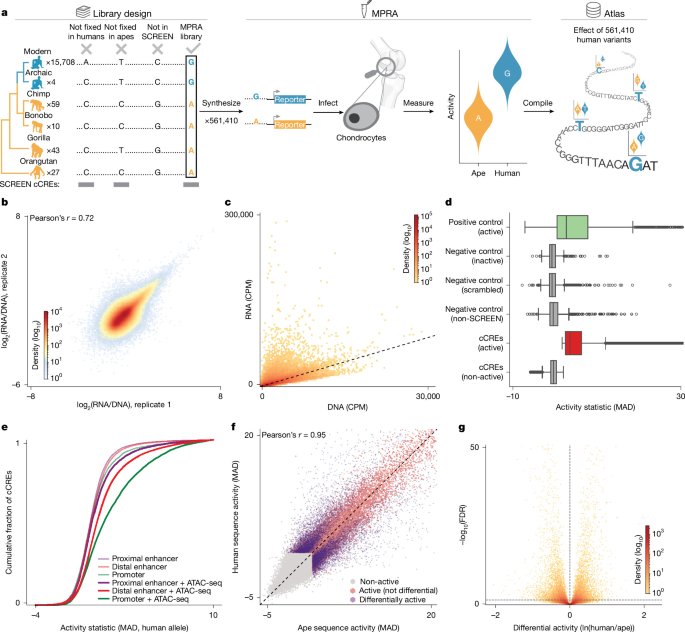
MPRAs are a powerful method to measure the cis-regulatory activity of thousands of variants simultaneously10,11. In MPRAs, a candidate CRE (cCRE) is cloned upstream of a transcribable DNA barcode, and the RNA abundance of each barcode is used to measure the expression driven by each sequence (Fig. 1a). Thus, MPRAs can be used to characterize variants underlying divergent regulation and to generate a genome-wide atlas of functional variants10,11.
a,A total of 561,410 single-nucleotide substitutions that distinguish humans from other great apes and that fall within cCREs21 were assayed by synthesizing the human (derived) and great ape (ancestral) allele of each cCRE, introducing them into human fetal chondrocytes and quantifying their transcriptional effect. This yielded a genome-wide atlas of the functional effects of each regulatory variant that arose and became fixed or nearly fixed in human evolution. b, Correlation of cCRE activity across biological replicates. c, RNA versus DNA counts per cCRE, normalized to sequencing depth (counts per million; CPM). RNA counts are capped at 300,000. d, Box plots showing activity (median absolute deviation; MAD) of positive controls (n = 1,404), negative controls (inactive, n = 961; scrambled, n = 1,051; and non-SCREEN, n = 759) and cCRE test sequences (active, n = 87,704; non-active, n = 557,093). Values are capped at 30. Box plots show the median (centre), second and third