// NATURE NEWS — SPAZIO & SCIENZA
Single-nucleus transcriptome-wide association study of human brain disorders
Nature
volume 657, pages 1016–1026 (2026) Cite this article
Common brain disorders impose a substantial health burden, but localizing their genetic risk in the brain remains challenging1. Although genome-wide association studies have identified numerous loci associated with neuropsychiatric and neurodegenerative disorders, many of these loci lie in non-coding regions that influence gene expression in specific cell types2,3,4,5. Traditional bulk brain transcriptomic analyses, which often focus on European ancestry cohorts, average over cellular diversity, obscuring genetic risk-related changes in gene expression. Here we use single-nucleus gene expression profiles from the dorsolateral prefrontal cortex in the multi-ancestry PsychAD cohort to develop transcriptomic imputation models of genetically regulated expression across major brain cell types. Applying these models to neuropsychiatric and neurodegenerative disorders reveals thousands of gene–trait associations that are undetectable in bulk tissue analyses and resolves many signals to discrete neuronal, glial and immune cell populations. Cross-ancestry analyses in the Million Veteran Program confirm these associations, reveal pleiotropic effects of cell-type-specific predicted expression and demonstrate that trait-related dysregulation is conserved across ancestries, enabling mapping of causal genes and pathways. Together, these findings provide a cell-type-resolved and ancestry-aware atlas of genetically regulated expression in the human prefrontal cortex and illustrate how single-nucleus transcriptomics can sharpen gene discovery and therapeutic target prioritization for complex brain disorders.
The genetic architecture of neuropsychiatric and neurodegenerative disorders (NPDs and NDDs, respectively) is highly polygenic, with much of their heritability attributed to common variants in non-coding regions that influence gene regulation rather than protein sequence2,3,4,5 (Supplementary Tables 1 and 2). Genome-wide association studies (GWAS) have identified thousands of risk variants for these disorders, yet mapping these loci to effector genes and mechanisms in the human brain remains challenging. Transcriptome-wide association studies (TWAS) integrate GWAS summary statistics with predictive models of genetically regulated gene expression (GReX) to implicate genes whose expression changes may drive disease susceptibility6,7,8,9. However, most brain TWAS reference panels are derived from homogenate bulk cortex RNA sequencing (RNA-seq) in predominantly European (EUR) ancestry cohorts6,7,8,10, which averages over diverse neuronal and non-neuronal populations and captures only part of the genetic regulation operating in the brain. Given the extensive cellular, transcriptional11,12 and regulatory13 heterogeneity of the human prefrontal cortex, approaches that treat it as a uniform tissue are poorly suited for resolving cell-type-specific contributions to NPD2,14 and NDD5 risk.
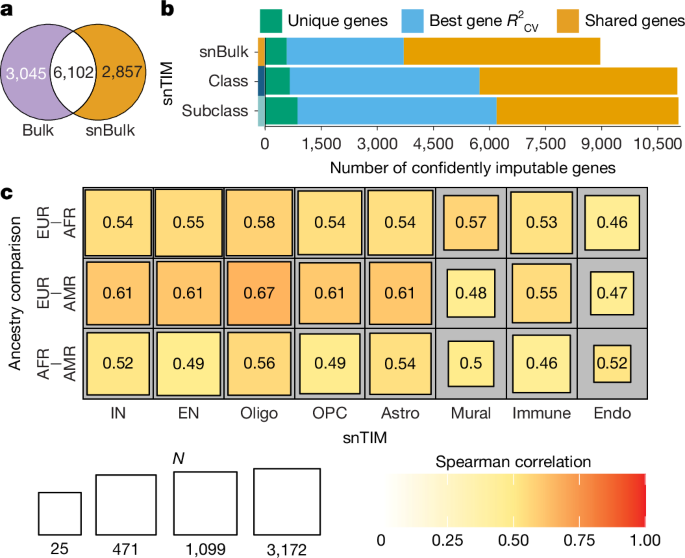
The PsychAD Consortium11,15 generated a population-scale single-nucleus RNA-seq (snRNA-seq) atlas of the dorsolateral prefrontal cortex (DLPFC), comprising over 6 million nuclei from 1,494 donors with and without major neuropsychiatric diagnoses and spanning EUR, African (AFR) and admixed American (AMR) ancestries. Leveraging this data, we constructed single-nucleus transcriptomic imputation models (snTIMs) across multiple cellular populations, enabling cell-type-resolved estimation of GReX across ancestries. We then applied snTIMs to 12 NPD and NDD GWAS to perform single-nucleus TWAS (snTWAS) and identify cell-type-specific gene–trait associations (GTAs), including previously unreported disease-linked loci. Finally, we validated and extended these findings in a large-scale phenome-wide association study (PheWAS) of approximately 600,000 participants in the Million Veteran Program (MVP). Using ancestry-matched snTIMs, we compared effect patterns across populations, characteri