// ARS TECHNICA — MOBILE & WEB
A space history mystery: What happened to the Viking arm used 50 years ago?
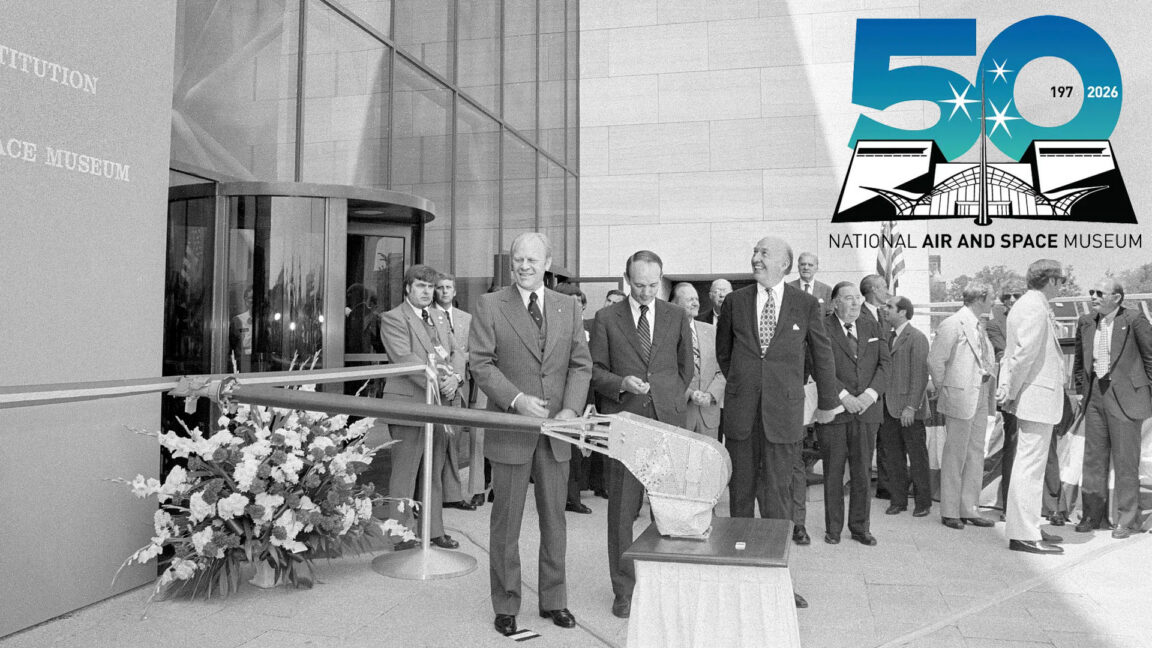
The Apollo 11 astronaut had already beaten the original schedule for the opening of the National Air and Space Museum by three days, but no one would remember that if these final 36 minutes didn’t go perfectly.
President Gerald Ford and Vice President Nelson Rockefeller took 35 seconds to find their seats on the red, white, and blue bunting-lined outdoor stage. The flyover by the Thunderbirds was quick enough. At any other event, it would have been the only time-dependent concern of the day.
Collins kept glancing at the time. The Presentation of Colors took 20 seconds.
The national anthem, performed by the Air Force band, took about 85 seconds. Then came the invocation delivered by the Bishop of Washington, and then the Secretary of the Smithsonian, Dillon Ripley, welcomed everyone who had come out for the ceremony.
Warren Burger, chief justice of the United States and the chancellor of the Smithsonian, made short work of introducing the president. Ford then took to the podium at 11:13 am.
“This beautiful new museum and its exciting exhibits of the mastery of air and space is a perfect birthday present from the American people to themselves,” he said. “Although it is almost impolite to boast, perhaps we can say with patriotic pride that the flying machines we see here, from the Wright brothers’ 12-horsepower biplane to the latest space vehicle, were mostly ‘Made in USA’.”
Nine and a half minutes later, Ford concluded. “Thomas Jefferson said, ‘I like to dream of the future better than the history of the past.’ So did his friendly rival, John Adams, who wrote of his dream ‘…to see rising in America an empire of liberty, and a prospect of two or three hundred millions of freemen, without one noble or one king among them. You say it is impossible. If I should agree with you in this, I would still say, let us try the experiment.’”
“I can only add, let the experiment continue,” said Ford.
Everyone on the stage then moved over to the entranceway of the new building, the “Smithsonian Institution National Air and Space Museum,” as inscribed on a 12-foot-tall (4-meter) teal backdrop. Mounted atop the temporary wall were two sets of traffic lights, a pair of side-by-side green lights (currently off) and a set of red lights, now blinking.
Centered in front of the wall, about 11 feet (3.45 meters) away, was a small table draped in white cloth supporting a piece of NASA hardware. It may not have been clear to all of the ceremony’s guests and spectators, but mounted to a wood base sitting atop the table was the surface sampler arm from an engineering model of a Viking Mars lander.