// NATURE NEWS — SPAZIO & SCIENZA
Lab-grown brain organoids: time for international oversight
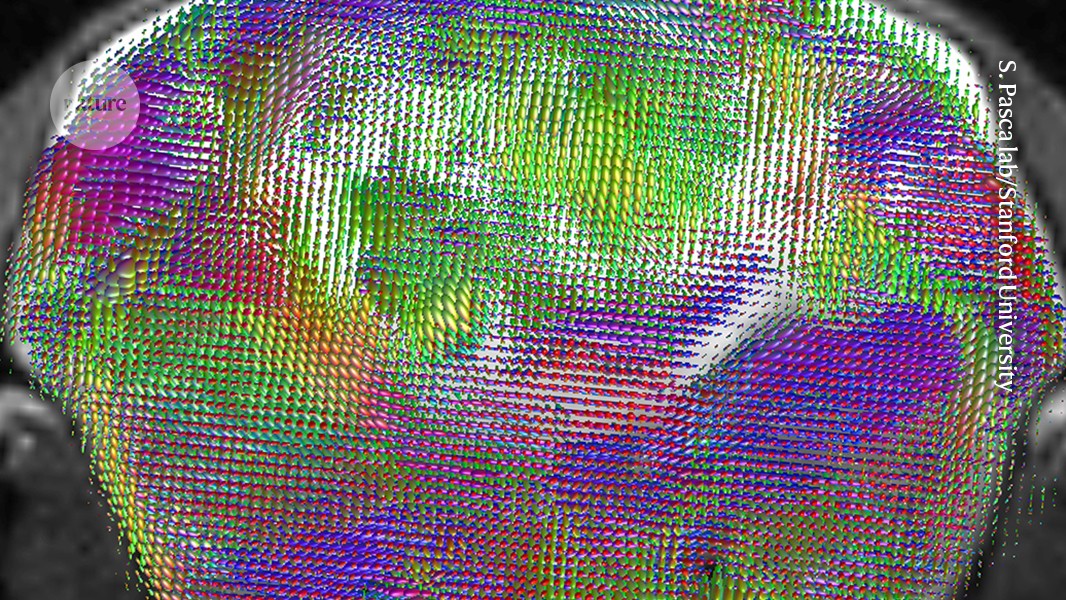
A cross-sectional scan of one of the transplanted lab-grown human brain organoids in a mouse, obtained using magnetic resonance imaging. Colours represent the direction of nerve fibres (green, top to bottom; red, front to back; blue, side to side).Credit: S. Pasca lab/Stanford University
For several days in mid-September, neuroscientist and stem-cell biologist Sergiu Pașca became inseparable from his phone. As one of the principal authors on a study by researchers at Stanford University in California reporting the successful transplant of laboratory-grown human brain ‘organoids’ into mice, he was doing many interviews every day.
Read the paper: Developmental xenocortication using human-derived organoids in mice
The mice had been bred so that almost all of their cerebral cortex was missing from their brains. The transplanted lab-grown human tissue survived and developed working connections to the mice’s brains and spinal cords (K. Kaganovsky et al. Nature 658, 430–441; 2026).
It is without doubt a landmark achievement. Animal studies can reveal only so much about the human brain, and options to study live human brain tissue inside a person are limited. Around a decade ago, the creation of organoids — tiny 3D cellular structures grown in the lab that mimic some functions of real organs — changed this. The latest finding, which represents the most extensive integration of human brain cells into an animal so far, opens up further possibilities to understand conditions such as cerebral palsy and autism spectrum disorders in a nervous system, and to test possible interventions.
At the same time, lab-grown organoids are prompting ever deeper ethical questions. Researchers are asking whether the animals receiving implanted brain organoids might gain any human-like properties of consciousness or cognition. How should these characteristics be measured, and what extra oversight should there be for such studies?
Discussions over establishing an international oversight mechanism for brain organoid research are well under way. Such an instrument was recommended in a policy paper published last year (S. P. Pașca et al. Science 390, 574–577; 2025), preceding a conference in late 2025 that Pașca and his colleagues co-organized with Stanford bioethicist Henry Greely. The event was attended by scientists, ethicists, philosophers, policymakers, science communicators and the families of people affected by brain conditions. It was held at the Asilomar conference centre in California, well known for a 1975 meeting of scientists and research funders that discussed the need for safety measures and oversight at the dawn of genetic modification techniques.
Hybrid brains: the ethics of transplanting human neurons into animals
Much has changed in the intervening five decades. Today, life scientists’ research plans must go through various regulatory and ethics processes before any experiments start. These are designed to ensure that experiments involving biological specimens are conducted safely, that consent has been obtained from study participants, including those donating cells, and that animal welfare requirements are met. That said, some of the questions raised by the latest research into brain organoids are not routinely considered.
What form any further oversight should take, and its terms of reference, are still being worked out. A report from the 2025 Asilomar conference, published earlier this month (see go.nature.com/4dvagey), shows that scientists have a strong desire for any oversight mechanism to provide a service to the research community, such as regularly updated and actionable guidance for research groups.