// ARS TECHNICA — MOBILE & WEB
A good little EV you won't be able to buy soon: The Volvo EX30 Cross Country
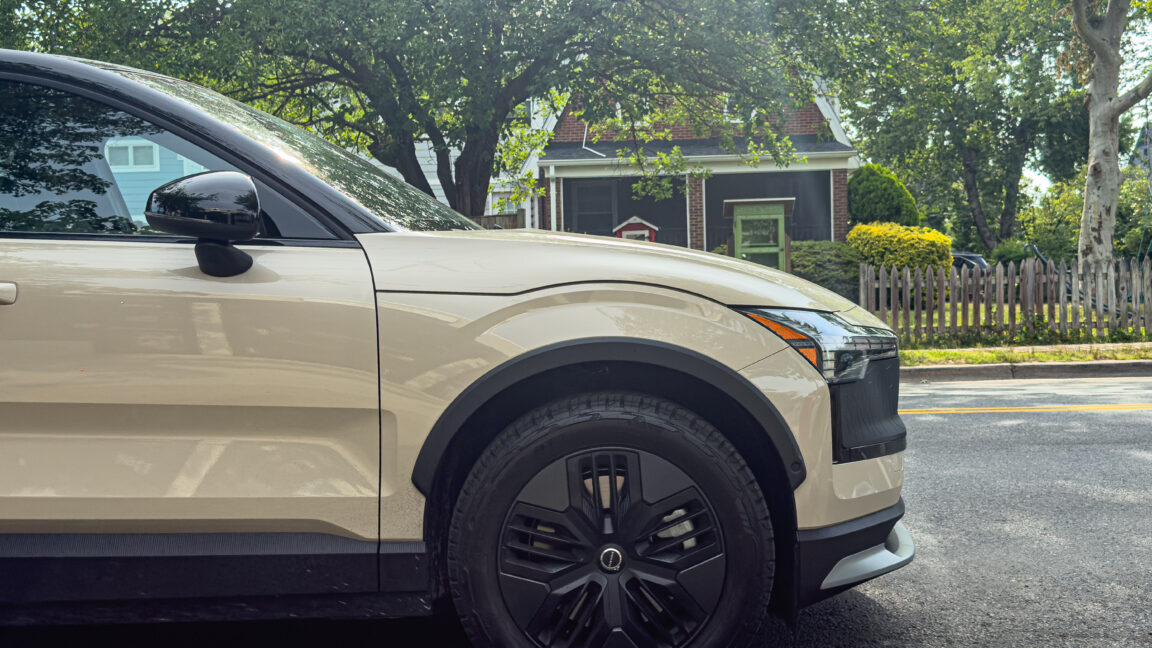
Tariffs and anti-China policies killed this little Volvo in the United States.
Did you know the average new vehicle in the US grew an inch (25 mm) wider and 22 inches (558 mm) longer between 2013 and 2023? That’s probably obvious to anyone who steps foot outside these days, and it’s a trend that we ought to reverse. Bigger cars might make their occupants feel more secure, but they invariably need more energy to get where they’re going. And with f=ma being what it is, bigger vehicles tend to leave a lasting and deleterious effect on anything unlucky enough to be the other party in a collision. That makes today’s tale a rather bittersweet one, because the Volvo EX30 could be the perfect antidote.
It’s a compact and efficient electric crossover with a tiny carbon footprint but no compromises on safety, and it would be perfect for the current moment, except that Volvo recently decided to stop importing the car to the US. With the order books now closed, once the ~1,200-odd cars left in inventory are gone, they’re gone.
After teasing us for a while, Volvo finally showed off the EX30 for real in 2023. At the time, the headline news was its price: $34,950 for the rear-wheel drive version before any tax credit. That would have made it one of the cheaper EVs available for sale in the US, but with Volvo’s premium badge attached. That was before geopolitics got involved.
Its diminutive purchase price was predicated on being cheap to manufacture in Zhangjiakou, China. However, heavy tariffs on Chinese-made cars were levied by the Biden administration in 2024, then by the Trump administration the following year, causing Volvo to delay imports while it instead shifted production of US-destined cars to its factory in Ghent, Belgium.
However, European-made cars are still subject to a 25 percent tariff, which jacked up the starting price of the EX30 to $40,345 (including destination charge) for the rear-wheel drive version, or $46,345 for the twin-motor all-wheel drive version.
Our test car is the EX30 Cross Country, which takes the all-wheel-drive EX30 and adds more ground clearance and some cladding and underbody protection that’s just as useful in a crumbling urban environment or tight Trader Joe’s parking garage as it is on an unpaved forest road. However, this pushes the starting price to nearly $50,000. That might be about the current average new transaction price, but it’s a lot to ask Americans to pay for a compact SUV, particularly an electric one with just 227 miles (365 km) of range.
The twin-motor powertrain certainly provides the EX30 Cross Country with plenty of pep: 422 hp (315 kW) and 400 lb-ft (542 Nm) from a pair of identical motors at the front and rear axles. That’s sufficient for a 0–62 mph (0–100 km/h) in just 3.7 seconds, although the 18-inch all-terrain wheel kit (a $3,495 option) fitted to our test car may have made that a little slower. Indeed, I left this little EV in Range mode for most of my week, which both reduces overall motor power and gives you a gentler throttle map, blunting acceleration somewhat.
The motors are powered by a 65 kWh (net; 69 kWh gross) lithium-ion battery pack, which can DC fast-charge at up to 153 kW and should take a little less than 27 minutes to go from 10 to 80 percent state of charge. Although Volvo announced in 2023 that it would adopt the NACS plug by 2025 for US-market EVs, this didn’t happen for the EX30, which still features a CCS1 socket. In practice, it took me 21 minutes to charge from 49 to 82 percent (25.6 kWh). At that state of charge, the car reported an estimated 152 miles (245 km) of range, with the air conditioning running at an appropriate level for the humid mid-Atlantic summer.
As part of Volvo’s low-cost design, the EX30 makes do with a buttonless interior. There’s no separate main instrument display either; the top section of the central infotainment screen shows a persistent speed and drive mode display instead. The user experience is much like in other Vol