// NATURE NEWS — SPAZIO & SCIENZA
Histone readers MLLT1 and MLLT3 concentrate AID to confer locus specificity
Nature
(2026) Cite this article
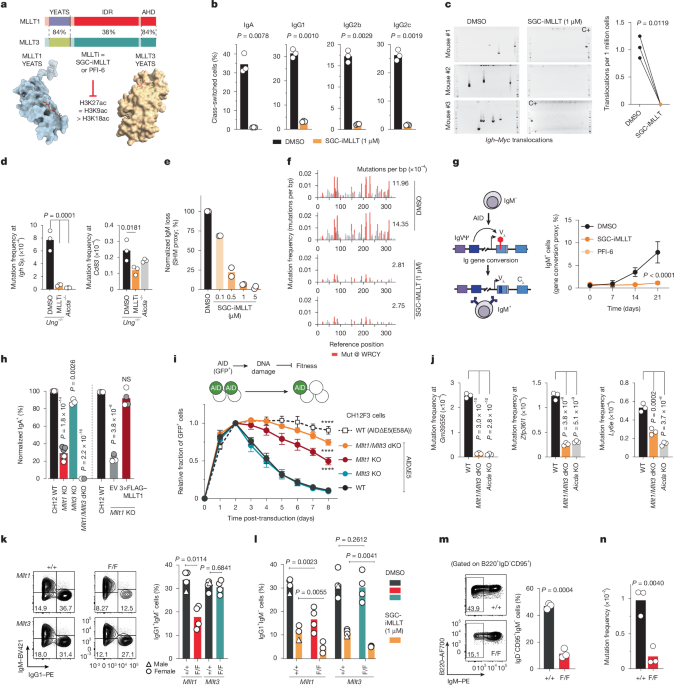
Activation-induced deaminase (AID) drives antibody diversification through class-switch recombination and somatic hypermutation of the immunoglobulin (Ig) genes, but its off-target mutagenic activity contributes to B cell lymphoma1,2,3,4,5. How AID selectively mutates Ig loci and a restricted set of other genes remains unknown. Transcription is required for AID activity, but most transcribed genes are not mutated1,5,6,7, and AID occupies more loci than it mutates7,8,9. Here we identify the super elongation complex histone readers MLLT1 and MLLT3 as determinants of selective AID activity. Combined loss of MLLT1 and MLLT3 abolishes all AID-dependent mutagenic processes, recapitulating AID deficiency. AID-mutated genomic regions in mouse and human B cells are precisely marked by high MLLT1 and MLLT3 occupancy (MLLT1/MLLT3high). Transcriptional changes after deleting both readers are modest and cannot explain the AID activity loss. Mechanistically, MLLT1 and MLLT3 are dispensable for global AID chromatin tethering but locally enrich AID downstream from promoter regions. Both readers bind to AID and act redundantly, but MLLT1 has a dominant role in mice through its intrinsically disordered region, which promotes condensates that selectively concentrate AID. Fusing AID to MLLT1 or MLLT3 is sufficient to restore class-switch recombination and mutagenesis in Mllt1−/−Mllt3−/− cells. These findings reveal that local MLLT1/MLLT3high-dependent enrichment licenses AID at a restricted subset of genomic regions by spatially confining and concentrating its activity, probably through condensate formation.
This is a preview of subscription content, access via your institution
Access Nature and 54 other Nature Portfolio journals
Get Nature+, our best-value online-access subscription
Prices may be subject to local taxes which are calculated during checkout
Raw and processed data of ChIP–seq and TT-seq generated in this study were deposited in the NCBI Gene Expression Omnibus (GEO) repository under the accession number GSE336466. Raw Nanopore amplicon-seq data have been deposited in the Sequence Read Archive under BioProject PRJNA1481264. The BioID raw data were deposited in the MASSIVE proteomics data repository under the number MSV000099228. Other datasets used in this analysis were downloaded from the GEO database: GSE121355 and GSE31039 (H3K27Ac and H3K9Ac ChIP–seq of CH12F3 cells, respectively), GSE82144 (H3K27Ac and H3K9Ac ChIP–seq of activated B cells), GSE130266 (GRO-seq of CH12F3 cells), GSE62063 (H3K27Ac ChIP–seq and super-enhancer list of Ramos cells and activated B cells), GSE182214 (H3K27Ac ChIP–seq of SUDHL5 cells), GSE24178 (AID ChIP of activated B cells) and PRJNA1194626 (AID CUT&RUN of RASH cells induced with doxycycline). The catalogue of regions affected by aberrant SHM in human B cell lymphoma was obtained from the LLMPP resource (https://github.com/morinlab/LLMPP/tree/main/resources/curated). In all cases, raw data were downloaded and reanalysed using the pipelines and procedures described above. Reference genomes used for sequencing analyses included GRCm38/mm10 and GRCh37/hg19, as well as the S. cerevisiae R64-1-1 and D. melanogaster dm6 reference genomes for spike-in normalization. CH12F3 datasets were also aligned to a custom CH12F3 genome based on GRCm38/mm10 and modified to reflect the recombined Igh VDJ locus, as previously described25 and available on GitHub (https://github.com/francoisrobertlab/dinoia_mllt1_3_project). The Ramos datasets were also aligned to a custom Ramos genome incorporating the rearranged IGH sequence; genomic resources are available (https://github.com/francoisrobertlab/dinoia_mllt1_3_project), with the Ramos IGH sequence derived from https://github.com/PavriLab/IgH_VDJ_PROcapseq. BioID mass spectrometry searches used the human RefSeq database (v57), supplemented with common contaminant and decoy sequences. MLLT1 and MLLT3 protein