// ARS TECHNICA — HARDWARE & GADGET
Katalyst's satellite rescue mission is now in pursuit of NASA's Swift
It will take several weeks for the Link spacecraft to rendezvous with NASA’s Swift observatory.
High above the remote Pacific Ocean, about halfway between Hawaii and the northernmost part of Australia, an air-launched rocket fired into space on Independence Day weekend to kick off a weekslong pursuit of a NASA astronomy satellite perilously close to falling out of orbit.
The endeavor to rescue NASA’s Swift satellite is the first mission of its kind. NASA put out a call for commercial companies less than a year ago to propose how they could rapidly build and launch a small satellite to latch onto the Swift spacecraft and boost its altitude so that it doesn’t come down in a few months.
Katalyst Space Technologies responded with the best offer. NASA awarded the company a contract last September to build and launch a mission to rescue Swift. A little more than nine months later, Katalyst’s nearly half-ton Link satellite is safely in orbit. For anyone who follows the space industry, building, testing, and launching a functioning first-of-its-kind satellite of that size in less than a year is a remarkable achievement; it would usually take several years.
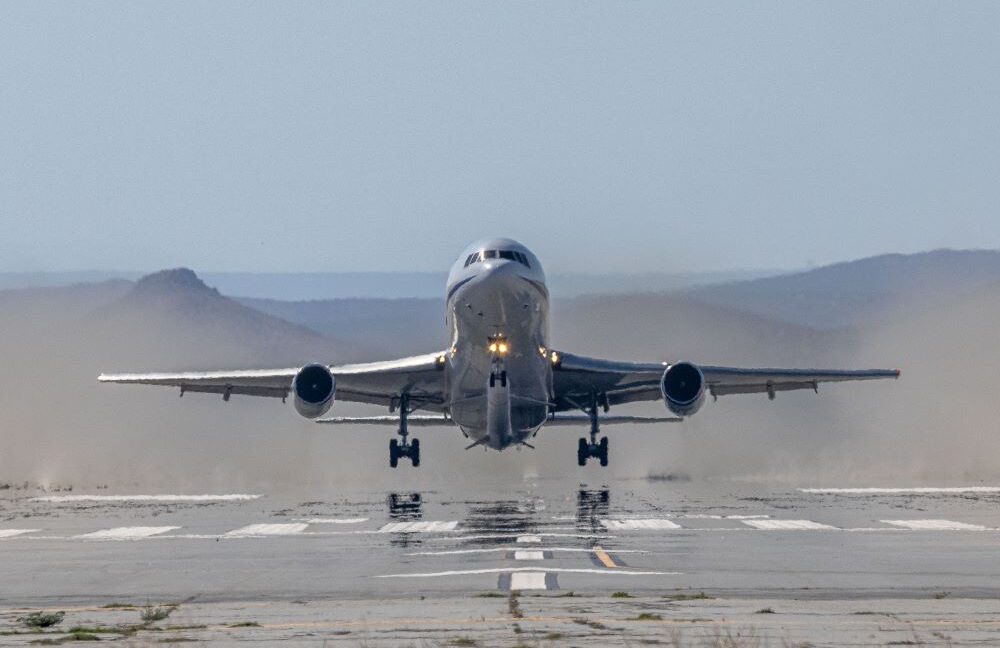
Technicians buttoned up the Link satellite inside the nose cone of a Northrop Grumman Pegasus XL rocket last month at NASA’s Wallops Flight Facility in Virginia. An aircrew flew the rocket and its L-1011 carrier aircraft from Virginia to the US Army’s Ronald Reagan Space and Missile Test Range on Kwajalein Atoll, a facility leased from the Marshall Islands more than 2,000 miles southwest of Honolulu.
Once there, the rocket and the L-1011 waited several days for good weather, then took off to fly to a predetermined launch zone south of Kwajalein. With everything in order and upon reaching a cruising altitude of 41,000 feet, the pilots released the 58-foot-long (18-meter) rocket at 4:36 am EDT (08:36 UTC) Friday. Five seconds later, the Pegasus XL ignited its solid-fueled first stage to begin the climb to orbit.
It took just shy of eight minutes for the Pegasus XL’s three solid-fueled motors to accelerate to orbital velocity. The rocket’s upper stage completed a preprogrammed sequence to deploy the Link satellite nearly 13 minutes after launch. NASA confirmed later Friday that ground teams from Katalyst established communications with the Link satellite, confirming the spacecraft survived the ride on Pegasus.
Katalyst selected the rarely used Pegasus rocket, which has flown just once in the last seven years, because the Swift rescue mission needed to launch into an unusually low-inclination orbit to reach its target. Swift’s orbit is inclined 20.6 degrees to the equator, and the Link satellite would have required a launch on an oversized, more expensive rocket to reach that orbit from a spaceport like Cape Canaveral, Florida. Launching from the equatorial Pacific solved that problem.
There are more trials ahead for Katalyst. The Swift rescue mission is the first time the company has flown this version of its Link satellite. In addition to the standard satellite systems required to generate power, maintain attitude control, and communicate with the ground, the Link spacecraft has cameras and sensors to guide itself toward Swift and three robotic arms to grab onto the observatory. Three plasma thrusters will propel Link and Swift to a higher orbit once Katalyst confirms a firm connection.
“Over the next several weeks, Katalyst will perform checkout procedures for Link, including assessments of its propulsion, sensor, and navigation systems,” NASA said in a statement. “Link will then approach Swift and complete a survey of the 21-year-old observatory, before capturing and lifting it over the course of several months.”