// NATURE NEWS — SPAZIO & SCIENZA
Rising numbers of Asian and African PhD students choose to study in China
Search author on:
PubMed
Google Scholar
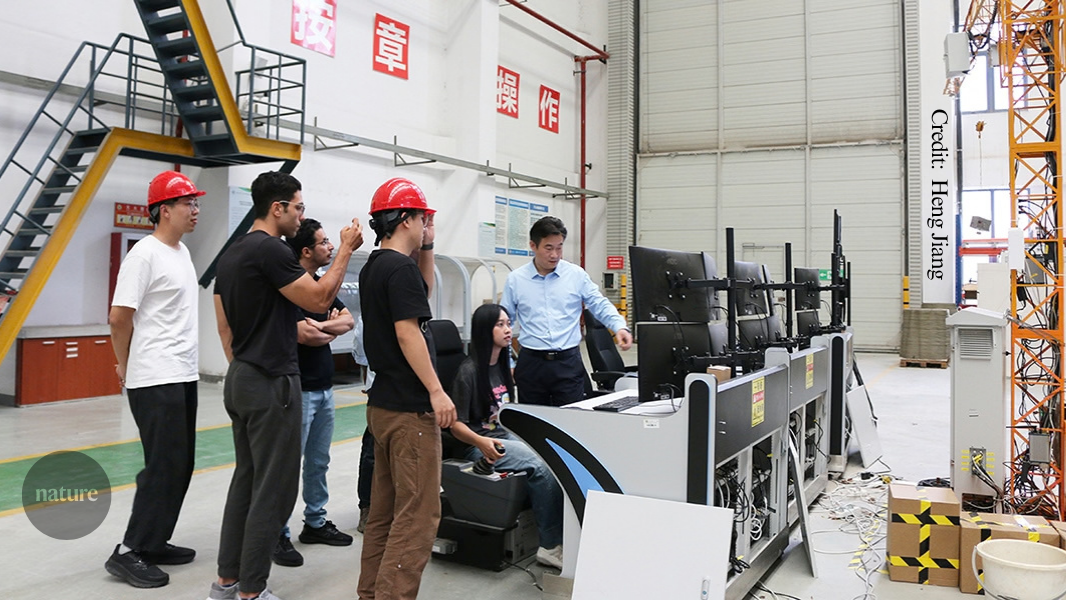
Engineering graduate students from Egypt, Yemen, Indonesia and Niger watch a demonstration of a smart construction system at Southeast University in Nanjing, China. Credit: Heng Jiang
Every weekday, Fatma Satyani, an Indonesian PhD student in China, gets up at 7.30 a.m. to get ready for her day.
She usually eats a youtiao (fried dough stick) or a couple of baozi (steamed buns) with warm soya milk, a traditional Chinese breakfast, before heading out to classes at the Nanjing University of Information Science and Technology in eastern China.
“I love studying here,” says Satyani, who is doing a PhD on big data and business intelligence. “Chinese people are friendly, the food is delicious and getting around Nanjing is very convenient.”
Satyani is one of a fast-growing group of students from low- and middle-income countries — especially nations in Asia and Africa where China has made large investments in development — who are seeking a postgraduate education in the Asian superpower.
The number of international university students in China has climbed steadily since the nation lifted its strict COVID-19 pandemic lockdown rules in late 2022. According to the latest official statistics reported by China Daily, a state-run newspaper, 380,000 international students were studying in the country during the 2024–25 academic year, up by 15% from the previous year. Even so, these students made up less than 1% of the 48.5 million students in China’s higher-education system in the 2024–25 academic year. And the proportion of international students in China represents just a fraction of the share studying in the United States and the United Kingdom (see ‘A small fraction’).
Sources: HESA; IIE; NCES; Ministry of Education of China; ChinaDaily
In China, 61% of international students come from Asia, with most of the rest coming from Africa and Europe, at 16% each. About 71,750 of those are in master’s or PhD programmes, according to statistics from the government. Although on the rise, the number of international students is still lower than China’s 2018 pre-pandemic record of nearly 500,000 students, according to QS Quacquarelli Symonds, a UK-based company that analyses global higher-education institutions.
International PhD students based in China say that they were attracted to the programmes by generous scholarships, the opportunity to learn Mandarin and make Chinese connections and China’s rising capabilities in frontier technologies, such as artificial intelligence and data analytics. However, they also face several obstacles. Mandarin is a difficult language to master, and students often have limited options to stay in China after their courses end. Moreover, some countries consider a Chinese degree to be less competitive.