// NATURE NEWS — SPAZIO & SCIENZA
Cells, who needs them? Biochemists turn to proteins in a tube
Amber Dance is a freelance science writer near Los Angeles, California.
Search author on:
PubMed
Google Scholar
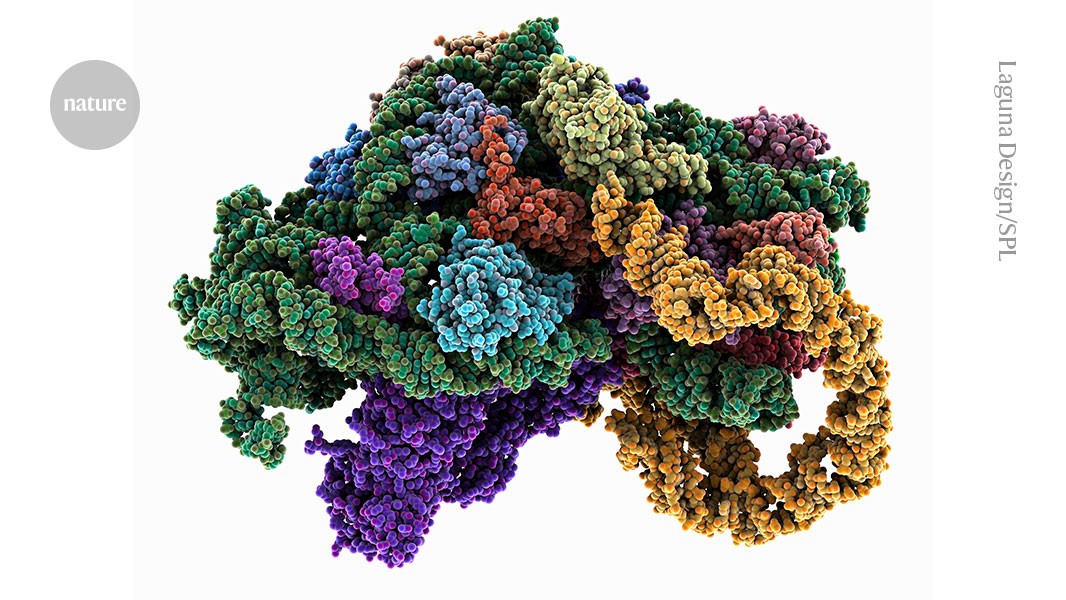
The ribosome complex, comprising several components, uses messenger RNA (orange) to synthesize proteins. Credit: Laguna Design/Science Photo Library
Michael Jewett sometimes finds himself at odds with biology.
As a bioengineer who uses synthetic biology to study ways to improve human and planetary health, Jewett needs microorganisms to manufacture specific compounds or follow the genetic instructions he’s given them. But the cells, evolved to ensure their own survival and reproduction, have other priorities. The microbes could, for instance, deactivate foreign DNA segments — or transgenes — inserted into their genome by Jewett. Or they might direct cellular resources towards their own needs instead of towards Jewett’s research goals.
How synthetic biologists are building better biofactories
So, he changed tack. “Rather than fight this tug of war that exists between what cells want to do and what we as engineers want to do, we kind of just cut the rope,” says Jewett, who works at Stanford University in California. “We rip off their cell walls and we collect the insides, and then we use the insides as a molecular factory to carry out the process of biology.”
It’s not a new idea: systems based on cell-free protein expression helped researchers to decipher the genetic code in the 1960s. But the technology is still evolving. “I would describe it as a very ‘in’ trend,” says biophysicist Vincent Noireaux, whose team at the University of Minnesota in Minneapolis developed its own system.
Although their composition varies, cell-free protein-expression systems generally contain all the machinery necessary to transcribe DNA into messenger RNA and translate that into proteins. These systems can be based on bacterial or eukaryotic cell lysates or assembled from purified components. The latter technology is called Protein Synthesis Using Recombinant Elements, or PURE.
With these methods, protein designers can screen hundreds or thousands of options without modifying and growing cells. This shortens the design–build–test–learn cycle from days or weeks to hours, says Wilson Wong, a synthetic biologist at Boston University in Massachusetts. Scientists can manufacture substances that would be toxic to living cells or get chewed up or altered by the cell’s enzymes. Some researchers are developing freeze-dried formulations to generate on-demand synthesis systems for biological medicines such as vaccines, or to serve as portable test kits for water-quality testing, point-of-care diagnostics and other purposes. Meanwhile, synthetic biologists are exploring PURE systems as a starting point for artificial cells.