// NATURE NEWS — SPAZIO & SCIENZA
Nuclear clocks tick for the first time
Akio Kawasaki is at the National Metrology Institute of Japan, National Institute of Advanced Industrial Science and Technology, Tsukuba, Ibaraki 305-8563, Japan.
Search author on:
PubMed
Google Scholar
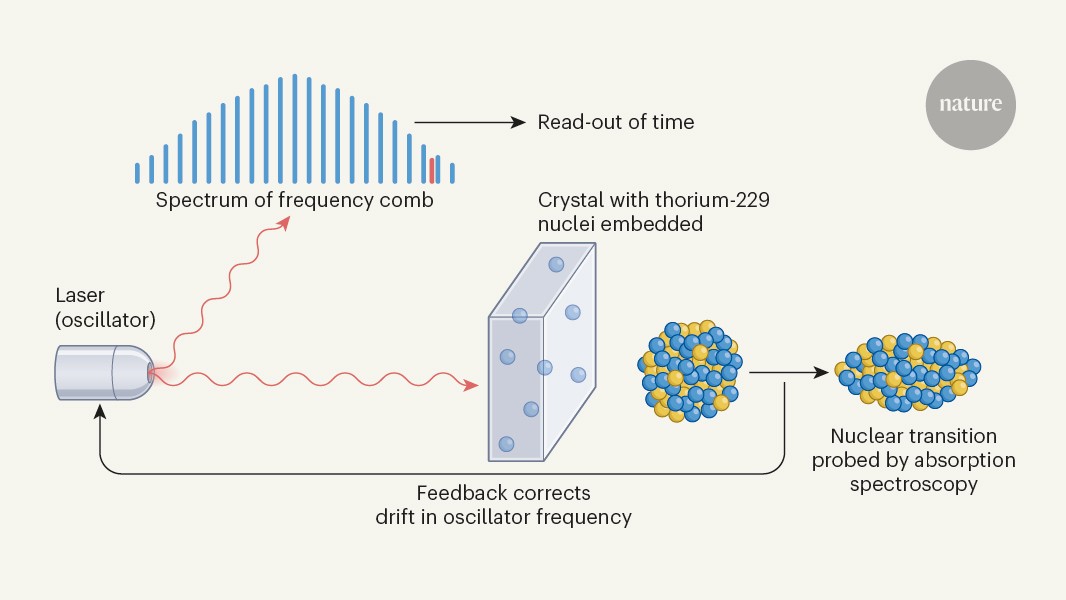
For decades, the most precise timekeepers have been atomic clocks. The mechanism of these clocks relies on the transition of electrons between the energy levels of atoms or ions. But some applications require even more precise timepieces — such as nuclear clocks, which depend on transitions that occur in the nuclei of atoms. Writing in Nature, Toscani De Col et al.1 and Huang et al.2 report the first implementations of a nuclear clock, a milestone in the field of metrology. Toscani De Col et al. also demonstrate that their clock shows promise for detecting a possible form of dark matter — the invisible material that makes up most of the matter in the Universe.
Access Nature and 54 other Nature Portfolio journals
Get Nature+, our best-value online-access subscription
Prices may be subject to local taxes which are calculated during checkout
Toscani De Col, L. et al. Nature https://doi.org/10.1038/s41586-026-11084-4 (2026).
Huang, B. et al. Nature https://doi.org/10.1038/s41586-026-11084-4 (2026).
Aeppli, A., Kim, K., Warfield, W., Safronova, M. S. & Ye, J. Phys. Rev. Lett. 133, 023401 (2024).
Article
PubMed
Google Scholar