// NATURE NEWS — SPAZIO & SCIENZA
‘When prevention disappears, infections rise’: can the world still end AIDS?
Bianca Nogrady is a freelance science journalist based in the Blue Mountains, west of Sydney, Australia.
Search author on:
PubMed
Google Scholar
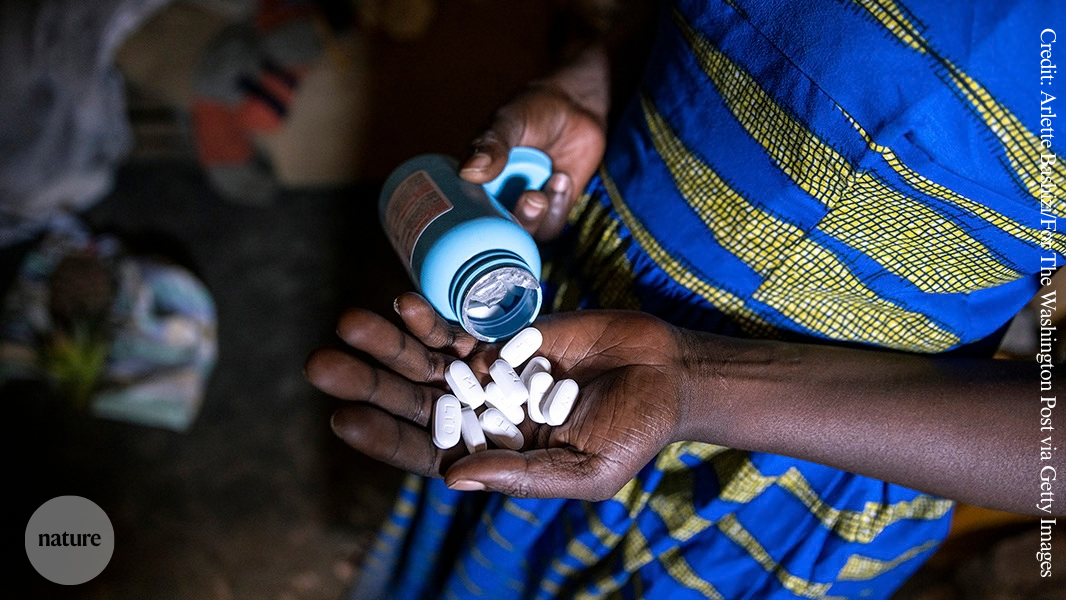
Antiretroviral medication is used to both control HIV and prevent its transmission, helping to reduce the incidence of AIDS.Credit: Arlette Bashizi/For The Washington Post via Getty Images
The year 2016 was one for the history books. It saw Donald Trump winning the US presidential election, the United Kingdom voting to leave the European Union and the declaration of Zika virus — a mosquito-borne and sexually transmitted virus that causes severe birth defects — as a global public-health emergency.
It was also the year that the United Nations committed to eliminating AIDS.
AIDS was first defined in 1983 as a disease caused by HIV, which is thought to have jumped into humans — most probably from chimpanzees or monkeys — in the early to mid-twentieth century. The virus destroys immune cells responsible for fighting off infection. Since then, more than 44 million people around the world have died of AIDS or HIV-related diseases, as a result of their immune system no longer being able to defend against even common infections. An estimated 41 million people are currently living with the virus.
Antiretroviral drugs are highly effective at suppressing HIV to undetectable levels, transforming what was once a death sentence into a manageable chronic condition. People with undetectable viral levels also can’t transmit the virus, and those same antiretroviral drugs can prevent infection in healthy individuals who are exposed to the virus. But despite decades of research, a complete cure or an effective vaccine have proved elusive.
In January 2016, the UN’s 17 Sustainable Development Goals (SDGs) — a global initiative to address poverty, inequality and climate change — came into force as part of the 2030 Agenda for Sustainable Development. Among them was SDG target 3.3, a strategy targeted at ending the AIDS epidemic, along with epidemics of other communicable diseases, by 2030. The initiative aimed to reduce the number of new infections by 90%; from 0.24 infections per 1,000 people in 2016 to 0.025 infections by 2030. Later that year, at the UN General Assembly High-Level Meeting on Ending AIDS in New York City, member states set a goal to reduce both new HIV infections and the number of deaths from AIDS-related illnesses to fewer than 500,000 by 2020, and made a commitment to end AIDS as a public-health threat by 2030.
Only one human disease has ever been completely eradicated. In 1980, after a 13-year vaccination campaign by the World Health Organization, smallpox — a deadly infectious disease caused by the variola virus — was eliminated worldwide, in what has been described as humanity’s greatest public-health achievement. At the time of its creation, SDG target 3.3 seemed bold but achievable.
By 2020, the world had made major gains towards achieving this aim, which included the targets of having 90% of people living with HIV diagnosed, 90% of those diagnosed being on antiretroviral therapy and 90% of those on antiretroviral therapy being virologically suppressed. The ‘90-90-90’ targets were then raised to 95-95-95 by 2030.