// NATURE NEWS — SPAZIO & SCIENZA
Revealed: How this common gut microbe protects against heart disease
Search author on:
PubMed
Google Scholar
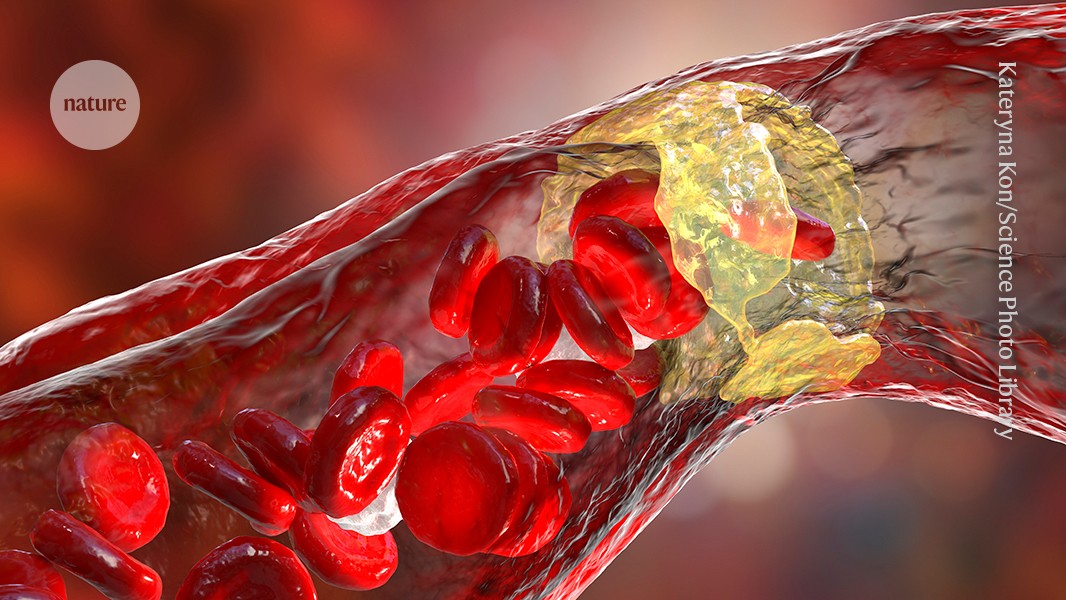
Atherosclerosis involves the build up of fatty plaque (yellow) in the walls of arteries, limiting the flow of blood (red blood cells shown).Credit: Kateryna Kon/Science Photo Library
A gut microbe that’s commonly found in humans manufactures a molecule that is capable of slashing cholesterol levels and shrinking plaque in arteries, according to a study published today in Nature1.
Baffling chronic pain eases after doses of gut microbes
When given to mice, the compound, from the gut bacterium Bacteroides uniformis, reduced the animals’ arterial plaque by about half. It achieved the feat, researchers found, using the same biological action as that of statins, drugs that are prescribed to hundreds of millions of people worldwide to ward off cardiovascular disease.
The findings underline new ways in which people’s collection of gut microorganisms, known as their microbiome, might be harnessed to protect the heart, says study co-author Wenjing Zhao, a microbiologist at Sun Yat-sen University in Shenzhen, China.
The study provides “valuable evidence that the gut microbiome can influence vascular health”, moving beyond a simple link between heart disease and the microbiome, and towards “evidence for a potentially causal biological mechanism”, says Ben Chen, a cardiovascular specialist at Monash Victorian Heart Institute in Melbourne, Australia.
Diseases caused by atherosclerosis, the progressive build up of inflammatory plaques in the walls of arteries, remain the leading cause of death globally. Although daily doses of statins have reduced deaths, this alone fails to reduce cholesterol sufficiently in nearly half of people with advanced heart disease. And some people can’t tolerate high doses of the drugs.
Memory loss is fuelled by gut microbes in ageing mice
To find an alternative, Zhao and her colleagues analysed the gut flora present in stool samples from people with and without cardiovascular disease. One species stood out: B. uniformis. That’s because levels of the bacterium were often depleted in those with heart disease compared with healthy individuals.