// NATURE NEWS — SPAZIO & SCIENZA
Structural basis for regulating lipopolysaccharide transmembrane transport
Nature
(2026) Cite this article
Gram-negative bacteria are surrounded by a multilayered cell envelope with a mostly impermeable outer membrane that provides intrinsic resistance to many antibiotics1,2,3,4,5. The outer membrane is an asymmetrical bilayer with phospholipids in the inner leaflet and lipopolysaccharide (LPS) in the outer leaflet6,7. An LPS transport (Lpt) machine called LptB2FGCADE moves LPS across a protein bridge from the inner membrane to the outer membrane8,9. LPS biosynthesis is regulated to prevent toxic accumulation of LPS molecules in the inner membrane during growth10,11,12. Whether LPS transport across the Lpt bridge is also regulated has been unclear. Here we present three structures of the trans-envelope Lpt complex in LPS-free, LPS-bound and ATP-bound states, along with a structure of a partial bridge. These structures, combined with biochemical experiments, show that Lpt bridge assembly triggers movement of the transmembrane helix of LptC (TM-LptC) in an LPS-dependent manner, resulting in increased ATP binding and hydrolysis. We also show that LPS transport in vivo requires bridge formation and movement of the TM-LptC. Our data support a model in which assembled Lpt bridges respond to the presence of LPS in the inner membrane to turn on transport by moving the TM-LptC, thus coordinating LPS transport activity with bridge assembly and the presence of LPS at the inner membrane.
Bacterial cells have an inner (cytoplasmic) membrane (IM) containing protein machines that assemble other cell-envelope layers, such as the peptidoglycan cell wall. Gram-negative bacteria also have an outer membrane (OM) that surrounds the peptidoglycan cell wall1,2. This OM has a phospholipid inner leaflet and an LPS outer leaflet6,7. The LPS layer of the OM excludes many antibiotics that are effective against Gram-positive bacteria, greatly limiting therapeutic strategies to treat Gram-negative infections4,5.
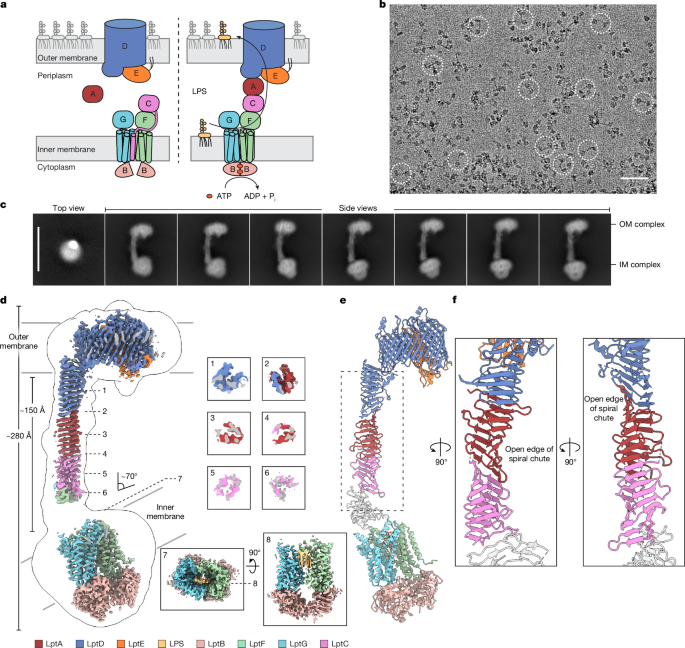
LPS is synthesized at the IM and must be transported across the aqueous periplasm and through the OM to the cell surface3. The LPS transport (Lpt) machinery consists of an IM ABC transporter complex (LptB2FGC), an OM translocon (LptDE) and a soluble periplasmic protein (LptA)13,14,15,16,17,18,19,20,21 (Fig. 1a). During the transport of LPS to the cell surface, LptA assembles with the two membrane complexes, forming a continuous trans-envelope protein bridge (LptB2FGCADE)22. LptB2FGCADE uses the energy from ATP binding and hydrolysis in the cytoplasm to extract LPS from the IM and transport it against its concentration gradient directly to the outer leaflet of the OM22,23,24,25,26,27.
a, Cartoon schematic showing the LPS transport proteins in the unassembled (left) and assembled (right) states. LPS is transported across a membrane-spanning protein bridge. Pi, inorganic phosphate. b, Representative electron micrograph of LptB2FGCADE complexes purified in detergent. Dotted white circles indicate selected LptB2FGCADE complexes. The representative micrograph was chosen to contain approximately the median number of particles per micrograph out of particles included in the final reconstruction. Scale bar, 50 nm. c, Representative 2D class averages generated in cryoSPARC, with orientation aligned to aid visualization. Scale bar, 210 Å. d, Composite density for LPS-bound LptB2FGCADE consisting of the local refinements of LptADE and LptB2FGC, shown from a front view perpendicular to the micelle containing LptDE. The consensus map used for local refinement, low-pass filtered to 10 Å, is shown as a transparent envelope. Cross-sections of the LptB2FGCADE density at the indicated positions are shown. For comparisons of the IM and OM refinements of LptB2FGCADE with previously reported structures of Lpt subcomplexes38,57,60,61, see Supplementary Fig. 5. e, Model of LptB2FGCADE shown in the same view and colours as in d. The periplasmic domains of LptFG did not refine to high resolution; for visualization,