// NATURE NEWS — SPAZIO & SCIENZA
How to build a mouse: Embryo development captured in stunning detail
Search author on:
PubMed
Google Scholar
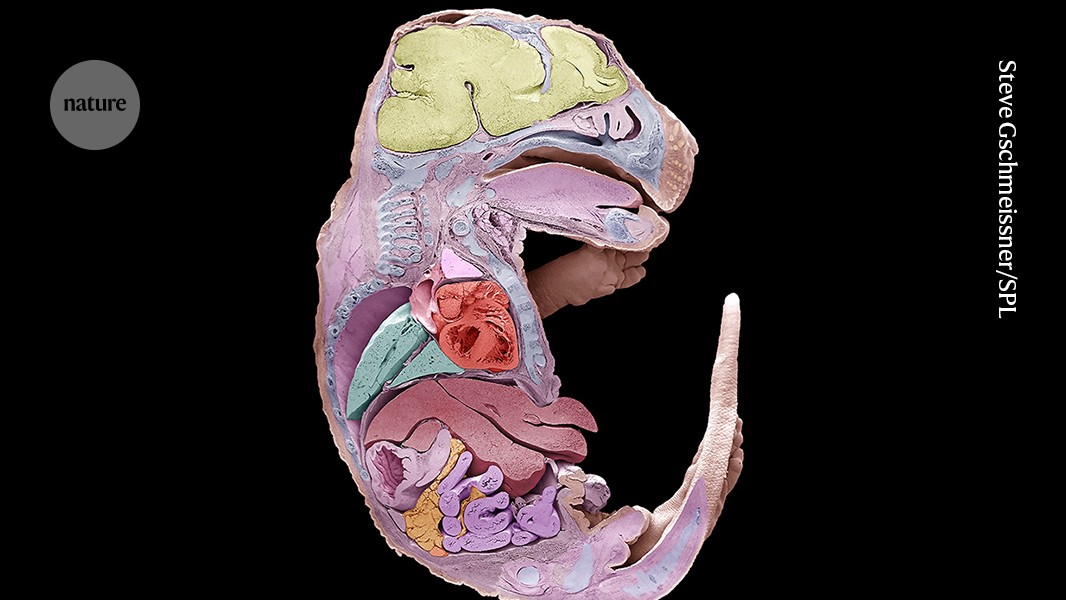
By introducing and tracking mutations as the cells of a mouse embryo divide, researchers have mapped relationship between cells. Credit: Steve Gschmeissner/Science Photo Library
‘Cell recorders’ based on gene editing have captured mouse development in unprecedented detail.
Two independent teams of scientists published the findings today in Science and in Cell. One team recorded the cell-by-cell development of a two-week-old embryo from a single fertilized egg1, and the other captured most of the cell divisions in embryos as organs formed2.
Both studies were inspired by a landmark early-1980s effort: the first — and still only — full map of animal development. Using only a microscope, UK biologist John Sulston observed each cell of the nematode Caenorhabditis elegans as the animal grew from an egg into an adult with precisely 959 somatic, or fully differentiated, cells.
Tracing the lineage of most other animals in this way, particularly mammals, isn’t possible, says Jay Shendure, a genome scientist at the University of Washington in Seattle, who led the Science study. C. elegans is transparent, and each worm develops in precisely the same way, with the same 959 cells having followed an unvarying pattern of cell divisions.
But in mammals such as mice — in which development is hidden and cells number in the billions — external cues such as growth factors influence whether a cell will end up in the lungs or liver, for instance.
Bizarre CRISPR enzyme kills cancer cells by shredding their DNA
A key question in biology, says Shendure, is how such randomness can give rise to individuals of the same species that have broadly the same form. “Twins look the same, humans kind of look the same, yet even twins develop through very different sets of cell divisions,” he says.
Shendure first tackled this question around 2016, when he and his team developed a method based on the gene-editing technology CRISPR that introduced ‘barcodes’ — gene edits at particular locations — into the cells of developing zebrafish (Danio rerio)3. The team then used DNA sequencing to check which barcodes were present in various cells, and inferred relationships between them.