// ARS TECHNICA — MOBILE & WEB
An experimental tour-de-force: Entanglement between glass bead and light
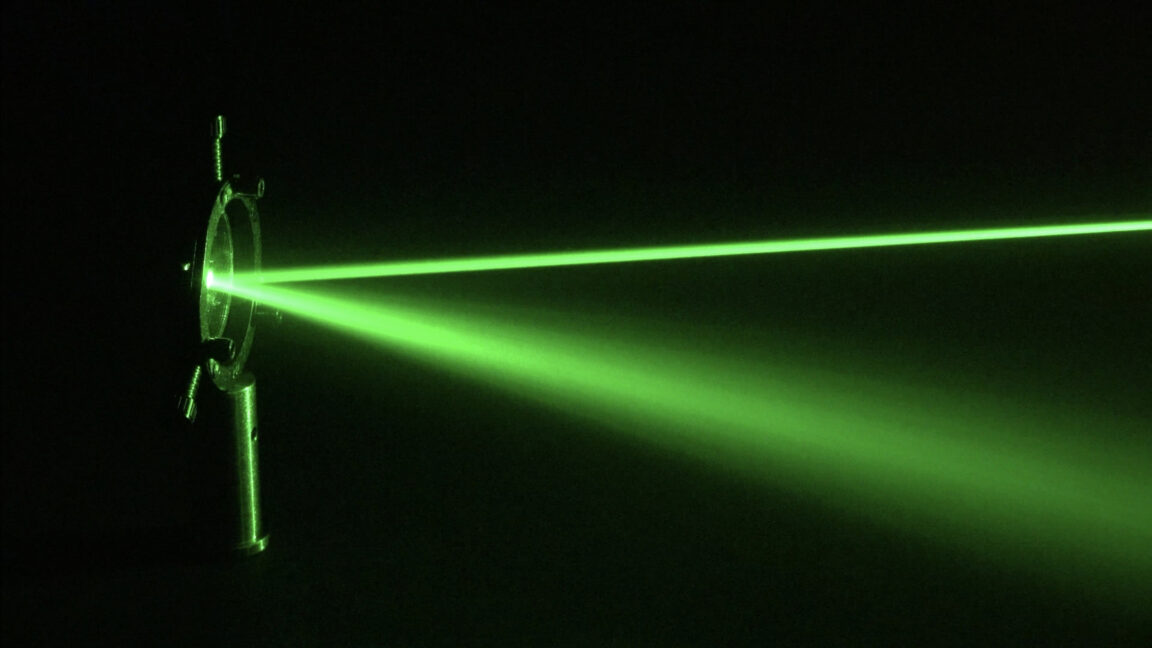
Getting a glass bead to act like a quantum object by entangling it with light.
Writing about quantum entanglement is always a challenge. There are so many clichés to avoid: It’s mysterious, ghostly, spooky, and weird. Entanglement is none of those things, and yet it is also all of those things—a superposition of clichés, you might say. So, having gotten all of my clichés out of the way in the second sentence, let’s take a look at how a group of researchers managed to entangle a light beam with a glass bead, which is, frankly, quite an achievement.
Quantum entanglement is nothing more or less than the idea that if two objects are linked, then their behavior will, in some ways, be correlated. To take a terrible example: My upper and lower arm are very strongly correlated in terms of relative position because they are connected at the elbow. No one is surprised by this because we can see that they are actually a single object called an arm.
Two photons can be, in a sense, joined together, meaning that they have correlations, too. In this case, we are (naively) surprised for three reasons. First, we think of photons as separate objects that cannot be joined—this is a mistake of understanding. Second, when we connect two photons, we only connect them in limited ways: The two photons may be wholly uncorrelated in terms of polarization, but strongly correlated in terms of energy.
Third and critically, the connections that turn two single photons into a single object can only be observed in the results of destructive measurements we make on the photons; we cannot see the connection otherwise. This last property (and to a lesser extent, the second) is unique to quantum mechanics and completely foreign to our everyday experience.
To make it obvious how far outside of our experience that last feature is, there is also no time delay in how this correlation works. Even though two entangled photons may be separated by the diameter of the Universe, a measurement of one photon has an immediate effect on a measurement of the other photon.
(No, this cannot be used for instant communication. No, I am not going to explain why—that’s why we have a comments section.)
Take a single photon that we, through some clever trickery, divide into two. Each new photon carries some of the energy of the original. The specific division of energy is unknown, so each photon is in a superposition of multiple energies—there is a string of probabilities that tells us the chance of finding that the photon has any particular energy. Yet, the sum of the energies of the two photons has to equal that of the original photon. When we measure the energy of one photon, we instantly set the energy of the second photon.
Now, you might be thinking this is just a trick: Each photon had the measured energy all along, we just never bothered to check. But if you make this assumption and start making predictions about measurement results, you will get the wrong answers.
Conclusion: The two photons have multiple energies before measurement and a single energy after measurement, and measuring one sets the energy of the second. This result upset a lot of people and generated all the loathsome clichés in the first sentence of the article.