// ARS TECHNICA — INTELLIGENZA ARTIFICIALE
Amazon has over 1 million robot workers. What’s next for human employees?
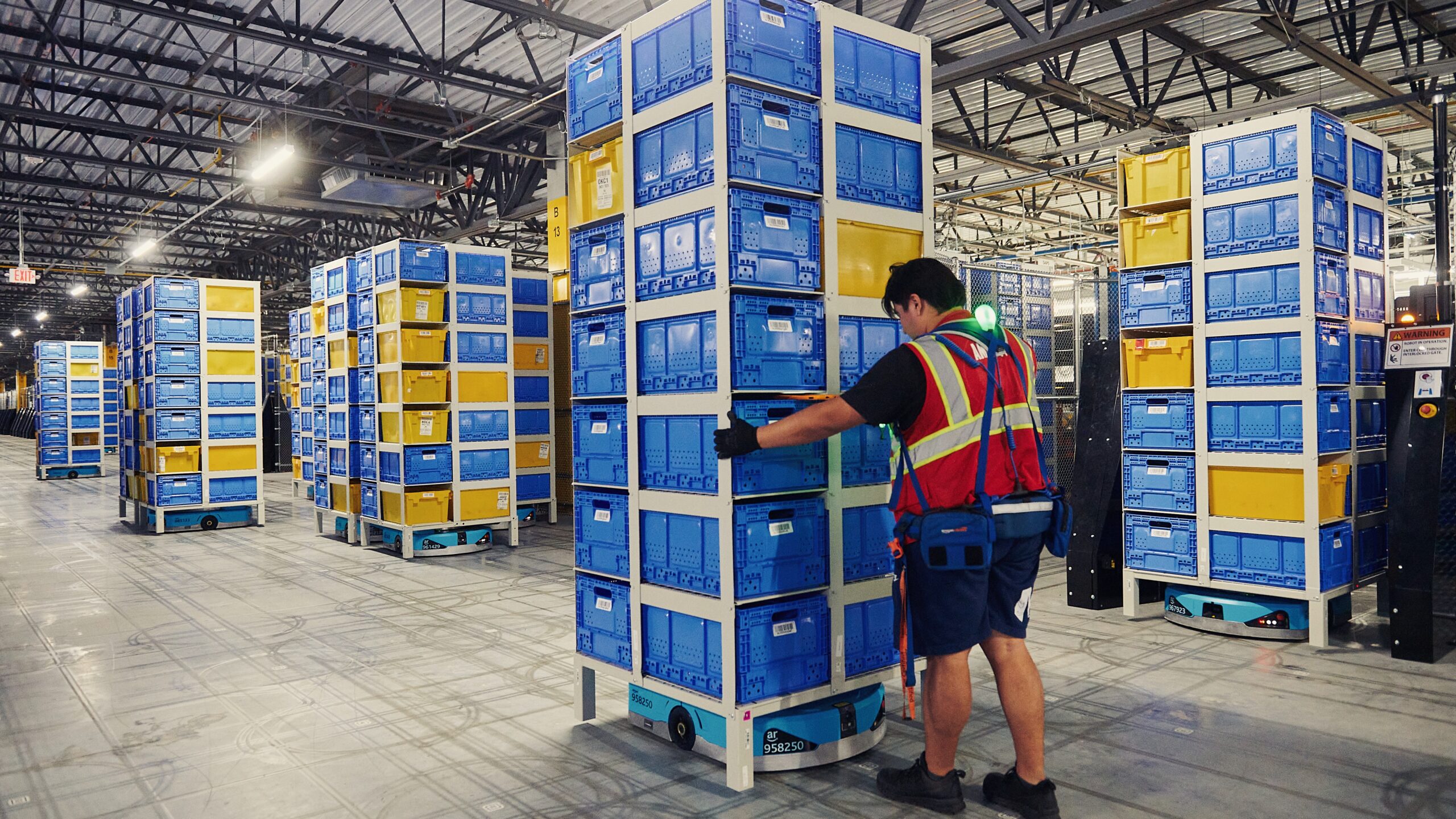
The second-largest corporate employer has bet big on robot workers to scale.
No organization in the world operates more robots than Amazon. The company already has more than 1 million robots working in warehouses around the clock to make tens of millions of same-day and one-day package deliveries happen on a daily basis—and Amazon is poised to significantly grow that robotic fleet in the coming years as it establishes new factories to churn out increasingly more capable robot workers.
Despite deploying so many robots, Amazon is also the second-largest corporate employer in the world, with more than 1.5 million full-time and part-time human workers, according to its 2025 annual report. Amazon executives say that the growing robot fleet has eased the burden on its human workforce by taking on the toughest fulfillment center tasks that carry the greatest risks of physical fatigue and injury. But labor advocacy groups and independent researchers point to evidence suggesting that warehouse automation driven by AI is not all upside for the humans who work alongside robots.
“For the last 100 years, most of the automation that we’ve seen usually happens away from workers—you’re taking that high-risk task away from the worker, and you’re doing so in a way that is not physically proximate,” Brian Greenwood, professor of business at George Mason University, told Ars. “The rise of collaborative robots really changes that dynamic for two reasons: one is that it is physically proximate, and two, the robot has the ability to dictate the pace of work.”
In many ways, robotics and AI are well suited to the relentless pace of work that is already happening inside e-commerce fulfillment centers. Amazon’s promise of speedy deliveries for its 200 million Prime subscribers in particular requires hundreds of thousands of human employees to speedily assemble and ship out customer orders that often combine a dizzying array of products.
Much of the work in fulfillment centers also frequently involves “dull, dirty and dangerous” tasks that people may prefer to hand over to robots. The injury and illness rate for workers in the US warehouse sector has typically been more than double the average across all industries, according to the US Occupational Safety and Health Administration.
“You have almost 2 million people working in the warehousing sector in the United States, and it’s characterized by very high turnover and very high workplace injury rates,” said Greenwood.
But robots are still far from capable of handling the many different tasks that human workers can perform. So Amazon still has a massive human workforce working in tandem with the company’s growing fleet of wheeled robots and robotic arms—and workplaces can get complicated when humans are expected to keep pace with robotic counterparts.
Amazon has rapidly built its robotic fleet following the pivotal decision to acquire the robotics company Kiva Systems in 2012. Kiva was among the earliest companies to pioneer wheeled mobile robots that bring racks of items to warehouse workers, instead of requiring people to continually walk around grabbing items off of shelves inside fulfillment centers.
Since the acquisition, Kiva was renamed Amazon Robotics and has focused on deploying an array of mobile robots and robotic arms that Amazon primarily manufactures in-house at facilities in Massachusetts. This year, the company also announced it would build additional production factories in Austin, Texas, and Greenwood, Indiana, to churn out even more robots in the future.