// SPACE.COM — SPAZIO & SCIENZA
Trump awards SpaceX founder Elon Musk National Medal of Science
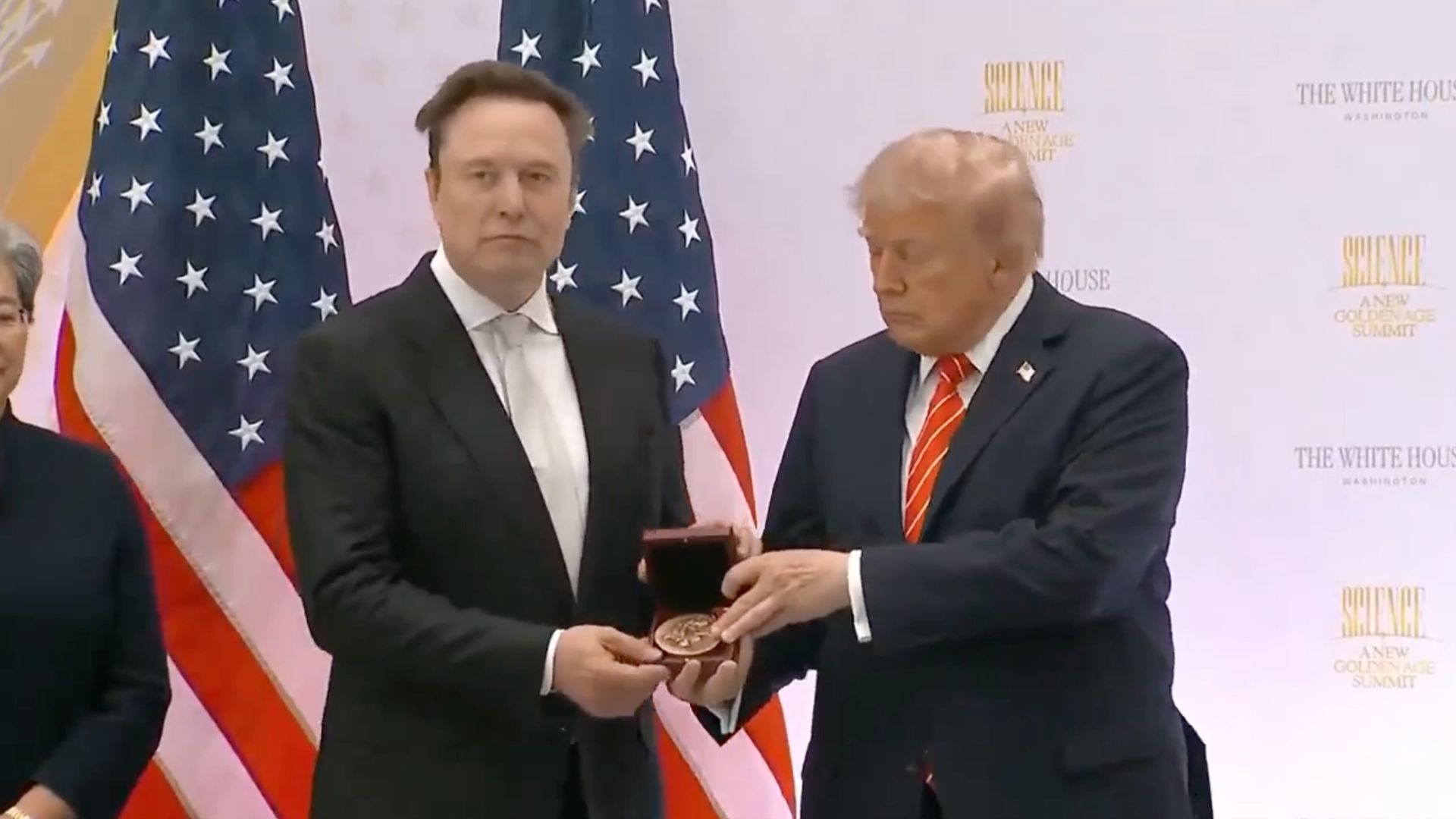
The SpaceX chief was recognized for "engineering achievements of extraordinary ambition and scale."
When you purchase through links on our site, we may earn an affiliate commission. Here’s how it works.
The world's richest man just got some more hardware for his trophy room.
During a ceremony at the White House on Thursday (Oct. 8), President Donald Trump gave SpaceX founder and CEO Elon Musk the National Medal of Science, the highest honor the U.S. can bestow on a scientist or engineer.
Musk was recognized "for engineering achievements of extraordinary ambition and scale that have pushed the frontiers of space exploration, intelligence systems, communications and beyond, renewing American technological leadership and opening a new chapter in American manufacturing," an announcer said during the ceremony.
.@POTUS presents the National Medal of Science to Sergey Brin, @JensenHuang, @elonmusk, and @LisaSu, and the National Medal of Technology and Innovation to @MichaelDell and @satyanadella. https://t.co/8IGZV6s9OfOctober 8, 2026
A little bit more about those achievements and that ambition: Musk also leads the electric carmaker Tesla and owns the social media platform X. And he founded the Boring Company, which is drilling tunnels beneath cities to potentially ease traffic congestion; Neuralink, which builds implantable brain-computer interfaces; and xAI, which makes the chatbot Grok, among other things.
Musk wasn't today's only honoree. Trump also handed out science medals to Google co-founder Sergey Brin, Nvidia CEO Jensen Huang and Lisa Su, CEO of Advanced Micro Devices, a leading semiconductor designer.
The president also awarded the slightly different National Medal of Technology and Innovation to two other tech CEOs — Michael Dell of Dell Technologies and Microsoft's Satya Nadella for contributions in their fields.
Congress established the National Medal of Science in 1959. Honorees are chosen for their "outstanding contributions to knowledge in the physical, biological, mathematical, engineering or social and behavioral sciences, in service to the nation," according to the U.S. National Science Foundation (NSF).