// NATURE NEWS — SPAZIO & SCIENZA
Elp1 is required for myeloid differentiation and brain repopulation
Nature
(2026) Cite this article
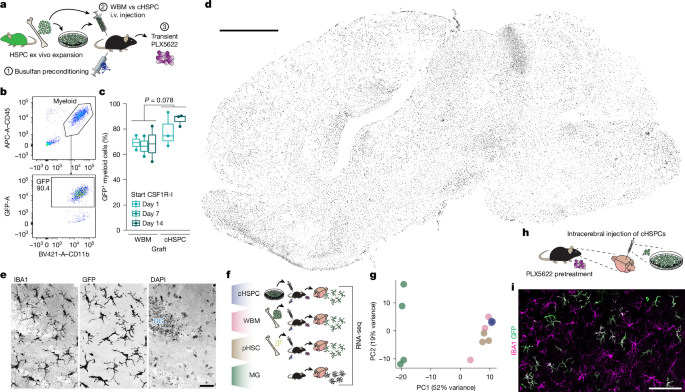
Haematopoietic stem and progenitor cell (HSPC) transplantation-mediated replacement of microglia—the reconstitution of the central nervous system microglial niche with donor-derived myeloid cells—represents a promising strategy for brain cell therapies1,2,3,4,5,6,7. However, the cell-intrinsic molecular regulators of HSPC-derived myeloid lineage commitment in the brain have remained largely uncharacterized. This is partially because the scarcity of primary HSPCs has rendered large-scale genetic interrogation intractable. Here we explored whether ex vivo expansion of primary cultured HSPCs (cHSPCs) enables unbiased genetic interrogation of haematopoietic differentiation. We established that cHSPCs can be genetically manipulated and readily differentiate into myeloid cells and repopulate microglia niches of the brain after transplantation. Moreover, primary neonatal astrocytes contained strong signals to induce myeloid specification of cHSPCs in vitro. To identify genes that regulate glia-induced myeloid differentiation, we successfully screened around 20,000 individual genetic perturbations and characterized genes involved in the regulation of cell signalling, cell cycle, mitochondrial function and protein translation. Among these genes was elongator acetyltransferase complex subunit 1 (Elp1), which suppressed the unfolded protein response during myeloid specification and was essential for the generation but not maintenance of myeloid cells. Our work establishes a platform to investigate the molecular mechanisms of brain myeloid biology.
This is a preview of subscription content, access via your institution
Access Nature and 54 other Nature Portfolio journals
Get Nature+, our best-value online-access subscription
Prices may be subject to local taxes which are calculated during checkout
The mouse sequencing datasets generated and analysed in this study are available from the Gene Expression Omnibus repository83 under accession numbers GSE255732, GSE255735 and GSE255893. The murine reference genome was obtained from www.gencodegenes.org, and the murine reference proteome was obtained from www.uniprot.org. Gene sets were obtained from www.gsea-msigdb.org and www.geneontology.org. The MS proteomic data have been deposited to into the ProteomeXchange84 Consortium via the PRIDE85 partner repository with the dataset identifier PXD049985. Source data are provided with this paper.
Computational analyses were performed using freely available software packages as described in detail in the Methods. If additional information for replication of this study is required, it will be available from the corresponding author upon reasonable request.
Biffi, A. et al. Gene therapy of metachromatic leukodystrophy reverses neurological damage and deficits in mice. J. Clin. Invest. 116, 3070–3082 (2006).
Article
PubMed
PubMed Central
CAS
Google Scholar