// NATURE NEWS — SPAZIO & SCIENZA
Modelling mouse embryogenesis from chemically induced totipotent stem cells
Nature
(2026) Cite this article
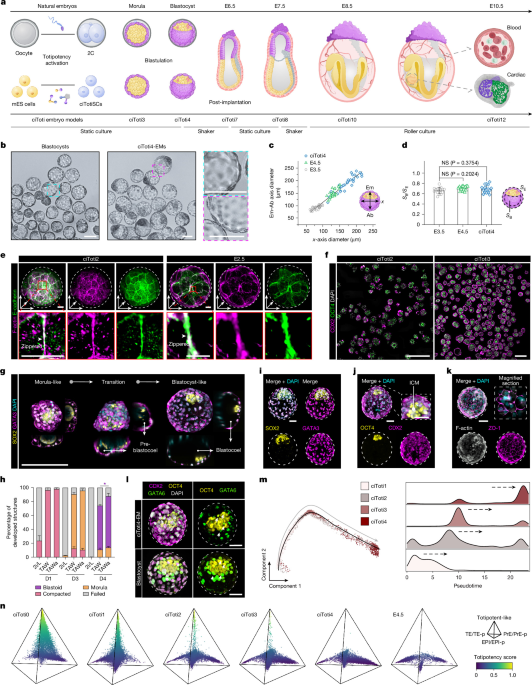
The ability to faithfully initiate embryogenesis from a single, induced non-germline cell type, akin to the totipotent blastomeres, remains a considerable challenge in developmental and synthetic biology1,2,3,4,5,6,7,8,9,10,11,12,13,14. Here we established conditions that enable the continuous ex utero development of mouse embryo models (EMs), starting solely from the chemically induced totipotent-like stem cells (ciTotiSCs)15 and spanning the pre-implantation morula, blastocysts and post-gastrulation stages with both embryonic and extraembryonic compartments. These ciTotiSCs self-organized into blastocyst-like structures that closely resembled natural blastocysts in both morphology and lineage segregation. The resulting ciTotiSC-derived EMs (ciToti-EMs) successfully progressed through key developmental milestones, including gastrulation, embryonic axis formation, haematopoiesis and early organogenesis, closely resembling embryonic day 8.5 (E8.5) natural embryos (NEs). Furthermore, extended culture led to the development of functional cardiac tissues in ciToti-EMs, highly comparable to those of E10.5 NEs. These findings demonstrate an extraordinary ability of a single induced cell type, ciTotiSCs, to autonomously recapitulate the complete spectrum of early mouse embryogenesis. Our ciToti-EM system provides a powerful model for investigating mammalian embryonic development and opens new avenues for creating multicellular organisms from non-germline cells.
This is a preview of subscription content, access via your institution
Access Nature and 54 other Nature Portfolio journals
Get Nature+, our best-value online-access subscription
Prices may be subject to local taxes which are calculated during checkout
All data needed to evaluate the results and conclusions of this study are provided in the Article and its Supplementary Information. All unique and stable reagents generated in this study are available from the corresponding author on completion of a materials transfer agreement. The scRNA-seq data generated in this study have been deposited in the NCBI Gene Expression Omnibus (GEO) under accession number GSE292862. The mm10-2020-A reference genome was downloaded from https://www.10xgenomics.com/support/software/cell-ranger/downloads. Published datasets used for comparative analyses included data from 2C embryos (GEO: GSE45719), pre- and post-implantation EMs (GEO: GSE243925; GSE135701; GSE208681; GSE189425; GSE294766; GSE287909; Genome Sequence Archive: CRA016958; and National Genomics Data Center BioProject: PRJCA027661) and mouse NEs (GEO: GSE134240; GSE135701; GSE186068; GSE100597; GSE109071; GSE117542; and EMBL-EBI BioStudies: E-MTAB-6967). Source data are provided with this paper.
The code used for scRNA-seq data analysis and visualization are available at GitHub (https://github.com/hwakwu/Wu-et-al.-2026-ciToti-EM).
Yang, Y. et al. Derivation of pluripotent stem cells with in vivo embryonic and extraembryonic potency. Cell 169, 243–257 (2017).
Article
PubMed
PubMed Central
CAS
Google Scholar