// NATURE NEWS — SPAZIO & SCIENZA
Computational design of metalloproteases
Nature
(2026) Cite this article
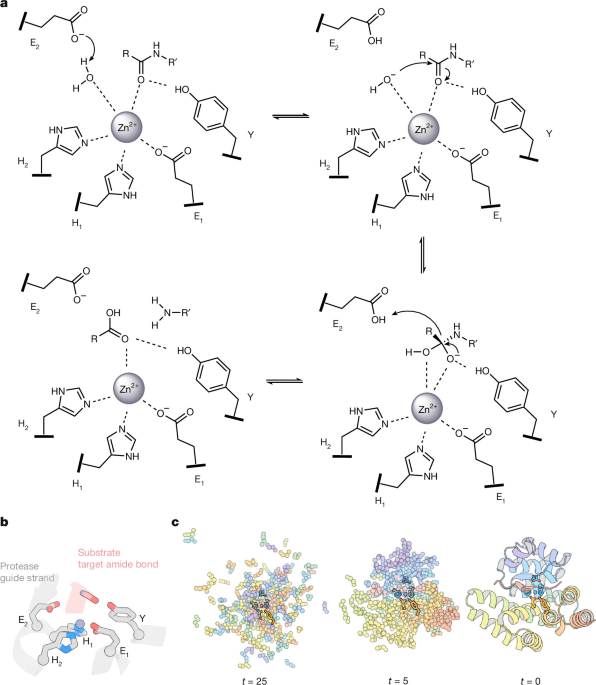
De novo design of enzymes that cleave amide bonds represents a major challenge1,2. Here we use RFdiffusion methods3,4 to de novo design proteins with water-activating zinc-based active sites adjacent to a peptide substrate binding pocket. Of 135 designs tested, 36% catalyse cleavage of their cognate peptide substrates at the targeted scissile bond. The best design accelerates peptide-bond hydrolysis by more than 108-fold relative to the uncatalysed reaction; four substitutions increase this acceleration to more than 1010-fold by improving active-site preorganization5. We use this approach to design metalloproteases that selectively cleave the human disease-associated proteins TDP-43, amyloid-β and serum amyloid A, with rate enhancements of up to 109-fold. We further design caged cytokines and receptor antagonists that are selectively activated by the designed proteases, enabling bioorthogonal control of cell state. Thus, de novo design can yield highly active, programmable proteases with applications in therapeutics, biotechnology and bioremediation.
This is a preview of subscription content, access via your institution
Access Nature and 54 other Nature Portfolio journals
Get Nature+, our best-value online-access subscription
Prices may be subject to local taxes which are calculated during checkout
All data generated or analysed in this study are available in the paper, its Supplementary Information and at Zenodo (https://doi.org/10.5281/zenodo.22654831)62. Crystal structures have been deposited in the PDB (https://www.rcsb.org/) under accession codes 11CE, 11CM, 11CP, 11CR, 11CU, 11CY and 11DU.
The code used in this study is available at Zenodo (https://doi.org/10.5281/zenodo.22654831)62.
Studer, S. et al. Evolution of a highly active and enantiospecific metalloenzyme from short peptides. Science 362, 1285–1288 (2018).
Article
ADS
CAS
PubMed
Google Scholar