// SPACE.COM — SPAZIO & SCIENZA
On this day in space! Oct. 19, 2016: Europe's ExoMars orbiter and Schiaparelli lander arrive at Mars
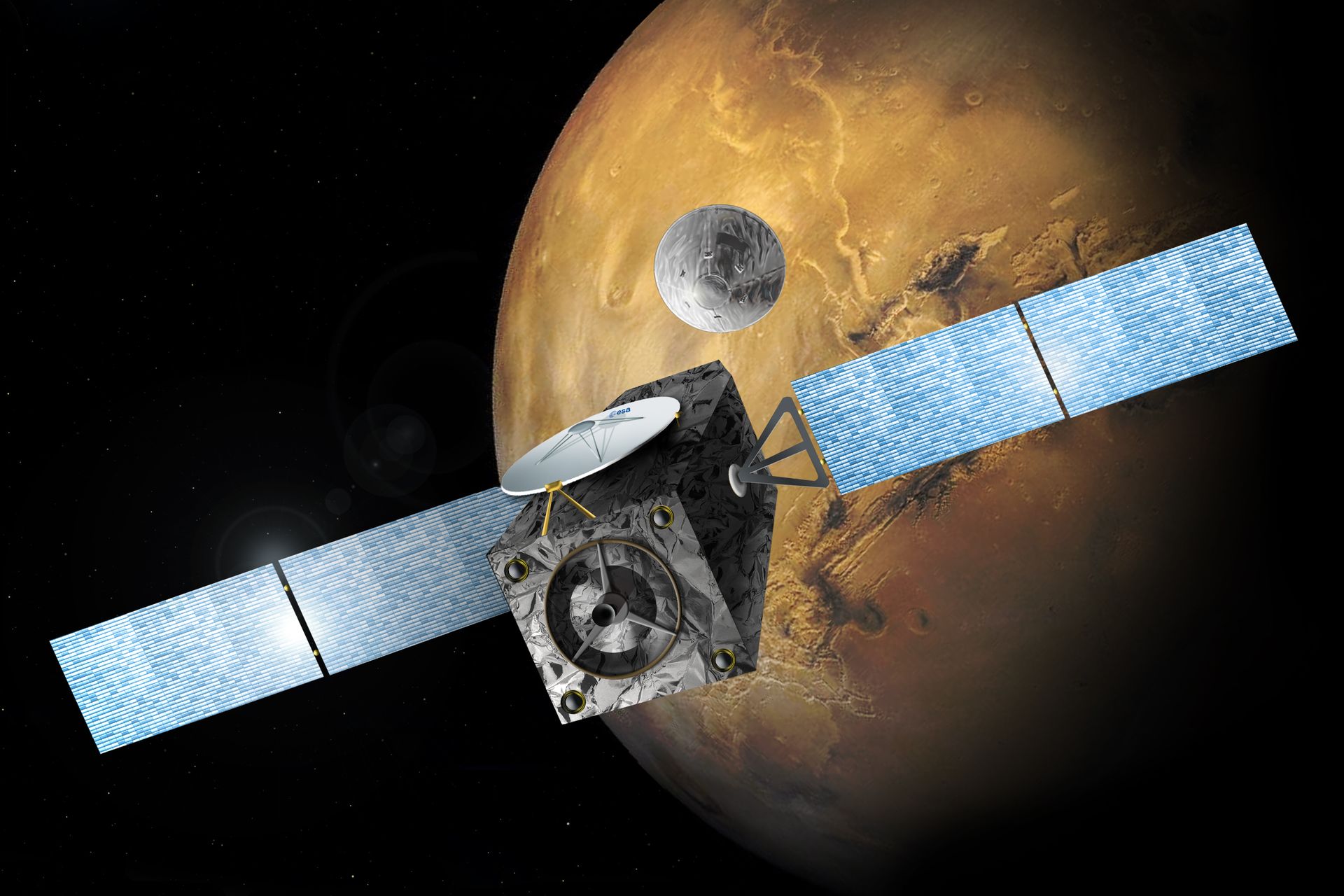
The ExoMars 2016 orbiter survived the Mars arrival. Sadly, its Schiaparelli lander did not.
When you purchase through links on our site, we may earn an affiliate commission. Here’s how it works.
On Oct. 19, 2016, the European Space Agency's ExoMars mission arrived at Mars!
ExoMars 2016 consists of the Trace Gas Orbiter and the Schiaparelli lander. The orbiter and lander traveled there together and separated on Oct. 16, three days before the orbiter entered orbit around Mars, and the lander touched down on the planet's surface. But something went wrong during the lander's descent, and it crashed into the ground.
Schiaparelli did not survive the accident, but the Trace Gas Orbiter is still functional. It is currently circling the planet, looking for methane and other gases in the Martian atmosphere that could be evidence for possible biological activity.
ExoMars 2016 was a landmark mission for the European Space Agency and designed to be the vanguard of a two-flight ExoMars program to send an orbiter, lander and rover to Mars.
Launched in March 2016, ExoMars 2016 aimed to achieve two goals for ESA and Russia. First, the mission aimed to use the Schiaparelli lander to test landing techniques that would be vital on a planned ExoMars 2018 rover. Second, the mission would deliver a critical orbiter around Mars to study the planet's atmosphere and serve as a communications link for that future Mars rover.
In the end, ExoMars 2016 was just a partial success, with ESA officials calling it "96% successful." due to the loss of the lander.
While Schiaparelli separated smoothly from the ExoMars Trace Gas Orbiter spacecraft, it stopped communicating with Earth just 1 minute before its planned landing on Oct. 19. Photos from NASA's Mars Reconnaissance Orbiter at Mars later revealed what appeared to be its crash site and, nearby, its jettisoned parachute. Officials suspect Schiaparelli did not fire its descent thrusters as designed in order to slow itself enough for a safe landing. A data glitch was cited as its cause.
The Trace Gas Orbiter, meanwhile, continues to study Mars to this day and has spent 10 years and counting studying the Martian atmosphere.