// NATURE NEWS — SPAZIO & SCIENZA
The contribution of salt marshes to wave attenuation during extreme storms
Nature
(2026) Cite this article
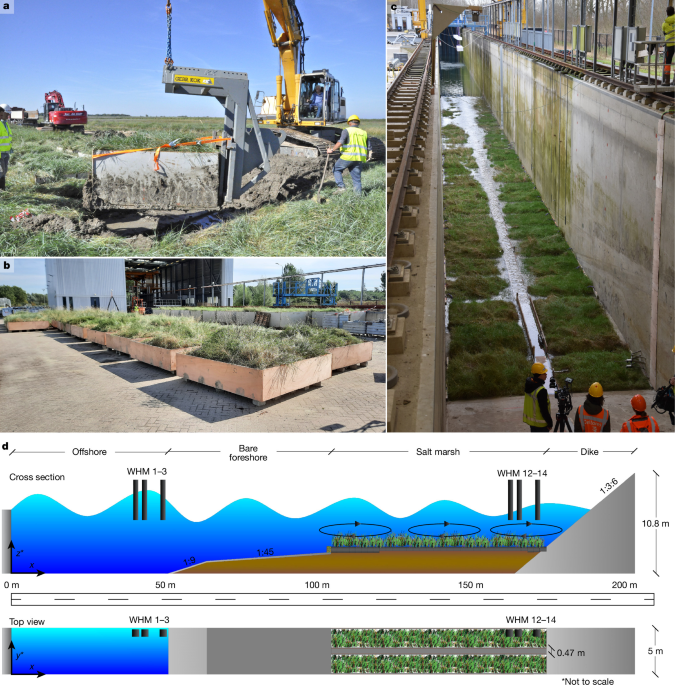
Salt marshes protect coastlines by attenuating wind waves with their elevated marsh platform and above-ground vegetation1. Confidence in the persistence of this service under a changing climate requires knowledge on how extreme storms damage the platform and vegetation; however, a comprehensive, quantified understanding of salt marsh–wave interactions under extreme events is lacking. A unique experiment was conducted by transferring intact salt marsh to one of the world’s largest wave flumes, and subsequently exposing it to increasingly higher waves that reach up to 2 m significant wave height. We show that marsh substrates can persist with negligible erosion, despite cumulative wave exposure. By contrast, the vegetation was progressively damaged during continued wave exposure, gradually reducing vegetation-related wave attenuation. Results emphasize that vegetation was most effective in attenuating waves at low-energy marsh coasts (up to 1 m), where attenuation exceeded 10% (up to 50%), whereas attenuation at high-energy marsh coasts (wave height > 1 m) does not exceed 10%. Our global assessment supports the differentiation between low- and high-energetic conditions resulting from the flume experiment. Our results suggest that the marsh platform remains stable under extreme wave events and that substantial wave attenuation by marsh vegetation is limited to low-energy marsh coasts.
In coastal regions characterized by high flood risk, people and assets are commonly protected from flooding by dikes, dams and sea walls; so-called grey flood protection. These engineered structures are increasingly challenged by changes in local and regional climate conditions, such as sea level rise, land subsidence and increased storm exposure, and may become unsustainable1. Hard engineering structures are static and do not adapt to a changing environment2. Therefore, so-called green–grey flood protection—which combines traditional grey-protection with green-ecosystems—is increasingly considered a more sustainable strategy for keeping coastal regions safe from storm events with extreme waves3.
Green–grey flood protection uses the natural capacity of ecosystems to buffer extreme wave events and consequently reduce flood risk. Specifically, salt marshes with unique salt-tolerant vegetation4, often located in the temperate climate zone at muddy coasts, serve to attenuate large waves during storm surge events5.
Salt marshes attenuate waves by dissipating wave energy due to (1) the elevated bed6, and (2) the drag and roughness of the vegetation growing in the marsh7,8,9,10,11. Both are expected to change during extreme wave events, thereby decreasing the wave-attenuating capacity. Studies so far have indicated that marsh substrates remain stable under moderate storms (significant wave height under 1 m), whereas stability under extreme wave exposure (wave height exceeding 1 m) has not been tested. At the same time, above-ground vegetation breaks and detaches from the marsh surface during moderate storms5,12. Modelling studies extrapolating field evidence highlight that nearly all vegetation is broken after exposure to waves up to 1 m (ref. 13), inevitably leading to decreasing wave attenuation5,13,14. Overall, there seems to be a relationship between wave forcing and vegetation loss: as a storm lasts longer, above-ground vegetation is progressively damaged and wave attenuation diminishes.
In several regions, future storm surges are expected to exceed the water levels that have been assessed in laboratories so far (maximum of 2 m)5,15 ; for example, the UK16 and the Netherlands15. Such surges are also predicted to occur with a 25-year return period in the Yellow Sea and East China Sea (China); the Gulf of Carpentaria (Australia); the Bay of Bengal (Bangladesh); and the Gulf and East coast of the United States17. Surge levels are expected to increase even further in the coming decades18. T