// NATURE NEWS — SPAZIO & SCIENZA
The anatomy of a personal health agent
Nature
(2026) Cite this article
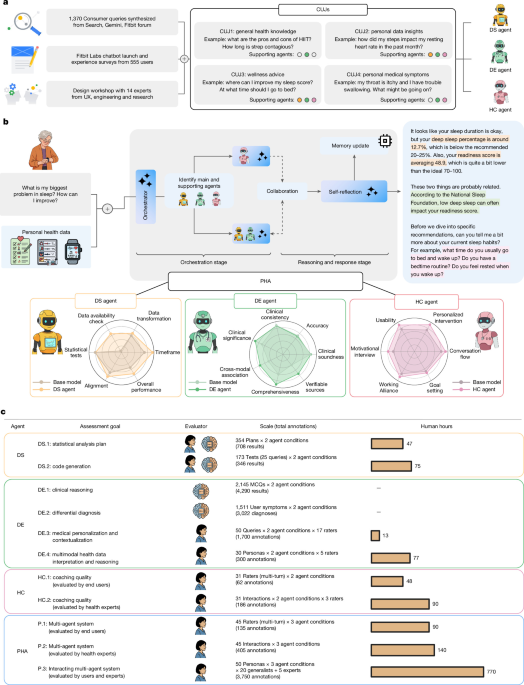
Large language models are enabling a new generation of health agents, yet their ability to address the diverse needs of individuals in everyday health settings remains underexplored1,2. Here we developed a comprehensive personal health agent that reasons over multimodal data from consumer wellness devices and medical records to provide personalized health support. Through analysis of web search and health forum queries, together with user-centred research involving end users and health experts, we identified four key user journeys: general health knowledge, personal data interpretation, wellness advice, and symptom assessment. These journeys informed three specialist sub-agents: (1) a data science agent that analyses longitudinal wearable and medical data, incorporating population-level statistics to contextualize numerical insights; (2) a health domain expert agent that integrates personal and contextual data with health knowledge to generate personalized insights; and (3) a health coach agent that synthesizes insights, supports multi-turn interaction and goal setting, applies specified psychological strategies and tracks progress. We integrated these capabilities in the personal health agent, an open-source multi-agent framework for dynamic, personalized health interactions. We evaluated the sub-agents and full system across 11 benchmark tasks using automated and human evaluation, with more than 7,000 annotations and 1,350 h of effort from health experts and end users. This represents the most comprehensive evaluation of a personal health agent thus far and provides a concrete foundation for improving access to high-quality personalized health support more broadly.
Rapid advancements in large language models (LLMs) have driven transformative changes in health. Current LLMs can support various clinical tasks, such as medical documentation3, diagnosis4, decision support5 and drug discovery6,7, as well as consumer health tools, including virtual health assistants8, symptom checkers9, digital coaches and advisors10,11, and clinical examination dialogues12.
Wearables add continuous activity, sleep, heart rate variability and other physiological signals13,14, providing longitudinal context for health support. Recent systems connect these data to LLMs1,2,8,15,16,17, but numerical time-series reasoning remains unreliable18. Previous systems either cover narrow fitness or sleep questions without deep numerical analysis8, or address broader numerical queries without evaluating health expertise and interactive coaching2. A comprehensive system must combine these capabilities while maintaining a coherent interaction19. Building on these multifaceted developments and the integrated nature of personal health journeys, we envision that the era of intelligent personal health agents is arriving.
Individual needs for daily health and wellness support are highly diverse2,20,21. We used a user-centred design process spanning end-user queries and discussions, surveys and an expert workshop to cover general wellness, fitness and medical topics. The analysis identified four categories of needs: (1) general health knowledge, (2) personal-data interpretation, (3) wellness advice, and (4) health symptoms (Supplementary Table 1). These categories require different capabilities. Personal data questions demand numerical precision and code execution; coaching requires open-ended, empathetic dialogue; and knowledge or symptom questions require factual grounding. Our experiments confirmed that a monolithic LLM architecture struggles to balance these competing objectives. We therefore adopted a modular multi-agent architecture that decouples these technical requirements while preserving a cohesive user experience through orchestration and synthesis of individual sub-agent processes.
Three specialists address these requirements. The data science agent (DS agent) converts personal and populatio