// NATURE NEWS — SPAZIO & SCIENZA
Daily briefing: How to rebuild science from ruin
Search author on:
PubMed
Google Scholar
Hello Nature readers, would you like to get this Briefing in your inbox free every day? Sign up here.
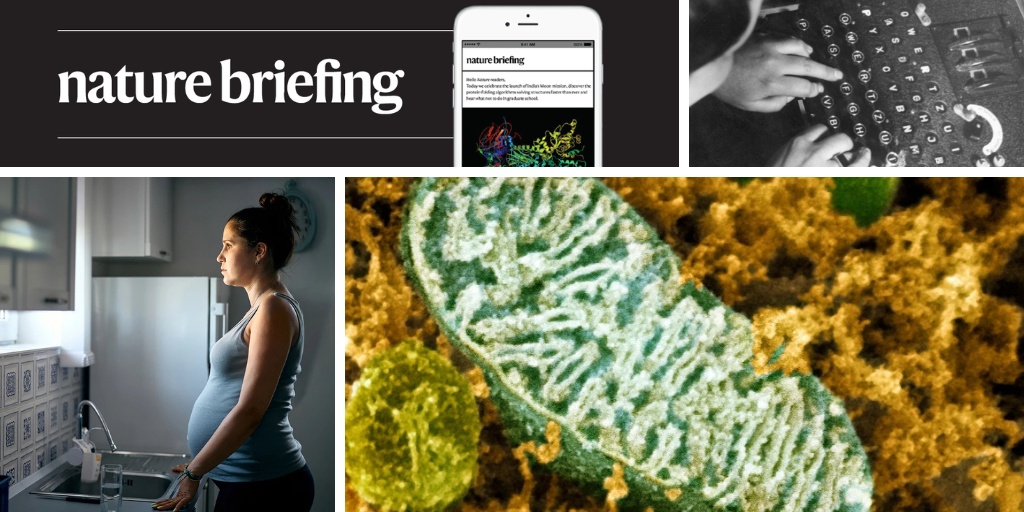
Enigma machines were used by the German armed forces to encrypt communications during the Second World War.Credit: Ullstein Bild via Getty
Amateur cryptographers are taking advantage of the abilities of artificial-intelligence models to help them crack historical coded messages, such as those used by the German armed forces during the Second World War. One aspiring codebreaker used OpenAI’s GPT-6 Astra to find a key to an unsolved cipher from 1809, which the model achieved in around six hours. Cryptography specialists are thrilled at the surge in interest in codebreaking — but they are also being overwhelmed by a deluge of requests to validate AI solutions, which can often be incorrect.
Scientists have mapped in unprecedented detail the proteins that make up the mitochondria in six organisms spanning the tree of life — five single-celled parasites and one plant. In a suite of nine papers, researchers reveal dozens of proteins that are shared among parasites, such as those that cause malaria and sleeping sickness, but not found in humans. The findings could help scientists devise new treatments for these illnesses. The work might also support the hypothesis that mitochondria emerged late in eukaryotic evolution, stoking the long-running debate over the organelles’ origins.
Reference: Nine papers published in Cell, Cell Press Blue, Molecular Cell and Current Biology
An enzyme in the brain might help to preserve cognitive resilience with advancing age, partly by clearing the organ of lipid droplets. Researchers found that high levels of this enzyme are linked to low levels of inflammation in the brains of aged mice, and that the protein boosts the growth of neurons in ageing brains. In people, activity of the gene encoding this enzyme was highest in individuals whose cognition remains intact even though their brains had deposits of the protein amyloid-β, a hallmark of Alzheimer’s disease.
In A Mother’s Brain, neuroscientist Susana Carmona details the myriad changes that the brain undergoes during pregnancy, and the long-lasting signatures the process can leave. The book conveys how biologically extraordinary pregnancy is, while acknowledging that it is not a universally positive experience, writes neuroscientist Liisa Galea in her review. Carmona also highlights the questions about pregnancy’s effect on the brain that remain unanswered, partly because the scientific community has long neglected the importance of this area of study.
On 29 August 2005, Hurricane Katrina — one of the deadliest storms ever to hit the United States — devastated colleges and universities in New Orleans. More than two decades on, the picture across the academic sector in the city mirrors that of New Orleans as a whole: an uneven but impressive recovery. The reasons for divergence provide lessons for other institutions around the world looking to rebuild after a disaster.
Physicist Francis Halzen won the Nobel Prize in Physics this month for his work in founding the IceCube Neutrino Observatory and for the discovery of high-energy neutrinos that come from deep in space. But future breakthroughs in astroparticle physics won’t come unless scientists — and funders — stay bold, writes experimental nuclear and particle physicist Lindley Winslow. “To repeat the experiment’s success, funding agencies, governments and universities must take risks and develop funding infrastructure that is designed to get projects over tricky hurdles,” Winslow writes.