// NATURE NEWS — SPAZIO & SCIENZA
Can scientists reliably tell if a novel is written using AI?
David Adam is a journalist based near London and author of The Man Who Couldn’t Stop (2014) and The Genius Within (2018).
Search author on:
PubMed
Google Scholar
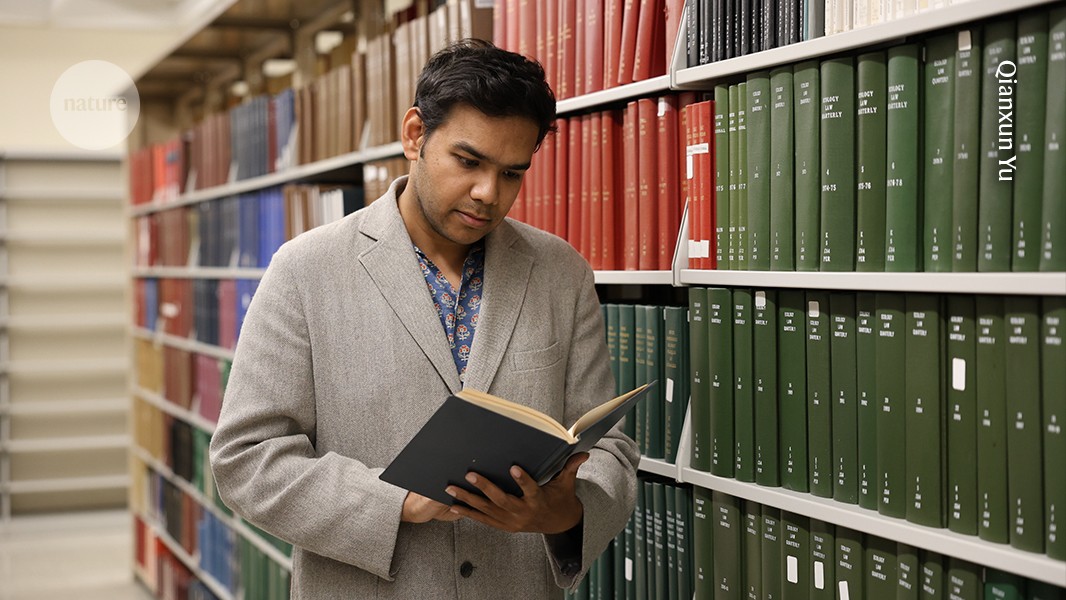
Tuhin Chakrabarty sees the publishing market splitting into human and AI-generated prose. Credit: Qianxun Yu
Tuhin Chakrabarty is a computer scientist at the State University of New York at Stony Brook who studies how to detect AI-generated text. His research drew global attention earlier this year after a journalist cited it as supporting evidence to claim that significant portions of the bestselling 2026 novel Daggermouth were produced using artificial intelligence — an allegation that the book’s author, H. M. Wolfe, has denied. Nature spoke to Chakrabarty about his work, why it matters and what the rise of AI means for the future of creativity.
I live in New York City, and I’m surrounded by creative people. I can understand why artists are enraged about AI. It can take years to write a book, but an AI chatbot can churn one out in 15 minutes. That got me interested in the subject of copyright and creativity. As AI use spreads, the future is going to get messier. What qualifies for copyright protection? How do you quantify the original human contribution when something is co-created with AI? How can you even tell the two apart?
Disclosure is important. At scientific conferences, we are seeing increasing numbers of disclosures stating that AI was used and for what — to polish writing, say, or for copy-editing. Once you disclose, things become easier to judge.
Can Anthropic’s invisible watermarks curb ‘AI slop’? Researchers remain sceptical
Over time, you could imagine separate markets developing for text written purely by people, hybrid writing and mass-market AI-written prose. That might create better economic incentives for people who don’t use AI or are morally opposed to its use. Everyone’s process is different, and there is a huge spectrum in how AI can be used. My moral concern relates to people who use AI, but pass off AI-written prose as their own. That is where the problem lies.
In a July preprint, my colleagues and I traced relatively unusual sequences of words that appear verbatim in different books (T. Chakrabarty et al. Preprint at arXiv https://doi.org/rsp2; 2026). We wanted to measure how much language books derive from books that came before them.
We compared the number of these rare expressions across three types of book for sale on Amazon. We looked at 200 titles flagged by the AI-detection software Pangram as containing substantial amounts of AI-written text, 200 self-published bestsellers with no AI-written text, and 200 literary fiction books that had won or been nominated for prizes. In each case, we identified rare expressions that appeared, word-for-word, in a sample of hundreds of thousands of titles on Google Books.