// NATURE NEWS — SPAZIO & SCIENZA
Clostridium perfringens Delta toxin targets CD9 to drive NEC and brain injury
Nature
(2026) Cite this article
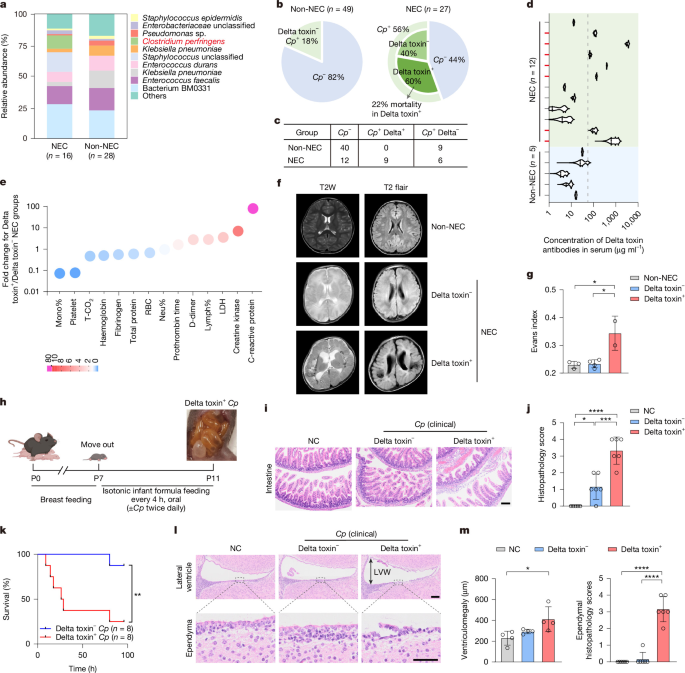
Necrotizing enterocolitis (NEC) is the most devastating gastrointestinal emergency in preterm infants, frequently causing mortality and long-term neurodevelopmental impairment1,2. Although the gut microbiota has been implicated in NEC pathogenesis3,4,5, the microbial factors driving NEC and the following brain pathology remain unclear. Here we identify Clostridium perfringens pathobionts containing Delta toxin in the gut microbiome of individuals with severe and fatal NEC. Clinically, infected infants show worse outcomes, including aberrant systemic inflammation, severe neurological damage and coagulopathy. We establish a mouse model in which Delta-toxin-positive C. perfringens infection, or Delta toxin exposure alone, recapitulates clinical features of NEC, including intestinal necrosis and acute cerebral injury. Mechanistically, Delta toxin preferentially targets macrophages, potently activating inflammasome signalling and pyroptosis, triggering a rapid inflammatory cascade that compromises blood–brain barrier integrity and drives neuroinflammation. Through a genome-wide CRISPR screen, we identify the tetraspanin CD9 as the host receptor for Delta toxin. Using systemic, myeloid-specific and intestinal-epithelial-specific Cd9-knockout mice, we show that systemic and myeloid Cd9 ablation protects mice against toxin-induced lethality, blood–brain barrier dysfunction and multiorgan injury, whereas epithelial Cd9 deletion shows partial protection, implicating macrophage targeting as a primary driver of C. perfringens CD9-dependent pathogenesis. Furthermore, a neutralizing anti-Delta toxin monoclonal antibody confers protection against disease progression. These findings suggest that a subset of NEC is a specific-toxin-mediated disorder and validate the Delta toxin–CD9 axis as a therapeutic target for this subset.
NEC remains a major cause of mortality and long-term morbidity in preterm infants1,2. NEC pathogenesis is multifactorial, involving the complex interplay of immature intestinal development, intestinal barrier dysfunction, gut dysbiosis and excessive inflammatory response3,4,5,6. The specific triggers of NEC and the mechanisms driving its rapid progression remain poorly understood.
The impact of NEC extends beyond the intestine. More than half of postoperative survivors develop brain injury and neurodevelopmental impairment7,8, with TLR4 inflammatory pathways implicated in this pathology9,10. Many insights are derived from experimental models that use hypoxia, cold stress and hyperosmolar formula feeding to increase intestinal vulnerability11,12. Although these models have been valuable for mapping inflammatory pathways, they may be less well suited to interrogating microbiome-driven early initiating events.
Gut microbiota are implicated in NEC susceptibility: NEC is associated with dysbiosis3,4,5, germ-free mice are resistant to NEC-like injury13 and microbiota-modifying interventions are protective14,15. Several studies identified enrichment of toxin-producing C. perfringens in NEC16,17,18, but causal virulence factors remain undefined.
C. perfringens is a ubiquitous, Gram-positive anaerobe producing diverse toxins19,20. Strains are classified into seven toxin types (A–G) based on toxin repertoire19. Type C strains produce Beta and Delta toxins, which are both pore-forming toxins (PFTs) that induce cell death by forming transmembrane pores21,22,23. While Beta toxin is well characterized, Delta toxin remains understudied. Here we identify C. perfringens Delta toxin as a virulence factor that drives intestinal necrosis and brain injury in a subset of NEC, providing an avenue for targeted therapeutic intervention.
To investigate the role of gut microbiota in NEC, we profiled faecal samples from 28 preterm infants without NEC and 16 preterm infants with NEC. 16S rRNA-sequencing analysis revealed an enrichment of C. perfringens in NEC samples (Fig. 1a), consi