// NATURE NEWS — SPAZIO & SCIENZA
Tumour assembloids recapitulate tumour–CAF–T cell crosstalk in renal cancer
Nature
(2026) Cite this article
Dynamic interactions between tumours and their microenvironment are crucial for cancer progression and therapeutic outcomes1,2. However, our understanding of these relationships remains limited by the constrained capacity of current human model systems to manipulate diverse cellular components and to interrogate complex tumour–stroma crosstalk. Here we generated combinatorial, mix-and-match tumour assembloids by conditionally reconstituting multiple components of human renal cell carcinoma, including cancer cells, cancer-associated fibroblasts (CAFs) and tumour-infiltrating immune cells. Using genetically engineered renal cell carcinoma assembloids with humanized mouse models, we uncovered mechanisms by which CAFs coordinate interactions between tumour cells and CD8+ T cells to maintain non-cell-autonomous CD8+ T cell stemness and drive responsiveness to anti-PD-1 therapy. These interactions operate through a tumour–CAF–T cell signalling axis in which tumour-derived WNT induces CAF expression of activin A, which enhances CD8+ T cell stemness and sensitivity to PD-1 blockade. In non-responders, we also identified a subset of WNT-unresponsive CAFs that do not produce activin A, which leads to impaired CD8+ T cell stemness and resistance to therapy. Together, these findings establish a tumour–CAF–T cell axis as a key determinant of heterogeneous responses to immune checkpoint inhibitors. Moreover, tumour assembloids provide a versatile platform for mechanistic dissection of the tumour microenvironment and evaluation of personalized immunotherapy strategies.
Immune checkpoint inhibitors (ICIs) have substantially improved the prognosis and survival of patients with various solid cancers3, including melanoma4,5,6, non-small cell lung cancer7,8 and bladder cancer9,10,11. However, the overall response rate remains around 30%, which leaves many patients without clinical benefit12. The mechanisms that underlie this heterogeneous response remain poorly understood, which limits the ability to predict and improve ICI efficacy in individual patients.
Recent advances in immunotherapy suggest that the tumour stroma has a pivotal role in shaping responses to ICIs, functioning both as a facilitator and a barrier to effective antitumour immunity1,2. Diverse stromal components engage in continuous reciprocal communication with tumour cells to influence tumour progression and therapeutic responses. A major challenge in defining how the tumour stroma shapes ICI responses is the lack of experimental systems that accurately recapitulate these dynamic, multicellular interactions with high human relevance. Recent advances, including patient-derived xenografts13,14,15, humanized mouse models16,17,18 and ex vivo culture of human tumour tissues using air–liquid interface (ALI) techniques19,20, have improved the representation of human tumour architecture and complexity. However, precise manipulation and tracking of individual cell types and their interactions in these systems are challenging, which limits detailed mechanistic analyses of tumour–stroma–immune crosstalk.
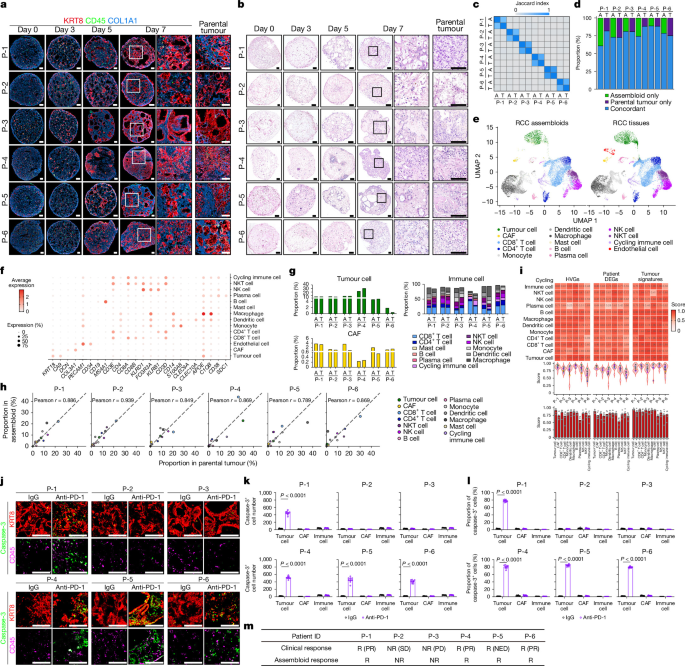
In this study, we developed patient-derived, combinatorial, mix-and-match tumour assembloids from individuals with renal cell carcinoma (RCC). These assembloids recapitulate dynamic interactions among tumour cells, CAFs and CD8+ T cells and reflect patient-specific responses to immunotherapy. By integrating genetically manipulated assembloids with humanized mouse models, we identified a signalling axis that governs tumour–CAF–CD8+ T cell crosstalk and the mechanisms that underlie differential responses to ICIs. Our findings provide mechanistic insights into heterogeneous ICI responses and establish a platform for developing strategies to enhance immunotherapeutic efficacy across diverse malignancies.
To investigate the cellular and molecular basis of heterogeneous ICI responses in RCC, we established patient-specific tumour a