// NATURE NEWS — SPAZIO & SCIENZA
Pharmacological inhibition of METTL1 as a therapy against solid and blood cancers
Nature
(2026) Cite this article
The N7-methylguanosine (m7G) modification is one of the most prevalent tRNA modifications, mainly catalysed by the METTL1–WDR4 protein complex1,2,3,4. The m7G methyltransferase METTL1 has been linked to oncogenic transformation and the maintenance of several aggressive malignancies; however, the clinical implications of therapeutically targeting a tRNA-modifying enzyme have not been established. Here we present the development and characterization of STM9005, a highly selective and potent first-in-class tRNA methyltransferase inhibitor of METTL1. Treatment of numerous cancer cell models (including leukaemia, melanoma, pancreatic carcinoma, oesophageal cancer and small cell lung carcinoma) with STM9005 blocks cell growth, causes differentiation changes and dysregulates cell cycle progression. These cellular effects were accompanied by a selective decrease in m7G on a subset of tRNAs and a reduction in their expression levels, which impacted the translation of oncogenic mRNAs. We show that pharmacological inhibition of METTL1 in vivo impairs tumour growth and significantly prolongs survival in multiple mouse cancer models of different tissue origin. Collectively, our results provide a strong proof of concept that targeting of tRNA methylation is a promising avenue of anti-cancer therapy and illustrate that catalytic inhibition of METTL1 represents a therapeutic strategy against a number of aggressive malignancies.
Over 150 RNA modifications have been described to date, with transfer RNA (tRNA) being one of the most highly modified RNA species5,6. tRNA modifications are critical for the folding, stability and function of tRNA2,7,8. One of the most prevalent tRNA modifications is m7G1,2. It is deposited at position 46 of tRNA (m7G46) by the METTL1–WDR4 heterodimeric protein complex, with METTL1 functioning as the catalytically active component of the complex, and WDR4 having a scaffolding and RNA-binding role2,3,4. The m7G modification on tRNA has been shown to have an important role in stabilizing the tRNA structure, regulating the translation of mRNA and influencing a number of cellular processes, including stress response and oncogenesis9,10,11,12,13. Recent studies have shown that METTL1 may also deposit the m7G modification on mRNAs and microRNA precursors14,15,16, although at a substantially lower rate compared with the m7G levels on the tRNA fraction.
Many studies have implicated the role of the epitranscriptome in the development and regulation of cancer17,18,19. An increasing amount of evidence shows that dysregulation of tRNA modifications and their pathways contributes to the pathogenesis of human disease, including cancer6,18. Notably, upregulation of METTL1 and its catalytic activity has been linked to oncogenic transformation as well as the initiation and maintenance of aggressive haematological and solid malignancies, including acute myeloid leukaemia (AML), melanoma, glioblastoma, liver and lung cancers11,20,21,22. Moreover, the non-catalytic function of METTL1 has recently been linked to the development of sarcomas through its interaction with the multi-tRNA synthetase complex23.
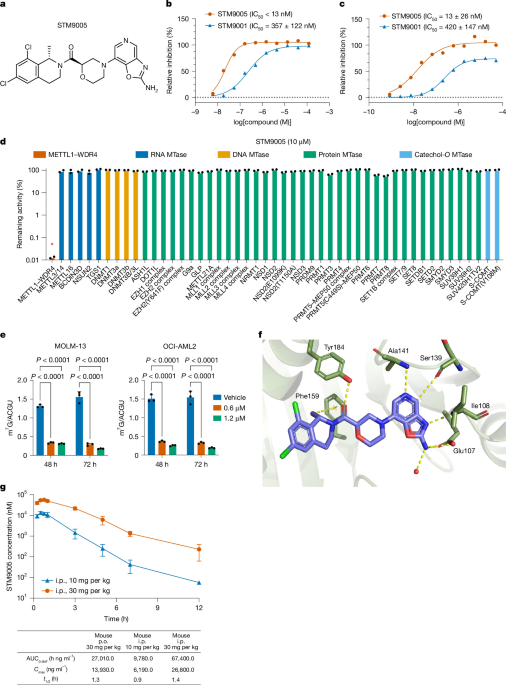
To date, epitranscriptomic drug discovery efforts have largely focused on the targeting of the m6A mRNA modification and its regulators24,25,26,27. Early prototype inhibitors of METTL1 have recently been described and support the feasibility of pharmacologically inhibiting METTL128,29. However, their limited potency and selectivity render them unsuitable as tools to assess the molecular and therapeutic impact of targeting METTL1 catalytic inhibition. Here we present the development and characterization of STM9005, a potent and highly selective first-in-class tRNA methyltransferase inhibitor of METTL1 that demonstrates significant anti-tumour activity across diverse cancer types through the reduction in m7G on tRNA substrates of METTL1.
We performed a high-throughput screen