// NATURE NEWS — SPAZIO & SCIENZA
Scale-rich network-based metamaterials
Nature
volume 659, pages 345–356 (2026) Cite this article
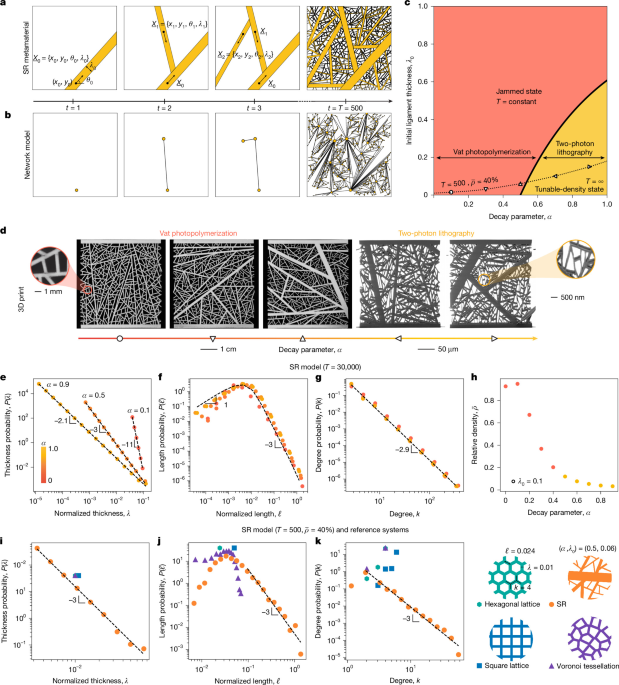
Materials, at their essence, are networks defined by homogeneity: uniform bonds, fixed thicknesses and discrete length scales. Mechanical metamaterials, while representing structurally more diverse microstructures, remain defined by the homogeneity of their unit cells, pore sizes or repeating features1,2. In contrast, as network science has revealed, real-world and biological systems—from the Internet to the brain—derive their function from broad, multiscale variability in connectivity and link length3,4,5,6. Here we introduce scale-rich metamaterials, a design framework that embeds network heterogeneity into mechanical metamaterials, achieving orders-of-magnitude heterogeneity in ligament lengths, thicknesses and connectivity. Governed by only two parameters, scale-rich networks span orders of magnitude in structural features, overcoming previous constraints in metamaterial design. Translating these network models into physically realizable materials, we use simulations and experiments to show that scale-rich metamaterials exhibit properties inaccessible to traditional single-scale systems, including highly tunable elastic anisotropy, delocalized nonlinear deformation with high energy absorption, enhanced energy dissipation under dynamic loading and programmable elastic-wave control. This network-based framework establishes a minimal and universal model for engineering multifunctional materials whose mechanical behaviour emerges directly from scale diversity, and also opens avenues of enquiry for network science itself.
At their core, materials are networks: in crystalline solids, atoms form regular lattices defined by uniform bonds, and in mechanical metamaterials, a distinct graph encodes the interactions among structural components. These graphs share a critical feature—an exceptional homogeneity of their local properties. Crystalline lattices are defined by unique bond lengths and interaction strengths, and even disordered systems such as amorphous microstructures show narrow distributions of connectivity and bond strength. Mechanical metamaterials, or architected materials, inherit this homogeneity: despite their structural diversity, they are typically governed by one or a few discrete length scales7, even in the presence of hierarchy2,8 or disorder9. Unit-cell design further enforces uniform connectivity10 and geometric compatibility constraints11,12, while plate- and shell-based architectures also rely on fixed thicknesses and uniform pore sizes13,14.
However, as network science has revealed in the past two decades, real-world networks rarely exhibit the homogeneity of crystalline or amorphous solids. Instead, systems as diverse as protein–protein interaction networks, social networks and global infrastructures such as the Internet show remarkable structural variability: node degrees span orders of magnitude and interaction strengths cover broad ranges3,4,5,6. This heterogeneity underlies their robustness15,16,17 and resilience18, facilitates dynamical processes19, and enables control through a small subset of nodes20. Even physical networks21,22,23, such as neuronal and vascular networks, whose nodes and links have material presence, are highly heterogeneous, with degrees, link lengths and strengths spanning several orders of magnitude24.
Elements of multiscale organization are also a hallmark of biological systems, defining their mechanical and transport properties. Dragonfly wings, for example, display vein lengths spanning more than three orders of magnitude, from ℓmin = 0.1 mm to ℓmax ≈ 50 mm (ref. 25). Leaves exhibit equally complex venation patterns, with length scales ranging from ℓ ≈ 10−1 mm to ℓ ≈ 103 mm and connectivity spanning roughly 3 decades26. Spider webs are made of string whose lengths extend from ℓ ≈ 1 mm to ℓ ≈ 103 mm (ref. 27), and bones represent hierarchical architectures built from rod- and plate-like ele