// NATURE NEWS — SPAZIO & SCIENZA
Independent interferometric observable confirms black hole shadow in M87*
Nature
volume 659, pages 317–323 (2026) Cite this article
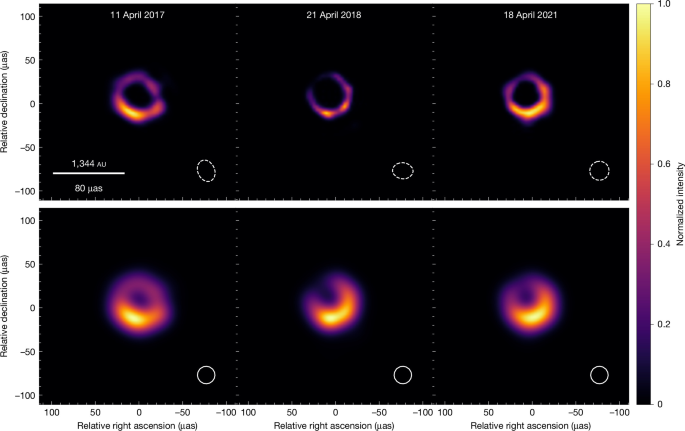
A new epoch for direct visualization of accretion dynamics near the event horizon of a black hole began when the Event Horizon Telescope Collaboration synthesized an Earth-sized aperture with millimetre radio interferometry and published the first reconstructed image1,2,3,4 of a black hole shadow at the core of radio galaxy Messier 87 (M87). The image appeared as a ring-like structure, representing the gravitationally lensed and redshifted emission around the central supermassive black hole, M87*, located at the galactic nucleus. However, application of various data analysis and imaging heuristics resulted in divergent representations of M87* fine-scale features3,5,6,7, with some external analyses even challenging the fundamental ring-like morphology of the source8,9. Such difficulties arise as a consequence of the inherent sparsity of the very long baseline interferometry measurements, making interferometric image reconstruction an inadequately constrained problem. Moreover, the solution is sensitive to instrument calibration, post-processing algorithms and imaging hyperparameters. Here we apply an independent imaging algorithm that we have developed to the M87* dataset that is free from prescriptive morphological priors and founded on observables immune to instrument calibration errors. We reconstruct the black hole shadow image and unequivocally reproduce a ring-like morphology, with an angular diameter of 42.2 ± 1.5 μas corresponding to a black hole mass of 6.5 ± 0.5 billion solar masses assuming nominal scaling parameters, observed at an inclination angle of approximately 20° from the approaching jet.
The M87* supermassive black hole, with a mass of MBH = (3–7) × 109 M⊙ (refs. 10,11,12) located at a distance of D = 16.8 Mpc (refs. 13,14), offers a unique window into horizon-scale general relativistic physics. Its appearance on event horizon scales is expected, on the basis of general relativistic predictions, to be dominated by a central shadow, which, for a non-rotating Schwarzschild black hole, is characterized by a critical impact parameter that is proportional to the black hole mass15 as \(3\sqrt{3}G{M}_{{\rm{BH}}}/({c}^{2}D)\), in which G is the gravitational constant and c is the speed of light. To observe with a spatial resolution capable of detailing the M87* black hole shadow requires unprecedented μas-scale angular resolution, roughly equivalent to the angle subtended by the width of a strand of human hair more than 1,000 km away. Achieving this feat requires a combination of millimetre wavelengths (λ ≈ 1 mm) and an effective aperture size comparable with the diameter of the Earth.
Such a synthesis of an Earth-sized aperture was realized through very long baseline interferometry (VLBI) techniques by correlating the signals from a global network of independent radio observatories, collectively referred to as the Event Horizon Telescope (EHT)1,16. As the Earth rotates, the separation vectors between pairs of geographical stations sweep out elliptical arcs that incrementally fill the Earth-sized synthetic aperture. Although this technique yields the requisite angular resolution to image the M87* shadow, the resulting virtual aperture remains substantially unfilled and lacks the sensitivity and reconstruction fidelity of a filled aperture. The data sparsity problem is further compounded by the requirement of calibrating rapid, station-based atmospheric phase and amplitude fluctuations on continental-scale separations, which often occur on timescales shorter than the coherence time of the observations.
These inherent challenges make image reconstruction from VLBI and EHT datasets an ill-posed problem, highly sensitive to instrument calibration and post-processing heuristics. Present algorithms regularly use manually tuned and independently weighted data terms and regularizations to bias the solution towards plausible morphologie