// NASA BREAKING NEWS — SPAZIO & SCIENZA
NASA’s Hubble Offers Cosmic Sampler of Targets for Roman
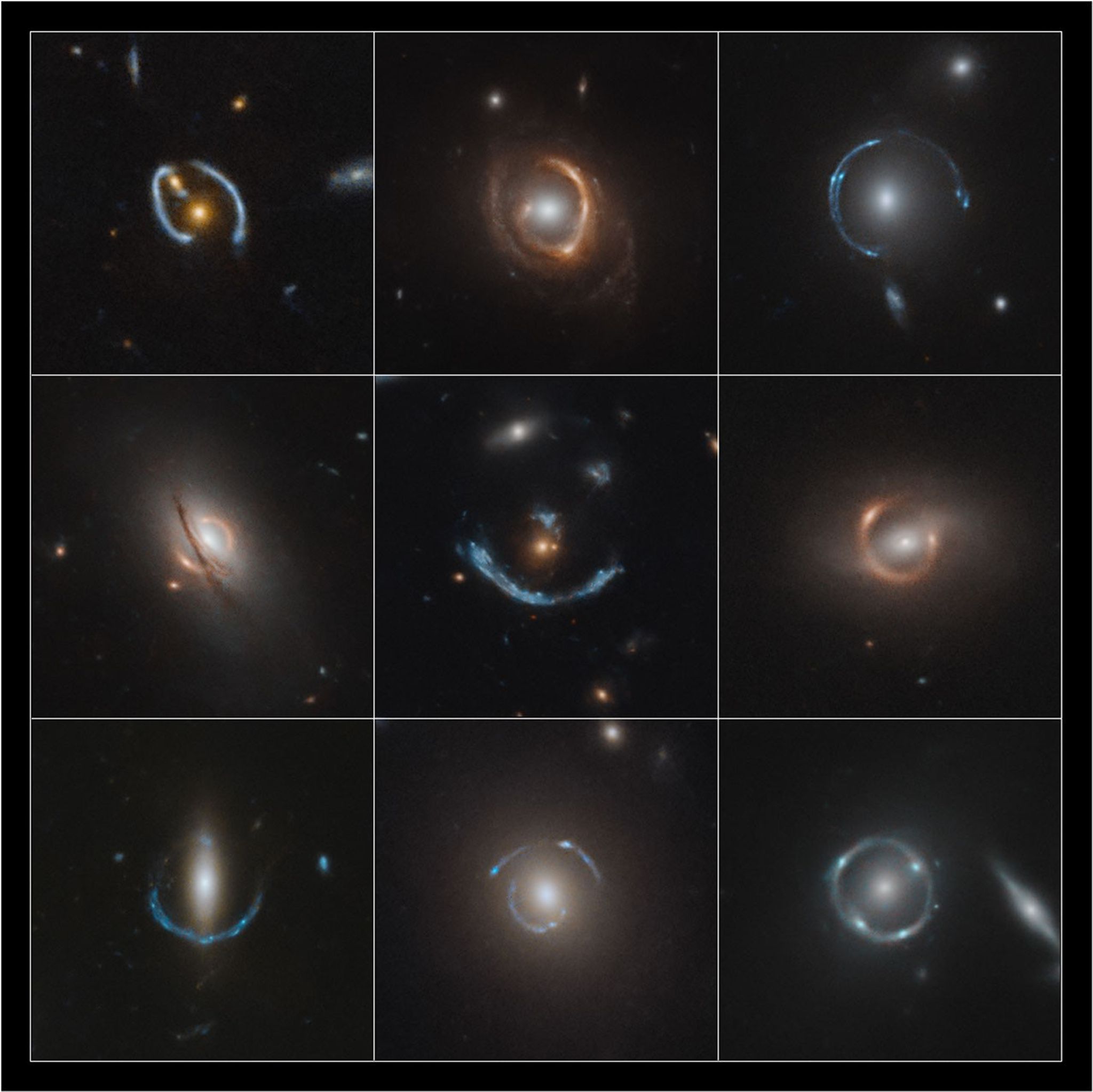
A gallery of gravitational lenses captured by NASA’s Hubble Space Telescope showcases the diversity of this cosmic phenomenon and lays the groundwork for follow-up observations by the new Nancy Grace Roman Space Telescope.
Gravitational lensing, first predicted by Albert Einstein, occurs when the gravity of a massive foreground object, such as a galaxy or cluster of galaxies, bends, warps, and magnifies the light from a more distant background object. The effect is similar to that of a giant lens in space that allows astronomers to view objects much farther away than any telescope could see on its own.
The lenses in this image formed from the precise alignment of a distant background galaxy with the mass of a foreground galaxy, creating distorted and magnified images of the background galaxy that appear as arcs around the foreground galaxy.
Astronomers will use these observations of a large and varied population of gravitational lenses to construct lens models that will help determine how much mass is in the lensing system’s foreground galaxy – and potentially prove or dispel a theory about dark matter. Astronomers study the amount of distortion of the lensed background galaxies to determine the quantity and distribution of mass in the foreground galaxy, including its invisible dark matter.
Hubble views the cosmos primarily in visible and ultraviolet light with some infrared coverage, providing a comprehensive, high-resolution view of individual objects. Roman sees primarily infrared light and some visible, over a much larger field of view to create panoramas of the universe. While Hubble gets a better view of individual lenses, Roman will be able to capture more lenses with its wider field-of-view. If Roman finds a particularly interesting lens, researchers may use Hubble to take follow-up observations using its visible and UV prowess for individual objects.
With Hubble's high-resolution imaging and precise models, researchers should also be able to detect small imperfections in these gravitationally lensed galaxy arcs that would indicate the presence of small clumps of dark matter. Researchers could use these previously undetected clumps to confirm the cold dark matter theory, which predicts the existence of many small dark matter clumps of between a million to a billion solar masses. In contrast, the dark matter halo of our Milky Way galaxy is around 1.3 trillion solar masses.
By studying Hubble lens images in detail, researchers intend to build a super-intelligence tool to efficiently search similar arcs in the upcoming Roman images. The Hubble images are expected to both yield their own results on dark matter and pave the way for analysis of Roman’s larger sample of lenses.
The unique lenses in this image display some of the different characteristics researchers will see as they collect a diverse and numerous assortment of lenses to test in their models. Panel A is an example of an arc-counterarc configuration, in which the lensed background galaxy appears as a duplicated pair of arcs. The lensed galaxy is being magnified by a pair of foreground galaxies whose combined mass bends the light of the background galaxy around them.
Panel F is an Einstein Ring, in which the alignment of the background galaxy and approximately spherical mass of the foreground lens are so perfectly situated that the lensed galaxy almost fully encircles the foreground galaxy. Panel I shows a quadruply lensed galaxy, in which the background galaxy is replicated four times, appearing as smeared dots around the foreground galaxy. Panel C also shows a quadruply lensed galaxy, with double knots that are most likely strong star-forming regions in the background galaxy.
Some of the magnified and warped background galaxies appear blue and some appear red. These bluish arcs indicate young stars, while reddish arcs indicate older stars. Roman and Hubble will explore these differences to better understand how galaxies evolved earlier in the universe