// SPACE.COM — SPAZIO & SCIENZA
Why hasn't the 'Blaze Star' exploded yet? Astronomers weigh in on what to expect
"T CrB *will* erupt sometime soon. Everyone is very confident on this."
When you purchase through links on our site, we may earn an affiliate commission. Here’s how it works.
For the past two years, stargazers have waited with bated breath for a "new" light to appear in the night sky, born of one of the most cataclysmic events known to occur in the cosmos — a nova explosion. But what is the "Blaze Star" T. Coronae Borealis, and why is it so difficult to predict when its overdue brightening will occur? We turned to the experts to find out.
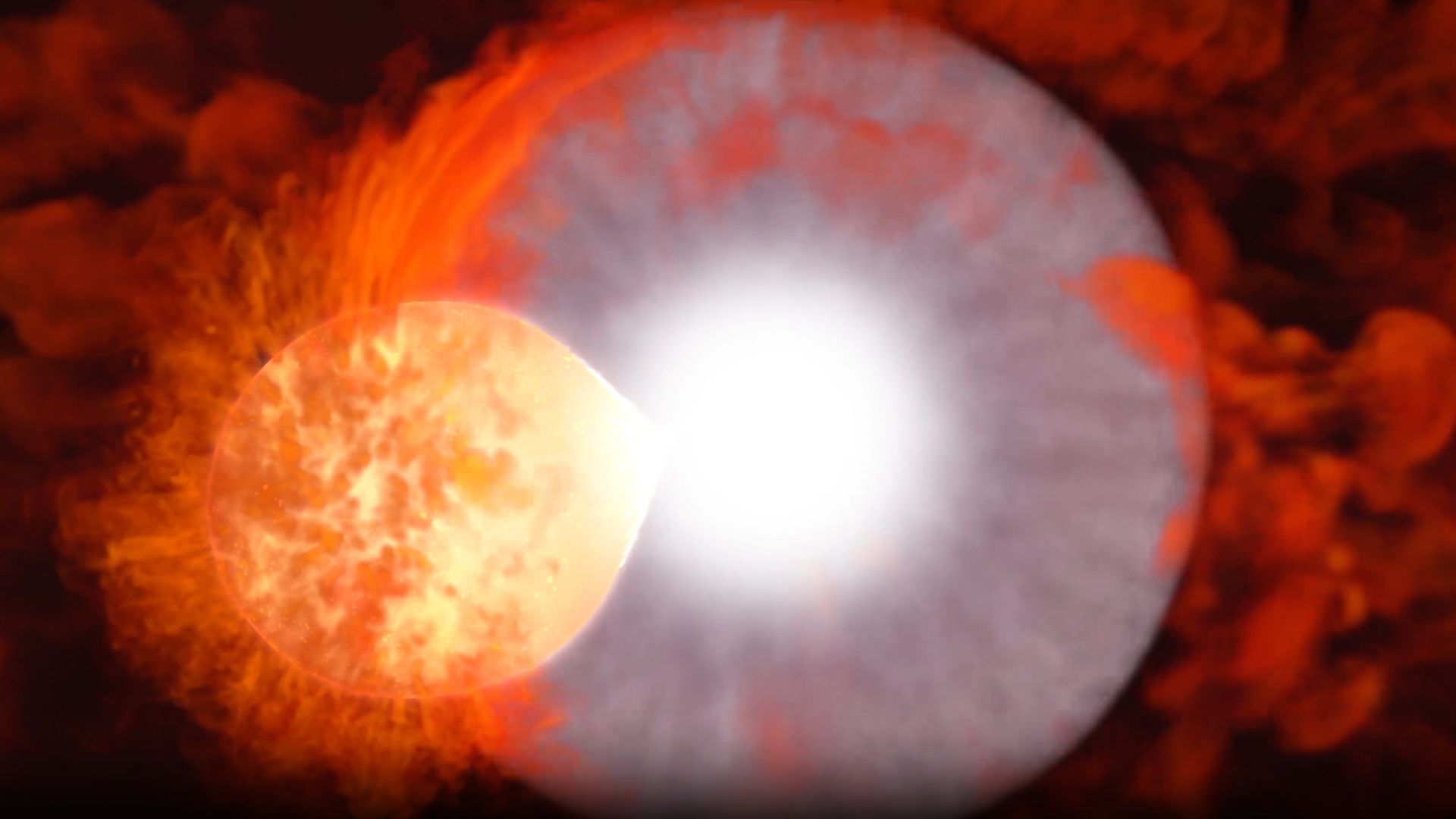
T. Coronae Borealis — or T CrB for short — isn't a single star, but rather a binary system containing a dense white dwarf star and a bloated red giant. Over a period of around 80 years, the white dwarf's gravity strips material from the red giant until it hits a critical threshold. Next comes a dramatic nova explosion that causes the star to flare to 1,000 times its usual brightness before gradually settling down and repeating the cycle.
"T CrB *will* erupt sometime soon," Bradley Schaefer of the Louisiana State University Department of Physics and Astronomy told Space.com in an email. "Everyone is very confident on this. But we cannot make high-accuracy measures of the rate of gas falling onto the surface of the white dwarf, and we do not have a high accuracy measure of the trigger mass for the big hydrogen bomb." Schaefer continued.
Historical observations reveal that the last nova eruption reached Earth in 1946, which places us well inside the window for another dramatic brightening of T. CrBb. However, the unpredictability of the white dwarf's feeding makes it difficult to pin down exactly when the explosion will become visible from Earth.
"The exact date of the upcoming T CrB eruption depends primarily on how fast the gas coming from its companion star is accumulating on the surface of the white dwarf," explained Schaefer. "When some specific trigger mass has accumulated, then T CrB will erupt. For the last 80 years, we have been watching the gas pile up on the white dwarf surface, and we know that it must be near the trigger threshold."
Astronomers have tried to predict T CrB's brightening by comparing a recent fluctuation in the light of the distant star system to a similar event that occurred in the runup to the 1946 event.
"There have already been some dimming and brightening episodes that caused excitement but did not yet turn into the main event," Elizabeth Hays, lab chief at NASA's Astroparticle Physics Laboratory at the Goddard Spaceflight Center, told Space.com in an email. "It is likely that the nova will happen in the next few years but we still don't know exactly when. I can't give you a guaranteed prediction, but I will be a little surprised if it gets to 2030, or 84 years past the last eruption."
Hays notes that the intense light from the red giant dramatically outshines the dimmer white dwarf, making detailed observation challenging. There is also no way to precisely measure the temperature and pressure of the matter lurking near the surface of the smaller star. "Predicting nova explosions are a little like predicting the weather; conditions may be right but the timing of the storm can be uncertain."