// SPACE.COM — SPAZIO & SCIENZA
'A shotgun marriage': Why are NASA's SkyFall Mars helicopters riding on a nuclear rocket?
"The connection to Space Reactor-1 seems to me to be a bit of a shotgun marriage, a tech-demo piggybacking on another mission as an opening bid for a 'nuclear NASA.'"
When you purchase through links on our site, we may earn an affiliate commission. Here’s how it works.
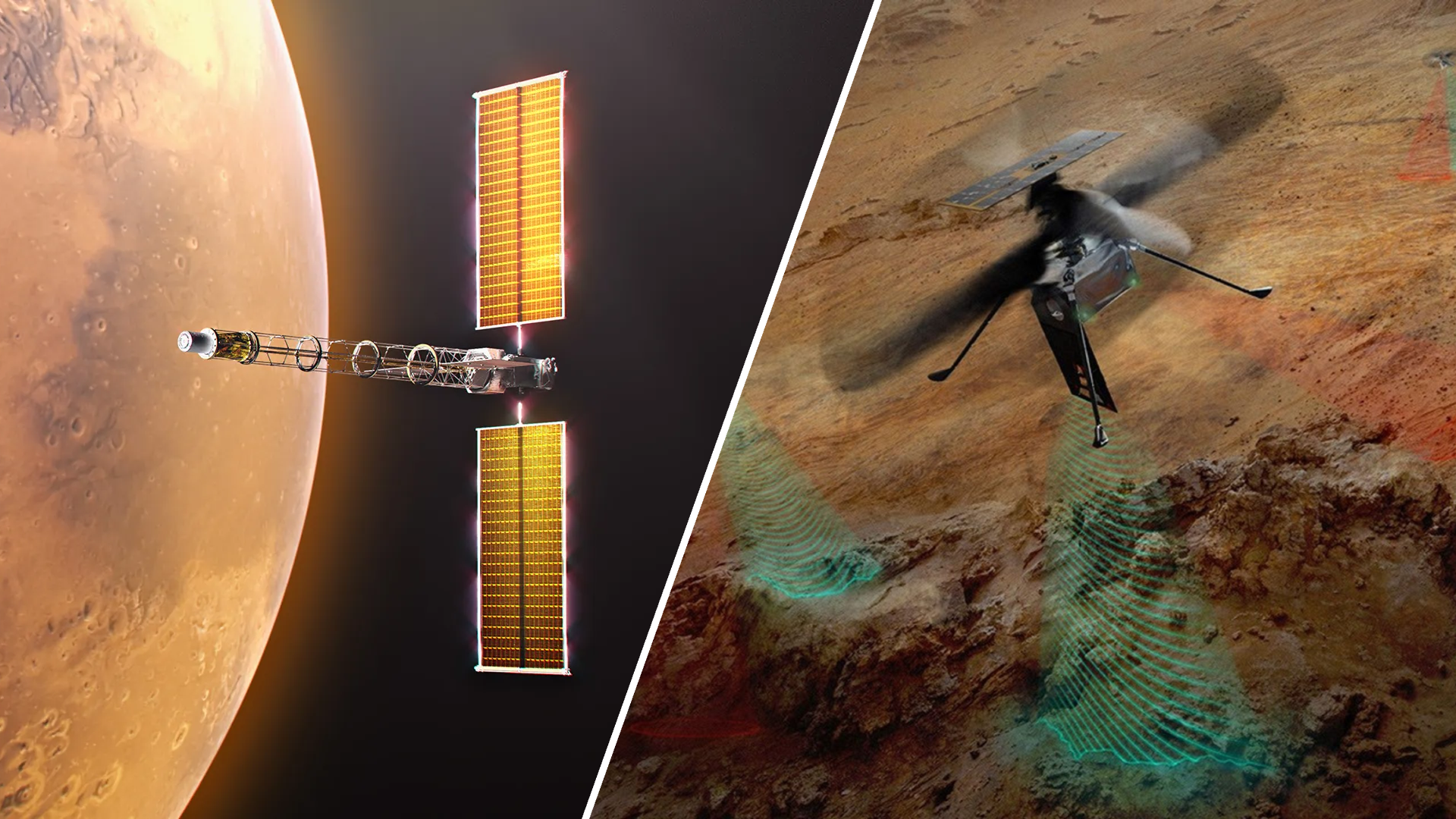
The pace is picking up on building, testing, and plotting out the flight paths for a trio of NASA Ingenuity-class helicopters to investigate Mars after riding there on a nuclear-powered rocket.
NASA's Skyfall mission will see those mini-choppers dropped off at Mars by the space agency's Space Reactor-1 Freedom (SR-1) rocket, the first fission nuclear-powered interplanetary spacecraft slated for launch in late 2028. After its cruise phase and initial Mars flyby in 2029, that nuclear carrier craft will make a second Mars approach in the Fall of 2030 to unleash a SkyFall entry capsule outfitted with a fleet of small aerial vehicles that will soar across the Red Planet.
But some experts are questioning why NASA is combining two such high-profile missions into one. "It is clear that SkyFall was approved for programmatic or political reasons," said Scott Hubbard, former director of NASA's Ames Research Center and the first Mars Program Director (aka the "Mars Czar") at NASA Headquarters, told Space.com. "The connection to Space Reactor-1 seems to me to be a bit of a shotgun marriage, a tech-demo piggybacking on another mission as an opening bid for a 'nuclear NASA.'"
Hubbard is a retired adjunct professor of aeronautics and astronautics at Stanford University. He is a major voice in shaping Red Planet exploration goals, drawing upon his expertise as NASA's former foremost Mars authority. His understanding is that the basic concept had been developed as a follow on to Ingenuity, an attempt to move beyond a technology demo and into a science platform.
Hubbard said that combining these two observations, the outcome presents "an unusual set of management issues." Since the SkyFall mission concept first appeared, he said, the usual sequence for a science mission is reversed.
"The science community is having to scramble to back into a set of requirements and objectives that match the SkyFall capabilities. Fortunately the community is very creative," said Hubbard, "and the basic Planetary Decadal objectives are very broad."
Decadal surveys reflect a broad consensus within the scientific community and provide detailed insights into the strategic priorities and mission directives set for the next decade across key scientific domains, including planetary exploration.
However, Hubbard said he has heard griping about the "fait accompli" process, "but the planetary community will make lemonade."