// NATURE NEWS — SPAZIO & SCIENZA
An inspiral of a star inside a common envelope with its giant companion
Nature
volume 659, pages 628–633 (2026) Cite this article
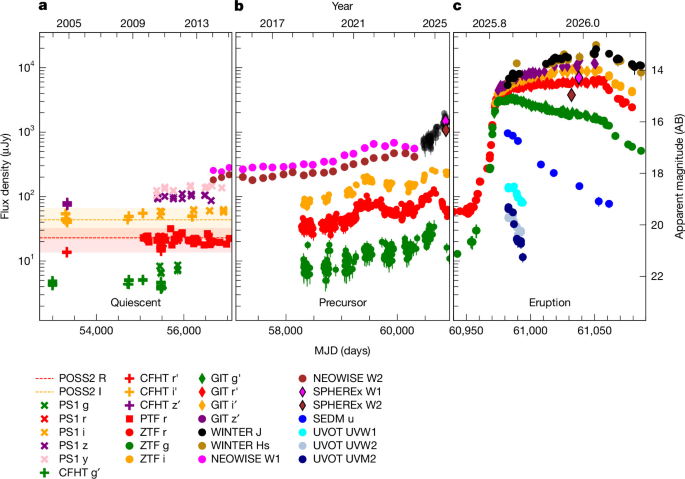
The formation of compact stellar binaries requires rapid orbital tightening of their progenitor binary stars1,2. This is theorized to happen through common envelope evolution (CEE)3, when the stars orbit in a loosely bound, shared convective envelope, triggering an inspiral due to frictional drag4,5. However, this inspiral in such a system has never been observed directly. Here we present observations of AT 2025abao, a transient eruption in the Andromeda Galaxy, which originates from the CEE of an approximately 7M⊙ asymptotic giant branch (AGB) star with its companion. Extensive pre- and post-eruption spectroscopy is best explained as an approximately 0.7M⊙ companion inspiralling within the convective AGB envelope that powers a seven-year period of gradual brighteningone of the first direct observations of frictional drag energy dissipation induced by CEE. This phase is radiatively efficient, consistent with predictions for convective transport in CEE5,6,7,8. The subsequent merger of the companion with the primary core powers the ejection of the outermost 10% of the stellar envelope at speeds about 10× the primary escape speed, and empirically constrains the fraction of dissipated orbital energy available to unbind the convective common envelope4,9,10,11, 0.01 ≲ α ≲ 0.4. This end-to-end characterization using multi-survey observations demonstrates a path towards mapping the landscape of CEE outcomes with upcoming surveys.
This is a preview of subscription content, access via your institution
Access Nature and 54 other Nature Portfolio journals
Get Nature+, our best-value online-access subscription
Prices may be subject to local taxes which are calculated during checkout
All ground-based optical and near-IR photometry and spectra, together with the JWST and SPHEREx SEDs presented in this paper, are available for download from Zenodo (https://doi.org/10.5281/zenodo.22948026). This repository also contains the bolometric parameters inferred from our SED fits. The JWST images are publicly available through the Mikulski Archive for Space Telescopes (https://doi.org/10.17909/07j6-dq13), and the SPHEREx Quick Release 2 (QR2) images are publicly available at IRSA.
The code used for the analysis of spectra and SEDs used in this paper is available on GitHub at https://github.com/virajkaram/at2025abao/. Any additional code or data can be obtained from the corresponding author upon request.
Tauris, T. M. & van den Heuvel, E. P. J. Formation and evolution of compact stellar X-ray sources (eds Lewin, W. H. G. & van der Klis, M.) in Compact Stellar X-ray Sources, Vol. 39, 623–665 (Cambridge Univ. Press, 2006).
Postnov, K. A. & Yungelson, L. R. The evolution of compact binary star systems. Living Rev. Relativ. 17, 3 (2014).