// NATURE NEWS — SPAZIO & SCIENZA
Single-cell variant-to-enhancer-to-gene map for coronary artery disease
Nature
(2026) Cite this article
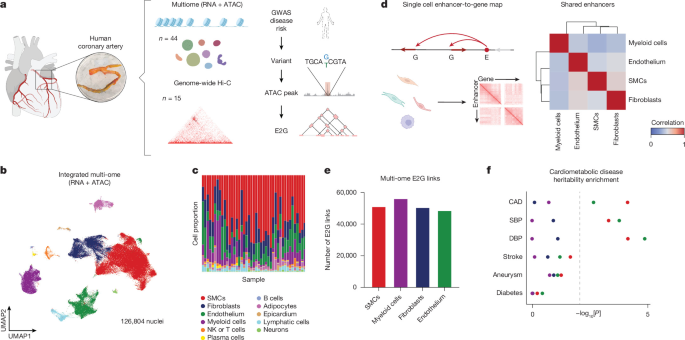
Although coronary artery disease (CAD) genome-wide association studies (GWAS) have identified hundreds of loci, most variants lie in non-coding regions, obscuring the causal gene programmes and cell types driving disease1,2. Here we performed single-nucleus multi-omic profiling of gene expression and chromatin accessibility in human coronary arteries from 44 people to construct a genome-wide single-cell variant-to-enhancer-to-gene map. We identified 11,269 chromatin accessibility quantitative trait loci (caQTLs) across principal vascular cell types, including CAD-associated caQTLs in smooth muscle cells (SMCs). Using dynamic single-cell caQTL modelling3, we show that variant effects on chromatin vary across SMC states. For example, rs658956-mediated suppression of the FGGY-DT enhancer through disruption of an AP-1 motif is amplified as SMCs transition towards a fibromyocyte fate. We next performed genome-wide high-throughput chromosome conformation capture (Hi-C) in 15 human coronary arteries, showing that rs4887091 in the ADAMTS7 CAD locus has allele-dependent effects on CCCTC-binding factor occupancy and loop strength. Integrating Hi-C, Hi-C with chromatin immunoprecipitation and in vitro clustered regularly interspaced short palindromic repeats interference (CRISPRi) nominated AMOTL2 as a distal SMC-specific CAD gene whose loss promotes proliferation and suppresses contractile identity. Finally, arrayed Perturb–seq of GWAS-nominated enhancers converged on extracellular matrix remodelling as a core SMC disease programme. Together, these findings provide a framework for mapping non-coding GWAS variants to cell types, chromatin states and gene programmes in human disease.
Common diseases are driven by a multitude of factors and remain difficult to treat given the lack of a unified disease mechanism4. Coronary artery disease (CAD) is among the most prevalent common chronic diseases, and numerous genome-wide association studies (GWAS) have now identified hundreds of variants linked to CAD risk. Although these results may potentially pave the way for new therapeutic target discovery1,2,5,6, much of the translation from GWAS to therapeutic targets for CAD has been restricted to lipid-lowering drugs7,8. Large-scale clinical studies have demonstrated a persistent residual risk of CAD independent of lipid levels9,10, but we lack drugs that directly target disease pathways in the vessel wall due to an incomplete understanding of causal disease mechanisms. Leveraging human genetics to uncover new lipid-independent biological mechanisms and drug targets in CAD represents a tremendous unmet need and would be a principal milestone in translating population-scale GWAS findings to therapies for patients11,12.
Although population-scale GWAS offer great opportunity for target discovery, most identified variants lie within non-coding regions of the genome, making it difficult to dissect the causal cell types and molecular pathways13. The advent of single-cell sequencing technologies now allows for the profiling of human tissues in health and disease at unprecedented granularity14. Previous studies have used traditional single-cell RNA sequencing (scRNA-seq) for detailed characterization of cell states in human tissue that drive disease15,16,17,18; however, these studies do not profile the non-coding genome, making it challenging to link GWAS variants to observed molecular changes. More recently, single-nucleus assay for transposase-accessible chromatin (ATAC) with sequencing (snATAC–seq) in human coronary arteries was conducted to link CAD GWAS variants to regulatory elements19. Although this represented an important advance in the field, the lack of complementary transcriptomic profiling rendered it challenging to nominate causal genes in vascular cell types. Furthermore, isolated snATAC–seq precludes the discovery of distal gene regulation as a driver of disease20, and there are