// NATURE NEWS — SPAZIO & SCIENZA
Licensing mechanisms during RNA-guided DNA integration by type I-F3 CAST
Nature
(2026) Cite this article
Precise genomic integration of large DNA cargo remains a central challenge in genome engineering. CRISPR-associated transposases (CASTs)1,2 offer a promising solution by coupling RNA-guided DNA recognition to transposon-mediated integration. Because of their exceptional targeting fidelity, type I-F3 CASTs have been a major research focus1, yet the structural basis of their RNA-guided DNA integration has remained unclear. Here, using cryo-electron microscopy, computational protein design and functional assays, we report the licensing mechanisms that control DNA integration activity of Vibrio cholerae CAST (VchCAST). Structural determination was enabled by zero-shot computational redesign of TnsA, which enhanced integration activity by nearly two orders of magnitude without compromising specificity. The structure of the holo integration complex reveals the conformational licensing events that govern activation of the integration machinery at the on-target site. Multiple components (Cascade–TniQ, TnsC and TnsA–TnsB) undergo conformational changes upon assembly into the holo integration complex, and the catalytically competent state is stabilized only within the full assembly. Comparison with existing CAST integration complex structures reveals conserved architectural features, suggesting a common molecular basis for RNA-guided transposition across CASTs. Our findings establish a general mechanistic framework for RNA-guided DNA integration and demonstrate that protein design is a powerful strategy for engineering highly active CAST systems.
A long-standing challenge in genome engineering is how to achieve precise, programmable integration of large (≥1 kb) DNA cargo. CRISPR–Cas nucleases are capable of efficient DNA cleavage3, but their reliance on host DNA repair pathways limits both the efficiency and fidelity of large insertions4. CASTs offer an alternative strategy by coupling RNA-guided DNA recognition to transposon-mediated integration, without the need for DNA double-strand breaks or homologous recombination1,2. CASTs evolved from Tn7-like transposons through the acquisition of a CRISPR effector, with distinct effectors defining each of the major subfamilies: type V-K, I-F3, I-B and I-D5. All CASTs encode a conserved set of proteins: TniQ (bridging protein), TnsC (AAA+ regulator) and TnsA–TnsB (TnsA/B, transposase complex) (Fig. 1a). The CRISPR effector and TniQ form the targeting module, and TnsA/B and TnsC form the transposition machinery (Fig. 1a). Although all CASTs perform RNA-guided transposition, they can display a remarkable diversity of targeting behaviours. For example, in type I-B2 CASTs, the transposition machinery can associate with either the sequence-specific DNA-binding protein TnsD or an RNA-guided targeting complex6. Type V-K CASTs exhibit a robust off-target pathway, driven by the propensity of TniQ and TnsC to load at non-cognate sites7. Type I-F3 CASTs have a Cascade effector and exhibit near-exclusive on-target integration8, which makes them of particular interest for clinical9 and microbial genome-editing applications10.
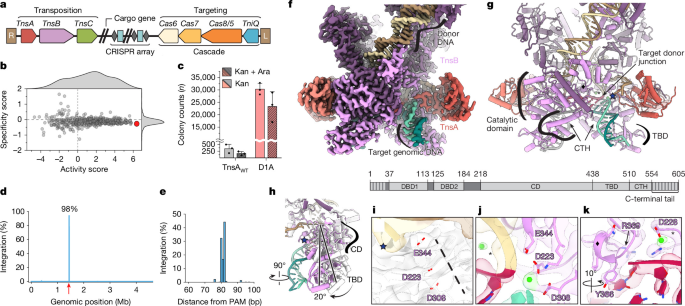
a, Transposon organization. R and L, right and left transposon ends. Parallel lines indicate discontinuity. b, Dual screen of TnsA designs: activity and specificity scores are plotted relative to wild type (normalized to 0,0), with density plots on the top and right. The red circle represents the top design, D1A. c, In vivo integration activity of VchCAST. The graph shows individual data points. Data are mean ± s.d. from biological triplicates. Ara, arabinose selection; Kan, kanamycin selection. d, In vivo genome-wide insertion profile. Red arrow indicates target site. e, Close-up view of target site in d with insertion window. f, Cryo-EM density map (2.9 Å) of the class 1 STC at 0.129 threshold. Proteins coloured as in a. Target-site duplication is shown in red. g, Top, atomic model of the STC oriented as in f. Black symb