// NATURE NEWS — SPAZIO & SCIENZA
Middle–Late Pleistocene Denisovans and unresolved Homo in southern China
Nature
(2026) Cite this article
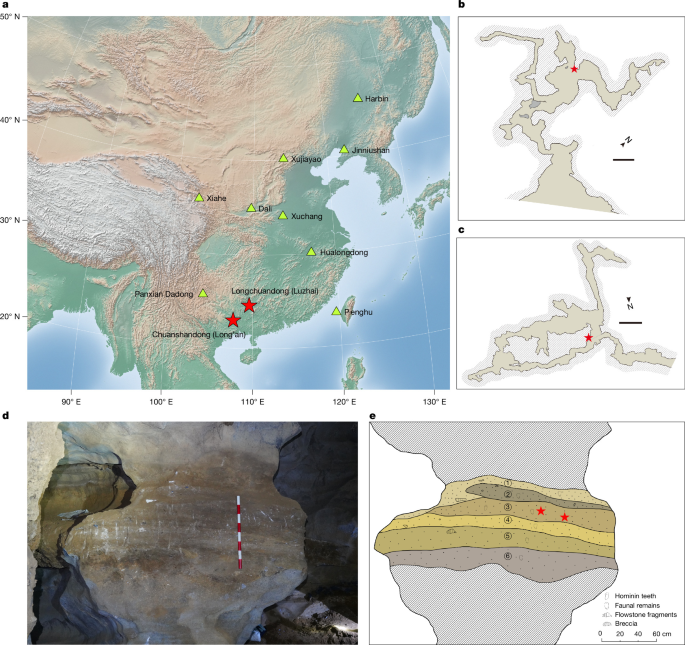
Molecular and morphological evidence increasingly supports the view that most East Asian Middle to Late Pleistocene archaic Homo belong to Denisovans1, yet the presence of other contemporaneous lineages has remained unclear. Here we report a set of newly discovered hominin fossils (4 isolated teeth; more than 100.8 thousand years ago and 104.5–42.6 thousand years ago, respectively) from 2 cave sites (Chuanshandong and Longchuandong) in Guangxi, southern China. Integrated morphological and palaeoproteomic analyses reveal substantial phenotypic and molecular diversity consistent with at least two distinct lineages. One lineage (Longchuandong) is assigned to a Denisovan-affinity population, owing to its extreme similarity to Altai Denisovans with respect to dental morphology and single amino acid polymorphisms that match those of Denisovans from Harbin, Penghu, Bianfu Cave and Altai. The other lineage, represented by the Chuanshandong hominin, is an unresolved archaic Homo, as it carries an ancestral variant (AMELY 179M) shared with Homo antecessor and great apes and another variant (AMBN 253G) that is diagnostic of East Asian Middle Pleistocene Homo erectus but lacks the Denisovan-associated AMBN 273V variant (it being highly probable that this is inherited from H. erectus). Dental morphology in this lineage exhibits a mosaic of plesiomorphic and derived traits but no clear Denisovan affinity. These findings indicate that diverse hominin populations may have inhabited subtropical China during the Middle and Late Pleistocene, including a Denisovan-affinity population and another unresolved archaic Homo.
The taxonomic classification of East Asian late Middle Pleistocene and early Late Pleistocene hominins has been a subject of intense debate. These hominins are consistently characterized by plesiomorphic features, including a long and low neurocranium with a thick vault, a massive supraorbital torus, a sloping forehead and a robust mandible with a retreating symphysis, combined with derived traits such as an enlarged cranial capacity, a highly arched temporal squama, reduced prognathism and simplified dental morphology2,3,4,5. Phenotypic and molecular evidence has increasingly aligned these hominins with Denisovans2,6,7,8. For instance, the Harbin and Xujiayao crania, the Bianfu Cave radius, and the Xiahe and Penghu partial mandibles have been classified as Denisovan on the basis of palaeoproteomic and/or mitochondrial DNA analyses1,4,6,7,8,9. Phylogenetic studies based on trait matrices have linked Harbin Denisovans to Dali, Jinniushan, Hualongdong and Xiahe, suggesting a potentially broader distribution of Denisovans across mainland East Asia2.
However, morphological heterogeneity persists among these hominins, for instance, cranial capacities of approximately 1,700–1,800 ml and a Neanderthal-like temporal labyrinth configuration and/or the presence of a suprainiac fossa in Xuchang and Xujiayao, and a round orbit in Maba10,11,12. Such variations have led to the proposal of distinct species, that is, pre-modern Homo sapiens, Homo juluensis and a Neanderthal-related lineage13,14,15,16,17. Moreover, most specimens attributed to the Denisovan assemblage have originated from northern and central China, with few contemporaneous hominin fossils reported from southern China, particularly subtropical regions. Thus, it remains unclear whether the East Asian late Middle Pleistocene archaic Homo represent only Denisovans or multiple lineages adapted to diverse environments across a vast territory.
Resolution of this question requires the discovery of more hominin fossils dating to the Denisovan period, especially from regions where such remains have not yet been reported. A comprehensive comparative study centred on such fossils should be conducted, incorporating a wide range of Eurasian Homo samples to establish a robust evolutionary framework for taxonomic identification. In