// NATURE NEWS — SPAZIO & SCIENZA
Submillimetre hot-electron transport in manganese-doped quantum dot solids
Nature
(2026) Cite this article
Colloidal quantum dot solids are promising for photoconversion and photochemistry, but their performance is fundamentally limited by rapid hot-carrier cooling, low carrier mobility and short transport ranges1. Here we demonstrate a spin-exchange-driven phototransport regime in manganese-doped quantum dot films that enables the generation, long-range transport and regeneration of hot carriers. Ultrafast spin-exchange-mediated Auger upconversion promotes electrons into high-energy, delocalized states before phonon cooling2,3, establishing a transient high-mobility conduction channel. Crucially, spin-exchange interactions not only generate hot carriers but also enable their repeated re-excitation, thereby sustaining long-range drift. This mechanism yields room-temperature mobilities of about 150 cm2 V−1 s−1 and submillimetre drift lengths—far greater than those of conventional quantum dot solids and approaching values characteristic of crystalline semiconductors. Time-of-flight measurements confirm drift-dominated transport, with transit times scaling linearly with distance and inversely with electric field. These results establish a route to long-range energy transport in nanoscale materials and enable the use of hot carriers in photoconversion, photochemistry and transit-time-limited photodetection.
Photoconversion processes underpin technologies ranging from photodetection and photovoltaics to photoemission and photochemistry. Their ability to exploit excess photon energy is limited by rapid phonon-assisted cooling of nonequilibrium (‘hot’) carriers to band-edge states, typically within picoseconds, severely restricting their lifetime and transport range. Stabilizing and transporting hot carriers therefore remains a substantial challenge for advanced solar-energy conversion4,5,6,7 and high-energy photochemistry8,9.
Recent studies have shown that hot carriers can be manipulated using ultrafast spin exchange (SE) interactions in manganese (Mn)-doped colloidal quantum dots (QDs)10,11,12. These interactions mediate subpicosecond Auger-type energy transfer between QD excitons and Mn spin states, reaching energy-transfer rates of about 10 eV ps−1 (ref. 11), well above typical phonon-related energy-loss rates (≲1 eV ps−1)13,14. By outcompeting intraband cooling, SE-Auger processes provide an efficient pathway for harvesting hot-electron energy, enabling phenomena such as visible-light generation of solvated electrons2,15 and carrier multiplication12.
Here we demonstrate that SE-Auger upconversion in Mn-doped QD films promotes photoelectrons into high-energy, delocalized transport states, enabling rapid, long-range hot-carrier transport through the QD solid. Transient photocurrent (TPC) measurements reveal time-of-flight (ToF) dynamics with drift mobilities of about 150 cm2 V−1 s−1 and submillimetre transport distances—well beyond those typically observed in QD solids. These results establish a route to long-range hot-carrier transport for photoconversion and hot-electron-driven photochemistry.
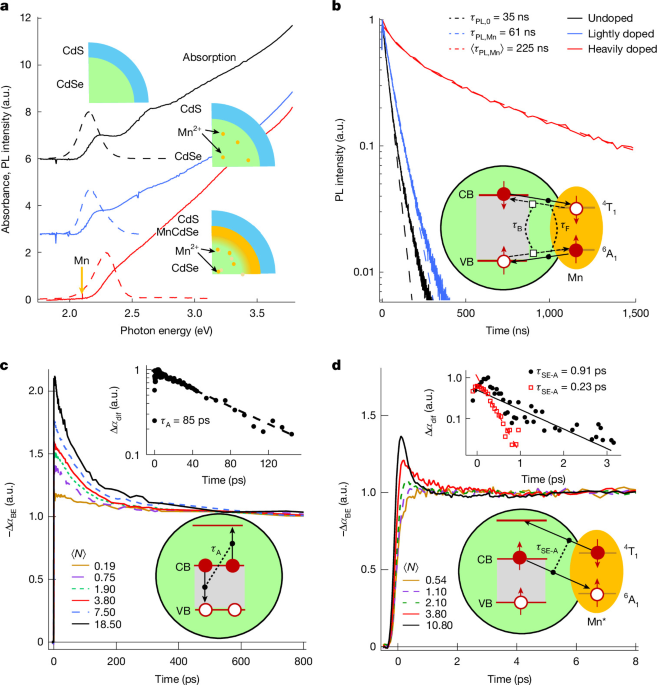
We prepared undoped (reference) and Mn-doped CdSe QDs overcoated with a thin protective CdS shell (Methods). We focus on CdSe/CdS QDs with an initial core radius of rCdSe ≈ 1.65 nm. The undoped sample exhibits a photoluminescence (PL) peak at about 2.15 eV and a band-edge (1S) absorption feature at about 2.23 eV (Fig. 1a, black curves).
a, Absorption (solid lines) and PL (dashed lines) spectra of undoped (black), lightly doped (blue) and heavily doped (red) QDs. The orange arrow marks the internal Mn spin-flip transition (EMn = 2.1 eV). Insets, schematics of undoped (top), lightly doped (middle) and heavily doped (bottom) CdSe/CdS QDs. In the heavily doped sample, an interfacial MnxCd1−xSe barrier layer forms between the CdSe core and CdS shell. b, PL dynamics of undoped (black), lightly doped (blue) and heavily doped (red) QDs. Single-exponential fits to the undoped and lightly