// NASA BREAKING NEWS — SPAZIO & SCIENZA
NASA Webb Explores Family Tree of Newly Discovered Distant Objects
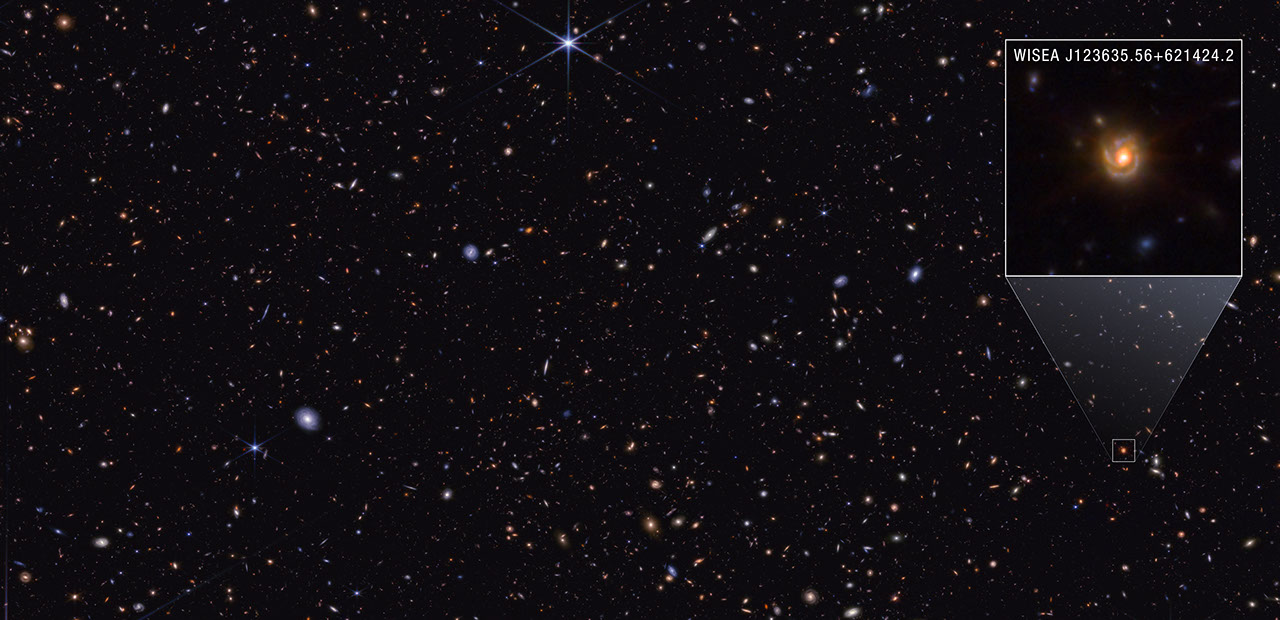
Since their discovery by NASA’s James Webb Space Telescope in 2022, little red dots (LRDs) have been the subject of great interest to astronomers. Understanding the nature of these extremely distant, compact red sources has been a puzzling scientific endeavor.
One popular theory is that little red dots are supermassive black holes known as active galactic nuclei, although they display characteristics unlike nearby active galactic nuclei. While they appear abundant at high redshift early in the universe, they rapidly decrease in number at lower redshifts. (The higher the redshift, the greater the distance the light has traveled across the universe.) This perplexing shift in number raises the question: What happens to little red dots as the universe matures?
A team of researchers led by Pierluigi Rinaldi of the University of Arizona’s Steward Observatory, now at the Space Telescope Science Institute (STScI) in Baltimore, has built upon their previous research in a new study published on July 29 in The Astrophysical Journal and proposed one pathway LRDs can follow as the universe ages: Though they may look like a unique galaxy population, these dots are affected by observational bias — some features just don’t appear at higher redshifts with current technology.
Their conclusions are based on their analysis of lower-redshift spiral galaxy WISEA J123635.56+621424.2, nicknamed the “Saguaro” for its prominent arms, like the cactus native to the Sonoran Desert in the Southwestern United States. A particularly intriguing feature of this redshift 2 galaxy, which corresponds to approximately 3.3 billion years after the big bang, is its little red dot-like center that is reminiscent of the ruby red fruit produced by the desert plant.
“Everything created in the early universe must evolve into something around us. We have had little idea of what LRDs become, but these results finally show us how to find their progeny,” said co-author George Rieke of the University of Arizona. Previous studies by NASA’s retired Spitzer Space Telescope provided the first hint of the dust-obscured, compact galaxy population in the lower-redshift universe that the Saguaro belongs to, paving the way for NASA’s Hubble and James Webb space telescopes’ high-resolution analyses.
“The Saguaro is important because it’s a prototypical little red dot and is one of the few we have found at lower redshift. It can be used to study the pathway of these dots throughout cosmic time,” said Fabio Pacucci of the Harvard-Smithsonian Center for Astrophysics in Cambridge, Massachusetts, and a co-author of the study.
Among the thousands of sources Rinaldi looked at across several surveys, the Saguaro was an example of the right place — with one of Webb’s microshutter arrays perfectly framed over the galaxy’s core to take spectroscopic data — and right time — being at lower redshift. To get as broad a view of the spiral galaxy as possible across the electromagnetic spectrum, the team used Hubble’s ultraviolet- and Webb’s infrared-imaging and spectroscopic archival data, respectively.
“Because the Saguaro is at lower redshift, we can see the very beautiful and bright host galaxy in high resolution and detail with Webb and Hubble,” said Zihao Wu of the Harvard-Smithsonian Center for Astrophysics, and a co-author of the study. “Webb’s observations can help us understand how the galaxy and its little red dot-like nucleus are connected.”
The team took multiple approaches to verify that the Saguaro’s compact red nucleus matched the characteristics of a prototypical LRD. In particular, the Hubble and Webb data showed that the nucleus is brighter in both ultraviolet and infrared light than in visible light, just like distant LRDs. The team also carefully disentangled the light emitted from the host and nucleus, and considered the presence of X-ray emission from the source.
Although the majority of little red dots at high redshift are not detectable in X-ray light, NASA’s Chandra X-r